
During the meeting between Zacharski and Vogel, a tentative date for the exchange was mentioned, vaguely set for mid-June 1985. Ultimately, the parties agreed that June 11 would be the most convenient date. The operation was to take place on the Glienicke Bridge, situated between West Berlin and Potsdam in the German Democratic Republic (GDR). The final draft of the negotiatedagreement provided for the release of the four spies from the Communist bloc mentioned above in exchange for 25 American spies detained in the East.
The road to the spy exchange was long and politically complicated.
The identities of all those mentioned remain unknown to this day; however, among those released were the Poles Norbert Adamaschek, Leszek Chróst, Jacek Jurzak, Jerzy Pawłowski and Bogdan Walewski; the Austrian Hannes Sieberer; and the Germans Eberhard Fätkenheuer, Gerhard Tietz, the brothers Gerhard and Jörg Süss, as well as the siblings Werner, Renate and Heinz Jonsek. Documents from the Communist Security Service (SB) reveal that the group of spies earmarked for exchange included a total of 17 Germans, including three women. The remaining two spies were probably from Bulgaria, but this cannot be confirmed with certainty. Interestingly, a complete list of the agents to be exchanged could not be found either in the now defunct archives of the Federal Government Commissioner’s Office for the security service files of the former GDR or in the Archivesof the Institute of National Remembrance (AIPN).
From Rakowiecka Street to Okęcie Airport, and then to Berlin
The road to the spy exchange was long and politically complicated. One might ask why this was the case, despite the initially rather accommodating stance of the political leadership and the secret police in East Germany, Bulgaria and Poland. It seems that the Soviet Union’s unyielding stance on the release of Anatoly Shcharansky to the West, as well as internal institutional disputes amongst the Americans themselves regarding the nature of the exchange, played a significant role.
Bogdan Walewski was only allowed to bring the Bible, photographs of his parents and a small prison knife.
Preparations for the exchange took place in two stages, although neither the Poles nor the Germans had planned it that way. This was a consequence of protracted negotiations and the setting of the original exchange date for December 1984. The American declarations were taken so seriously at the time that the leadership of the Stasi and the SB prepared detailed logistical arrangements, security procedures and the entire exchange schedule. However, when the December exchange did not take place, the ready-made plans were not thrown away. They were pragmatically adapted for the purposes of the operation codenamed Exchange of June 1985. The final decisions were made at a meeting held at Stasi headquarters in Berlin on May 30-31, 1985, attended by Colonel Konrad Biczyk, Lieutenant Colonel Eugeniusz Bossart and Lieutenant Colonel Maria Żołądkowska. The HVA, or East German intelligence, was represented at the time by Colonel Fritz Kobbelt and Colonel Eberhard Kopprasch.
On June 11, 1985, at five in the morning, the Polish prisoners due to be exchanged, who were being held at the prison on Rakowiecka Street, were woken up. After a quick breakfast, they were ordered to pack their most essential personal belongings. Bogdan Walewski was only allowed to bring theBible, photographs of his parents and a small prison knife. Later, after the prisoners had changed into civilian clothes, they were handcuffed in pairs together with the accompanying Security Service officers, searched twice and led out into the inner courtyard between Pavilions I and II. Here, accompanied by staff from Bureau B of the Ministry of Internal Affairs, cameras and photographers, the spies were led one by one to the prison van Stara 200, routinely used by the Communist Citizens’ Militia and the Prison Service to transport detainees. After some time, the convoy arrived at Okęcie Airport and parked next to a special government aircraft operating the flight to Berlin. The spies to beexchanged were only released from their handcuffs after take-off. SB officers guarded them all the way to Berlin. On board the plane, the crew served them a packed lunch of sandwiches, which tasted exceptionally good compared to prison food. Walewski recalled the journey:
“We were all silent, »guests« and guards, with only one woman not shutting her mouth for a second. […] Then I figured she must have been [Barbara Zacharska] the wife of [Marian] Zacharski, the Pole who was getting exchanged for us spies.”
It was only after lunch that the pardoned spies began to talk amongst themselves, whilst the officers remained reserved and silent. After landing in Berlin, the five spies were taken away in a minibus, escorted by the East German Communist police. From the airport, they travelled directly to the outskirts of Potsdam and stopped by the River Havel, just before the Glienicke Bridge.
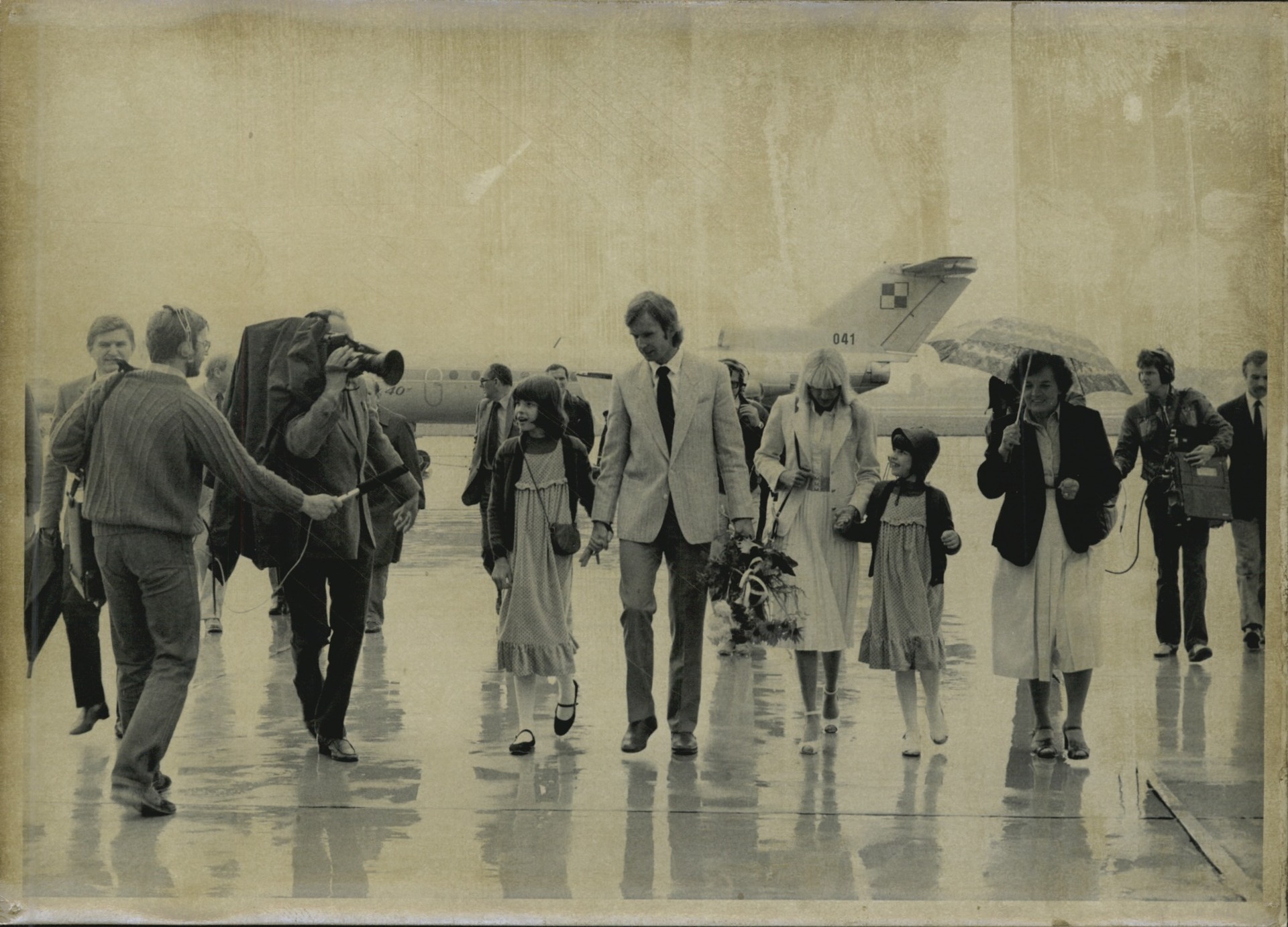
Marian Zacharski and his family after landing at Okęcie Airport (photograph from the archives of the Institute of National Remembrance)
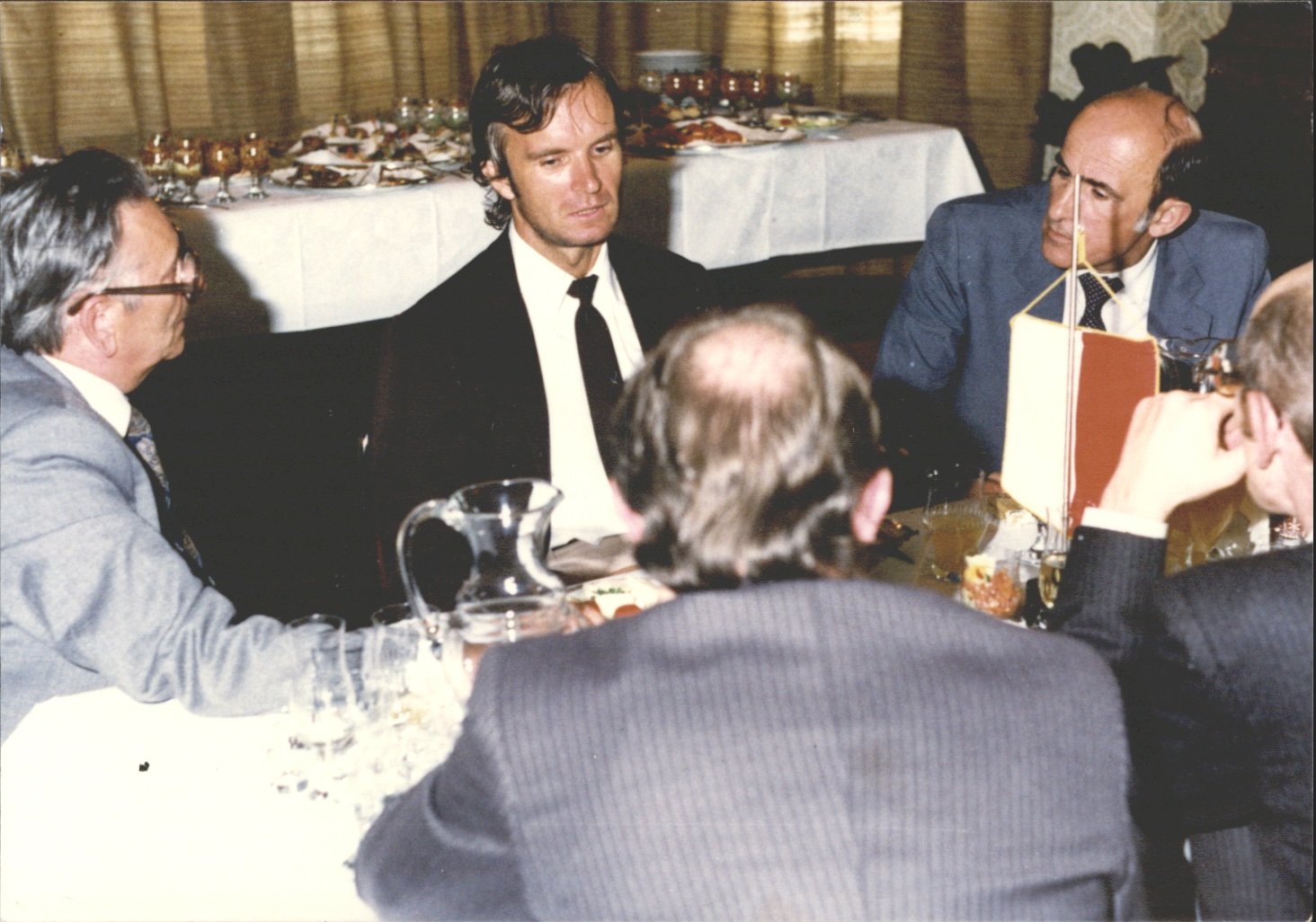
Marian Zacharski with Colonel Zbigniew Twerd and East German intelligence officers (photograph from the archives of the Institute of National Remembrance)
From New York to Berlin, constantly in handcuffs
Next, the bus came from the other side of the river carrying the spies caught in the West for the exchange: Marian Zacharski, Penyu Kostadinov, Alfred Zehe and Alice Michelson. Their journey to the exchange was not easy. Zacharski was treated very roughly and he spent the whole trip in handcuffs. The prisoner transport was extremely heavily guarded, and it was secured by various U.S. special services and the Army.
Several Stasi officers dressed in navy blue coats were the first to cross the bridge from the East German side. They were followed by East German, Bulgarian and Polish diplomats.
The escort was so large that the flight from New York to Frankfurt am Main was carried out using no fewer than three military aircraft. From there, the journey continued to Tempelhof Airport in West Berlin. For 24 hours, the pardoned spies were given no food, nor were they allowed to shave or carry out any other aspects of daily hygiene. All communication was forbidden, and even the slightest movement or gesture was closely monitored by American Secret Service agents. The greatest attention was, of course, on Zakhar, who was the key figure in the exchange.
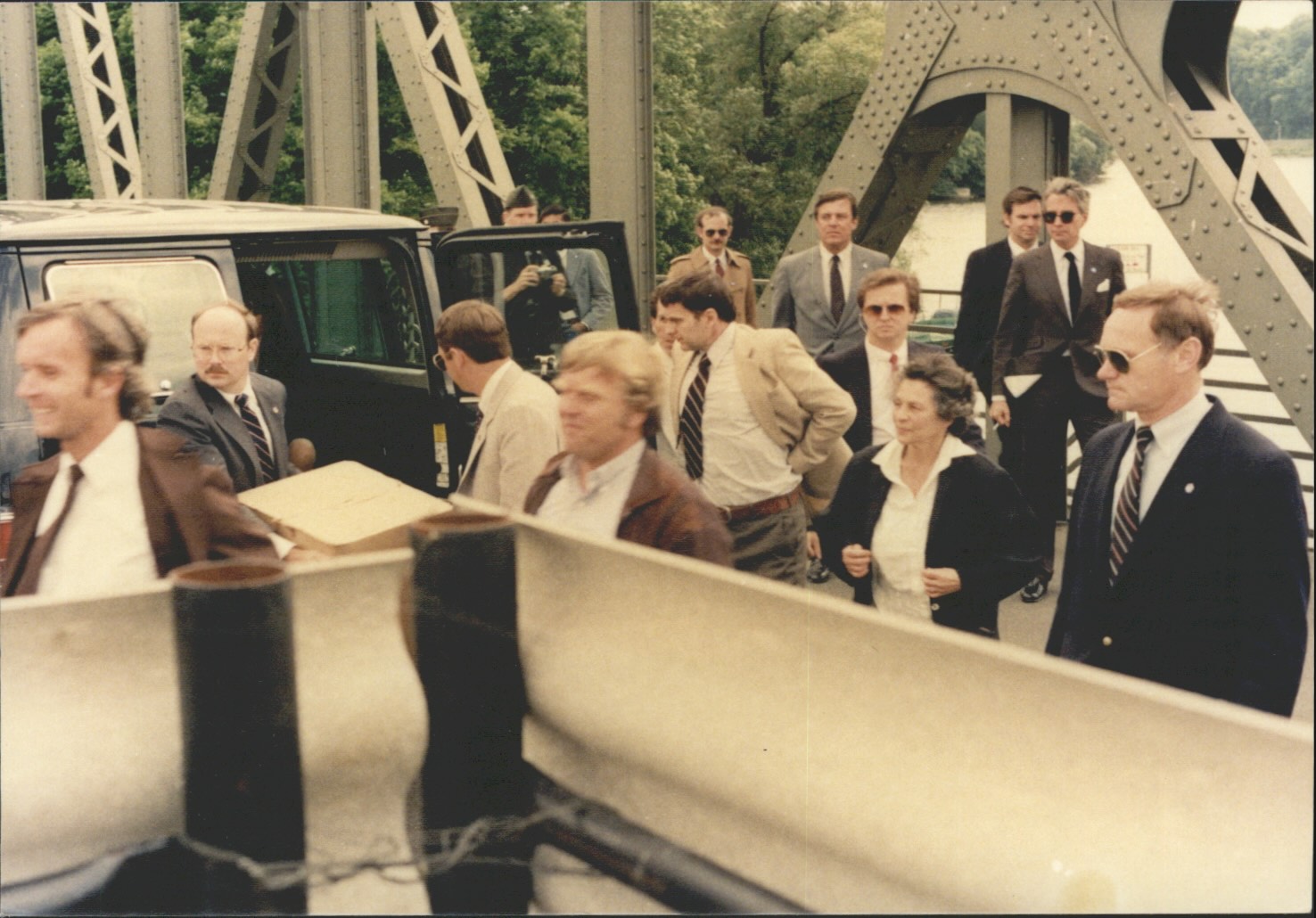
Several Stasi officers dressed in navy blue coats were the first to cross the bridge from the East German side. They were followed by East German, Bulgarian and Polish diplomats, as well as other security service officers. Unfortunately, we know very little about them. If we are to believe the operation plans drawn up in advance, those taking part in the exchange on the GDR side included Colonel Heinz Volpert, head of the Stasi’s special division for foreign currency procurement and prisoner release; Colonel Paul Enke, head of the Stasi’s Investigation Department; and Colonels Fritz Kobbelt and Eberhard Kopprasch, officers of the Stasi’s Main Directorate for Reconnaissance (HVA). Poland was certainly represented on the spot by Maria Żołądkowska and Zygmunt Młodziejowski from the Consular Department of the Polish People’s Republic in Berlin. The whole operation was coordinated by attorney Wolfgang Vogel, with his wife Helga Vogel acting as interpreter. Walewski recalled this extraordinary moment:
“I kept looking at the bridge. »Brücke der Einheit«, the Bridge of Unity. What irony! Its East German side on the right was permanently blocked off with six slanted concrete blocks, about two-meters-high. As a result, it was only possible to pass on the left side of the road, but there was no traffic anyway since entry was forbidden. There was grass growing in the asphalt’s cracks! The surface of the road was clearly in repair, and the works must have been halted for our arrival. The symbolic name of the bridge did not correspond to reality!”
A woman then approached the bus and gave instructions to the Security Service officers, who took the passports and pardons out of a briefcase. One of them announced that the exchange would take place shortly. Anyone who wished to do so could cross over to the other side with the Americans or return to Poland as a free man.
Some of the spies who were being released to the West cried with emotion.
Only Norbert Adamaschek had no right to choose, as he had West German citizenship. At that moment, one of the Poles at the back of the bus spoke up, saying, “I’m staying here.” The others regarded this as a provocation by the Security Service and did not react to the remark at all. Walewski did not identify this person, but he was a decorated sportsman and a major in the PolishPeople’s Army, Jerzy Pawłowski. The fencer fulfilled his obligation, which was part of the “contract”he had entered into with the Security Service officers. By the decision of President Wojciech Jaruzelski, he was included in the exchange and could be released only on condition that he remained in the Polish People’s Republic after the exchange.
“I welcome you on behalf of Ronald Reagan”
Tensions rose with the arrival of representatives from the U.S. diplomatic corps. The U.S. State Department was represented on the ground by: Richard Burt, then serving as Under-Secretary of State for European and Canadian Affairs, the equivalent of a Deputy Foreign Minister; John Kornblum, Director of the Bureau of Eastern European and Eurasian Affairs; Thomas M.T. Niles, Deputy Assistant Secretary of State; Andre Surena, Assistant Legal Adviser; representative of the U.S. Embassy in Bonn, Thomas Weston; Colonel Lonnie Spivey, Commander of Berlin-Tempelhof Central Airfield, representative of the USAF; Mark Lissfelt, Political Advisor from the U.S. Military Liaison Mission in Germany; and Edward Murphy, Security Advisor. One of the U.S. officials, who introduced himself as Richard Burt, along with John Kornblum and Wolfgang Vogel, got into the vehicle. Richard Burt, the future U.S. Ambassador to West Germany (from September 16, 1985), said:
“I welcome you on behalf of President Ronald Reagan. You will be free in a moment. If anyone has any questions or concerns, we will discuss them individually. Mr [Wolfgang] Vogel will be assisting you. We are delighted to see you here. Good luck!”
Applause broke out, and some of the spies who were being released to the West cried with emotion.
Then the vehicle carrying the freed American spies drove slowly, with its doors open, towards West Berlin, manoeuvring around the barriers lying on the road, and reached the middle of the bridge. At that moment, as if on a command that was, of course, never given, the passengers began to quickly cross the border between East and West Germany. On the other side, two officials checked the identities of those being exchanged against their passports and compared their photographs with the details in a special notebook. After a quick identification, they were allowed to proceed, while their small luggage was collected by U.S. soldiers.
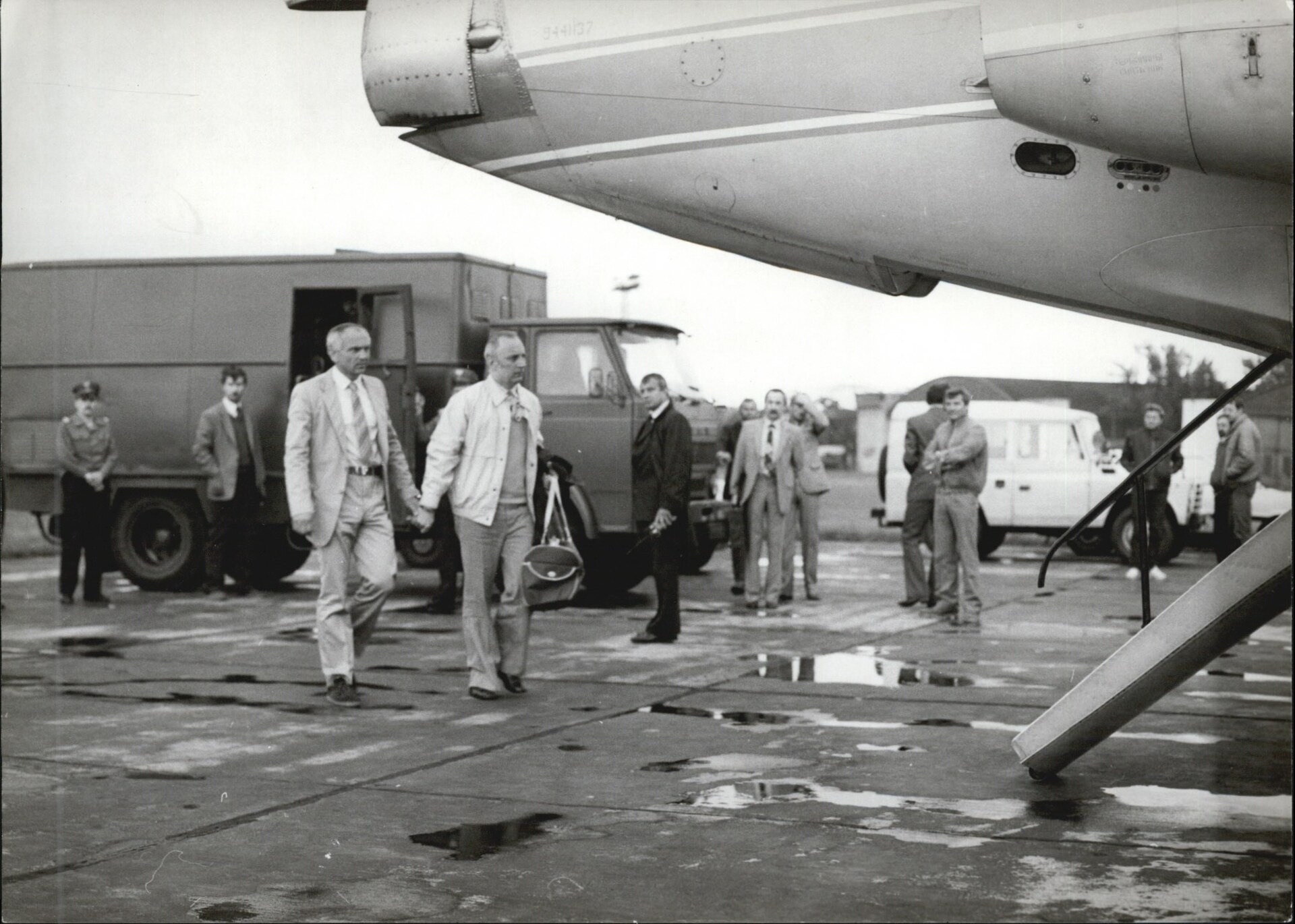
Bogdan Walewski at Okęcie Airport before departing for his exchange programme in Berlin (photograph from the archives of the Institute of National Remembrance)
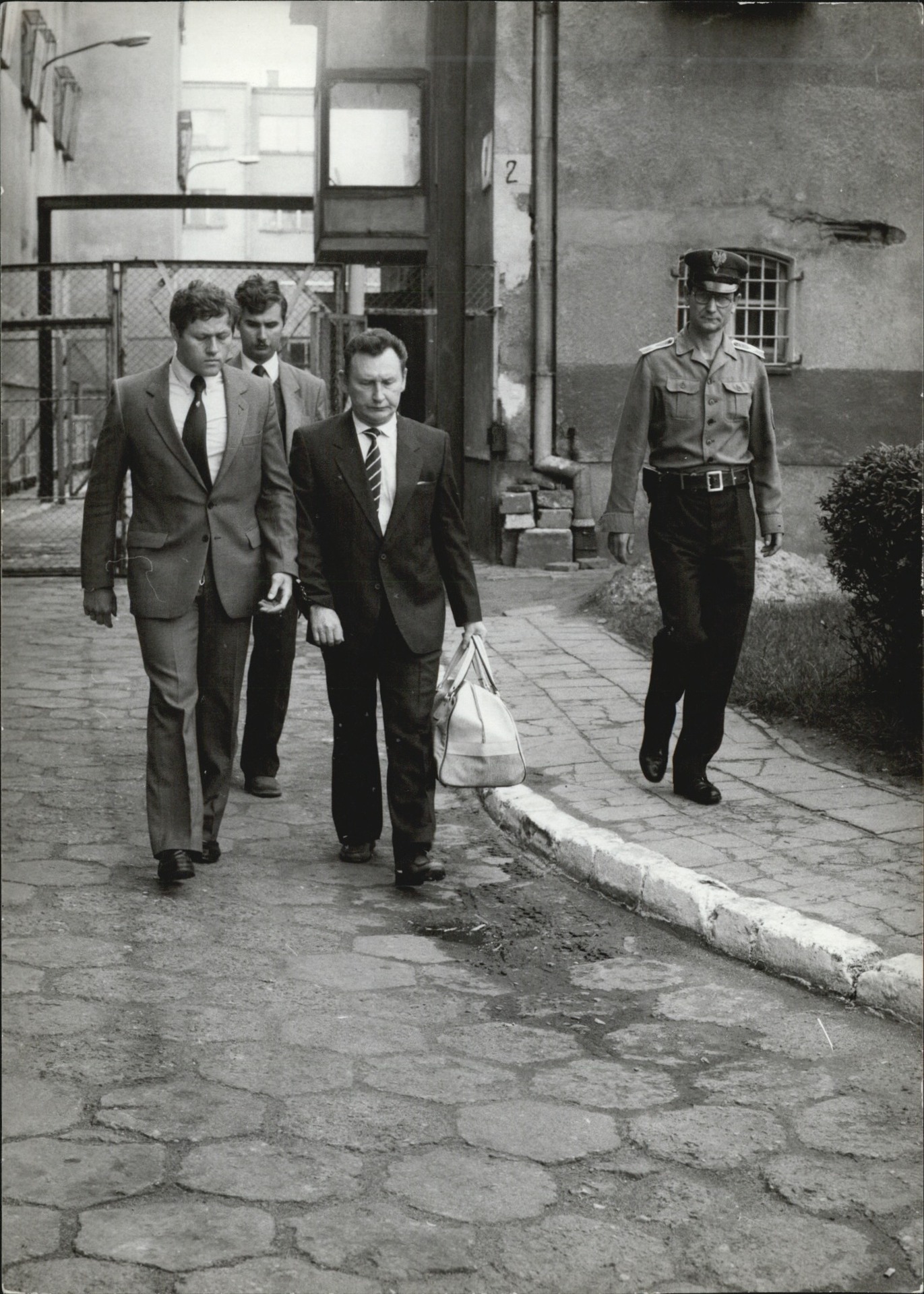
Leszek Chróst outside the Mokotów prison, before leaving for the prisoner exchange (photograph from the archives of the Institute of National Remembrance)
Two people are staying behind
The Poles who had decided to leave boarded the military bus, along with the Germans and the Austrian. Of the 25 American spies released from prisons in East Germany and the Polish People’s Republic, two refused to leave and remained in Potsdam. They were Jerzy Pawłowski and Renate Jonsek.
Of the 25 American spies released from prisons in East Germany and the Polish People’s Republic, two refused to leave and remained in Potsdam. They were Jerzy Pawłowski and Renate Jonsek.
Everyone present on the bridge and in its vicinity during the exchange displayed considerable anxiety and a corresponding level of vigilance. Motorboats patrolled the river, while uniformed officers of the Communist Citizens’ Militia on the East German side stopped pedestrians who had happened to appear by the Havel. The Americans, armed with submachine guns, frantically scanned the heavily wooded opposite bank of the Havel. They displayed a great deal of mistrust following the tragic death of Major Arthur D. Nicholson, a military intelligence officer shot dead on March 24, 1985 whilst infiltrating the barracks of the Soviet Independent Tank Regiment in Ludwigslut, part of the 2nd Guards Tank Army and stationed in Mecklenburg in the north-western part of the GDR. They exchanged remarks amongst themselves about the high risk of an ambush. They did so so clumsily that they completely demoralised the four spies being released: Zacharski, Kostadinov, Zehe and Michelson. Ultimately, they too crossed the line marked with white paint in the middle of the bridge and found themselves in the GDR. From a distance, officers of the communist security apparatus Colonel-General Markus Wolf, Colonel Zbigniew Twerd, Colonel Konrad Biczyk and Lieutenant Colonel Eugeniusz Bossart observed the scene through binoculars. On the other side, tenserepresentatives of the Western secret services were doing the same.
The American bus took off towards West Berlin, escorted by at least two cars, and made its way to the U.S. Air Force terminal at Tempelhof Airport. Here, in the VIP area, a welcome reception was held for the American spies released from communist prisons. Aforementioned Walewski remarked at the time that he was rediscovering the taste of fizzy drinks and savouring ordinary sandwiches. At the same time, he felt intimidated by the open space around him. He was not ready for this and continued to behave as if he were still in prison. He walked close to the wall with his head bowed. A trip to the neat and functional airport toilet seemed like something unreal. A stay in a communist prison leaves a deep mark on one’s personality.
“I felt nothing but fear”
Eberhardt Fätkenheuer, one of the German agents of the American intelligence services exchanged on June 11, 1985 on the Glienicke Bridge, had almost identical observations to those of Bogdan Walewski. This resident of Brandenburg, captured by the Stasi and sentenced in 1979 to 13 years in prison, recalled years later:
“The arrangement was that we were to arrive by bus at the meeting point precisely at noon. On the way, the bus stopped about 10 kilometres before the Glienicke Bridge for around 15 minutes, so as to arrive on time. It then turned right from the Potsdam side into position and came to a halt. A short while later, three men boarded the bus. [Richard] Burt was from the U.S. Department of State and was responsible for Europe. John Kornblum acted as interpreter. And the lawyer, Dr. Wolfgang Vogel. And the first thing [Richard] Burt said was that he would like to convey President [Ronald] Reagan’s warmest regards to us, which John Kornblum translated. And everyone shouted with joy and clapped. There was a great sense of euphoria, and then we were told that everyone on the bus, regardless of what decision they had previously made, could stay on the bus and go to the West with the others. […] Then Vogel came up to me and I asked him what he knew about my wife. He replied: »Your wife is living, so to speak, with another man, and has filed for divorce.« I asked: »How do you know that? Did the security tell you?« He couldn’t give a clear answer, and it was a completely ridiculous situation. I was fed up with it. Then I asked Mr. [Richard] Burt if we could speak in private. He agreed, and we got off the bus. There stood [Richard] Burt, [John] Kornblum and me. Perhaps [Wolfgang] Vogel was there too. I can’t remember now. And I asked whether, if things didn’t work out for me in the West, I would be able to return to the East afterwards. He took out the contract and quoted passages from it where it was clearly stated that there would be no reprisals against those who decided to return to the East. And that my family, that is my wife, children, as well as my mother, father and brother, could, if they wished, go to the West. [I asked:] »So is that guaranteed, as it is, by the Eastern side?«[He replied:] »That’s what was written in the agreement.« […] I was, how shall I put it, confused, exhausted. At first I tried to speak English, but I couldn’t find the words. I’d forgotten many of them from my school days, but [John] Kornblum translated everything. I thought, I’ll stay on the bus and somehow it’ll all work out. […] I went back to the bus, and [Wolfgang] Vogel handed me a form which I had to sign; it concerned my education during my time in the GDR. I hadn’t signed anything like that before; then the bus pulled up right in front of the white line. That was roughly halfway across the bridge. At that point, there were construction sites on both the left and right. I remember it as if it were yesterday: there was about 30–40 centimetres of free space on either side of the tyres stacked along the sides, as the bridge was undergoing repairs at the time. Then we got off the bus and walked, one after the other, in single file across the white line to the western bus standing across the road. And that feeling of moving from the East to the West has remained incredibly strong within me to this day, because the power over me of those who had previously held me in their grip had ended once and for all. On the other hand, I was certain that I wasn’t influential enough for anyone to want to get hold of me once I was in the West. As had happened to many others, some of whom lost their lives when the Stasi tracked them down, took them back and sentenced them to death. That was certainly the case. And then someone suddenly said: »Please get on the bus« Yet I felt paralysed, as if I’d partly lost consciousness. At that moment, it was all too much for me. Tears welled up in my eyes of their own accord. And then I sat there waving my hand by the window, while a woman was filming this spectacular exchange of agents. Then I looked around, my God, I thought, I’m in the West. What are these green and red igloos standing there? I’d never seen anything like it before. No, they were bottle banks. Then we drove to the Tempelhof district, where we were identified by the Americans. There I saw a colour photograph of myself that Ihad never seen before. Then we were given some money for clothes. I guarded that money like treasure. I thought I would be able to pay two months’ rent with it, and I was terribly afraid that the West would kill me. Two weeks earlier I had been in high spirits; now my worries and fears were much greater. We were flown by a Hercules plane from Tempelhof Airport to Frankfurt am Main, and from there to Giessen. I was exhausted and ended up in the infirmary. At first, I could not pull myself together at all; I felt nothing but fear.”
This feeling of happiness and freedom was ever present among the spies. But it was mixed in with the physical toll and a range of concerns about the future.
Marian Zacharski, who had been released from prison, found himself in a slightly different situation as he returned to Poland under the supervision of the Communist intelligence officers from the Eastern Bloc. And with the reputation of an exceptionally capable and effective intelligence officer. His future looked quite different from that of spies being released to the West. Certainly much more secure. Even if the leadership of the Ministry of Internal Affairs had planned to remove Marian Zacharski from intelligence work, no one spoke of it at such a momentous occasion, so as not to spoil the atmosphere of the grand welcome in East Berlin, and later in Warsaw. One of the CommunistSecurity Service officers reported live to the Security Service headquarters in Warsaw:
“The handover took place at 1 pm on the Glienicke Bridge in Potsdam. By 1:05 pm, Captain Marian Zacharski was already among us. He is in excellent mental condition. Physically very tired. Happy and grateful for his release. He fully identifies with our intelligence service. He feels like an intelligence officer. He is proud of what he has done and happy with our recognition. Grateful for his promotion to the rank of captain. He hates the Americans, who treated him very brutally right up to the last moment. He is well-informed about the situation in the country and the global political situation. He sees his future in active work in the country and for the country, as well as further intelligence activities appropriate to his situation.
Marian Zacharski himself recalled the moment of crossing the border years later:
“I am on the eastern side of the bridge. I feel as though I have been reborn. I am in a state of euphoria I have never known before.”
Press releases, radio reports and television broadcasts spread like wildfire across the world at the time. There, in Berlin, representatives of two opposing value systems, democratic and communist, had reached an agreement and exchanged nearly 30 spies. Snapshots from the Bridge of Unity, known since 1962 as the Bridge of Spies, were closely followed not only by ordinary citizens, but also by virtually every intelligence agency in the world. The official statement from the U.S. Justice Department stated that although the exchange did not involve any American citizens, some of those handed over to the West were ‘of interest’ to the United States. This publicly confirmed that at least some of those released had been engaged in espionage on the other side of the Iron Curtain.
In Poland, a rather brief statement was issued by the Polish Press Agency. However, documents from the communist Security Service reveal that the text was drafted by the Ministry of the Interior, and then it was approved by Army General Wojciech Jaruzelski and Major General Czesław Kiszczak.
In communist Poland, these reports were carefully collected and analysed. Similar measures were taken by officers of the East German Stasi. Today, it is precisely these press reports from that era that formed the main part of the preserved materials in the archives of the now-defunct Federal Government Commissioner’s Office for the Records of the Security Services of the former GDR, relating to the spy exchange on the Glienicke Bridge in 1985. Official information provided during the enquiry suggests that the East German intelligence documents were destroyed. It cannot; however, be ruled out that they were seized by the German Federal Intelligence Service (BND) or the CIA. It is also possible that former intelligence handlers are still using this method to protect their collaborators from revealing their identities.
In the propaganda language
In Poland, a rather brief statement was issued by the Polish Press Agency (PAP). However, documents from the communist Security Service reveal that the text was drafted by the Ministry of the Interior, and then it was approved by Army General Wojciech Jaruzelski and Major General Czesław Kiszczak. The draft even included a handwritten note on the subject, along with a brief description: “Issued on June 13, 1985 on RTV and on June 14 in the press as a PAP statement”. It contained several key elements:
“On the 11th of this month, following an exchange in Berlin of CIA spies captured in Poland, the U.S. authorities released Captain Marian Zacharski, Polish officer of the Polish Ministry of Internal Affairs’ intelligence service, who had been sentenced to life imprisonment in the U.S. in 1981. Captain Marian Zacharski was serving this sentence in a high-security prison. The American secret services repeatedly urged him to betray his homeland. The intelligence officer of the Polish People’s Republic remained steadfast in his patriotic stance, firmly rejecting all enticements and offers of cooperation. As part of the exchange, the Polish side handed over five American spies: Bogdan Walewski, sentenced in 1982 to 25 years’ imprisonment; Jacek Jurzak, sentenced in 1984 to 25 years’ imprisonment; Norbert Adamaschka, sentenced in 1984 to 15 years’ imprisonment; Leszek Chróst, sentenced in 1980 to 25 years’ imprisonment; and Jerzy Pawłowski, sentenced in 1976 to 25 years’ imprisonment. The release took place under a multilateral prisoner exchange. During the exchange, despite pressure from U.S. officials, Jerzy Pawłowski refused to surrender to the American authorities and decided to return to Poland. The Polish State Council granted Jerzy Pawłowski a pardon, remitting the remainder of his sentence.”
Several key elements are worth pointing out in the text prepared by the Interior Ministry. The statement opens with a reference to “CIA spies captured in Poland.” Moreover, whilst working on the text, it was decided that an adjective indicating his nationality did not necessarily apply to Zacharski. Despite being crossed out by hand, the final printed version used a more elaborate phrase: “Captain Marian Zacharski, officer of the Polish Ministry of Internal Affairs’ intelligence service”.
A few months later, the authorities of the Polish People’s Republic and the GDR decided they should ride the wave and conduct another exchange.
To sum up the spy swap of June 1985, each side attempted to portray the operation as a success. The U.S. State Department emphasised that this event would be a boost for democratic opposition activists behind the Iron Curtain, and additionally increase the chances of the special services recruiting agents among East Germans and Poles. By no means, however, was this event seen as a sign of improved bilateral relations between the Polish People’s Republic and the United States. In Poland, the release of the talented and well-established spy Marian Zacharski was cause for celebration. Meanwhile, in the GDR, Erich Honecker was pleased with the return of Professor Alfred Zehe. He had fought for his freedom, sparing no expense nor the efforts of Stasi officers and agents.
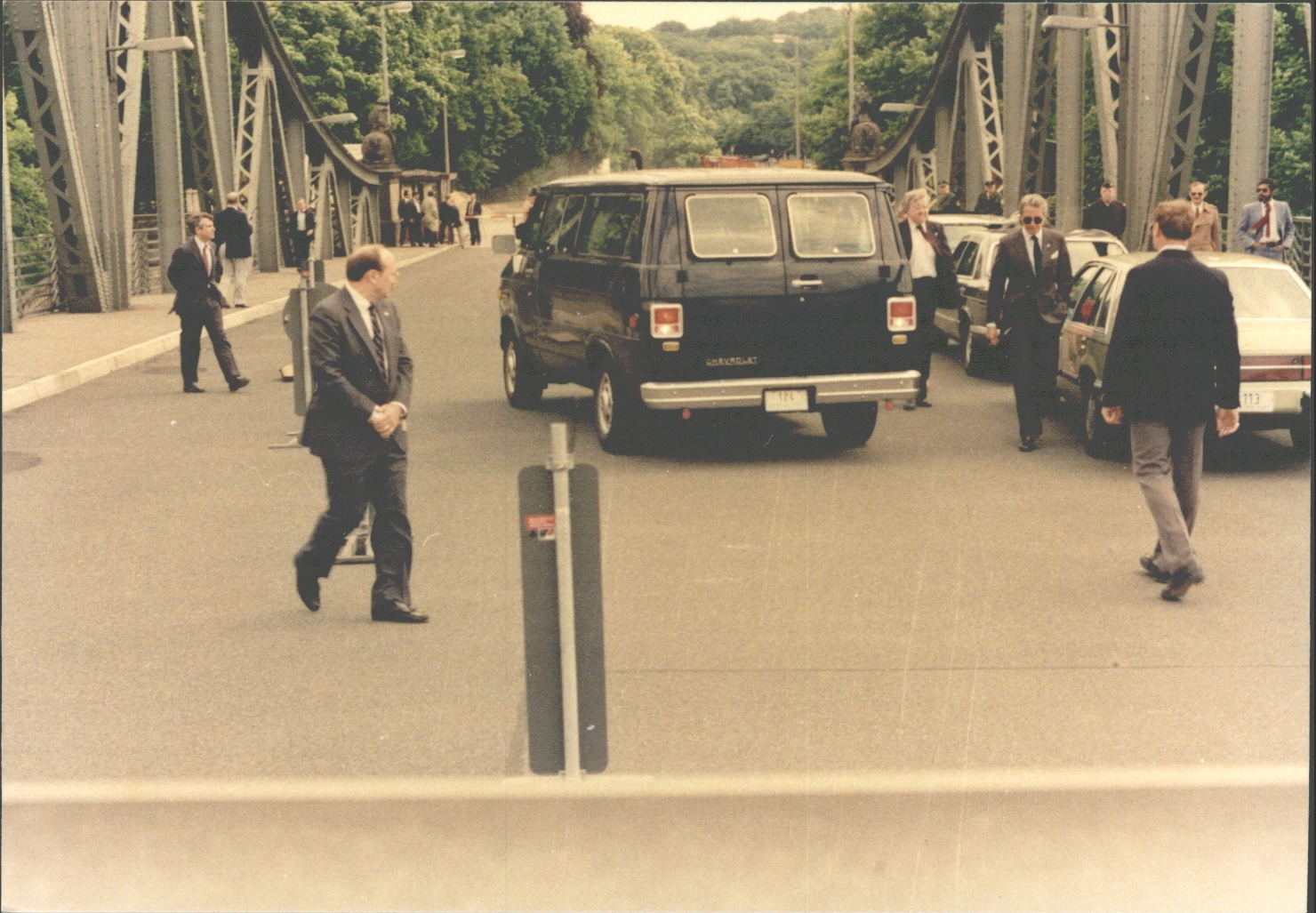
Glienicke bridge, June 11, 1985 (photograph from the archives of the Institute of National Remembrance)
The exchange also did not end the “ties” of the Glienicke bridge with intelligence. A few months later, the authorities of the Polish People’s Republic and the GDR decided they should ride the wave and conduct another exchange. In a letter from the second half of June 1985, addressed to Lieutenant General Czesław Kiszczak, Brigade General Zdzisław Sarewicz wrote that the East German side had already begun preparations for another operation. The head of the East German intelligence, Colonel General Markus Wolf suggested on this occasion that the Americans should release two agents of the Polish communist intelligence in the U.S., William H. Bell and James D. Harper. This did not occur in the end, but Department I of the Interior Ministry did finalise the release of Captain Jerzy Kaczmarek from West Germany in February 1986.