
In 1942, during the height of the Second World War, when Poland was under occupation, the World Union of Poles Abroad addressed the Polish political refugees in a book published in London, titled The Polish Question. Doubts and answers. This book was meant to help Poles in their conversations with foreigners on the subject of Poland, including questions on Polish national heritage in Europe and the world, as well as German accusations regarding Polish history, science and culture. One of the questions was:
“Poles tend to reference their outstanding cultural role in Central Eastern Europe. What’s the reasoning behind that?”
The author of this work, Jan Światosławski, when providing his readers with an answer, pointed to e.g. Copernicus, and wrote:
“Poland has always played and still plays the role of the first line of defence in Europe, the first line of the western and Christian civilisation, and it has done so for centuries. (…) Despite the never-ending wars ravaging Europe, its western culture and Christianity, Poland kept developing its scientific, literary and artistic life. […] The growth of Polish science can be locked and placed between two names: Copernicus (1543, De revolutionibus orbium coelestium), who transformed the global worldview of the thinking man, and Maria Curie-Skłodowska (discovery of radium) during our times.”
Quartercentenary
The Polish American diaspora understood the need to promote the figure of Nicolaus Copernicus and his legacy in the United States already during the Second World War. The perfect opportunity to honour the Polish astronomer came in 1943 for the quartercentenary (400) of his death.
The first ceremony for this occasion took place on May 3, 1943, at the Polish Science Institute (PIN) in New York City. Four lectures in English were organised. Prof. Louis Karpiński from the University of Michigan described Copernicus as the first citizen of the new world order. Renowned French science historian from the University of Sorbonne in Paris, prof. Alexander Koyre, spoke about the Copernican Revolution in astronomy and the role of the Copernican heliocentric theory in developing science. Prof. Rafał Taubenschlag gave a presentation on the Jagiellonian University at the time of Copernicus, while prof. Wacław Lednicki characterised Polish literature of that time.
Prof. Oskar Halecki, one of the greatest Polish historians and anti-communist, also talked about Copernicus’ importance for Poland, and reported on the ceremony to the Polish Prime Minister in exile, Stanisław Mikołajczyk (in a letter from May 6, 1943).
The Kościuszko Foundation, founded in New York in 1925, also honoured the 400th anniversary of Copernicus’ death. Its founder and first President, great philanthropist Stefan Mierzwa, recalled that the idea of Copernican celebrations was born in the United States even before 1939, when he himself was working on a book about the greatest Poles (Great Men and Women of Poland). Its goal was to familiarise Americans with Polish cultural and scientific heritage, and whose greatest representative next to Chopin was actually Copernicus. The Kościuszko Foundation wanted to introduce the Polish astronomer to the Anglo-Saxon literature, but, more importantly, to resist the Nazi propaganda which claimed the Polish astronomer was of German descent.
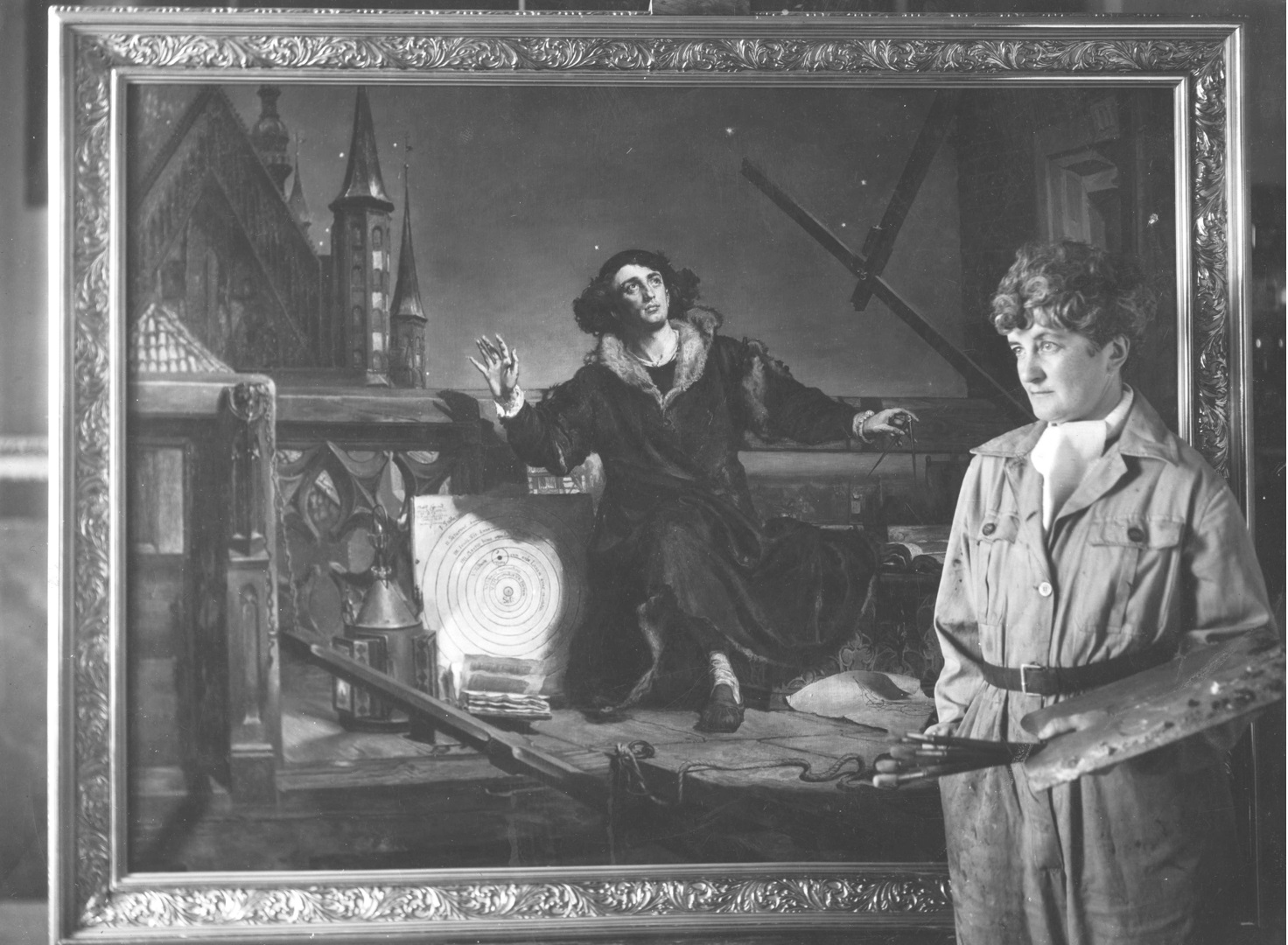
Anna Szyszko-Bohusz Szymborska in front of her copy of Jan Matejko's painting “Nicolaus Copernicus”, intended for the Polish Room at the University of Pittsburgh, 1939. (photo from the Polish National Digital Archives)
As part of the 1943 ceremonies, Mierzwa published a book in New York about Copernicus with colourful illustrations by Artur Szyk. More than 10 thousand copies were distributed to rectors of universities and colleges, astronomers and directors of planetarium observatories, as well as press and radio journalists both in the United States and Canada and South America. Four thousand were delivered to American public and Catholic schools. It was a great success of the Kościuszko Foundation, paradoxically possible thanks to the ongoing Second World War and the Americans joining it. The animosity towards the German minority was palpable in the American society, as they were suspected of sympathising with the Nazis.
But the American Copernican celebrations did not stop there. Thanks to the efforts of the entire Polish diaspora, May 24 was pronounced Copernicus Day in the United States in 1943. Seven governors issued proclamations on this occasion from the following states: New York, Massachusetts, New Jersey, Pennsylvania, Michigan, Illinois and Wisconsin. Many city mayors followed in their footsteps. The main ceremonies of May 24, 1943 took place in the New York’s Carnegie Hall. It was a Monday. This evening gathered the leading minds of the entire American scientific community, including Albert Einstein, in one of the most prestigious concert halls in the world. Einstein gave a speech on Copernicus. The entire event was hosted by prof. Harlow Shapley, Harvard astronomer. After reading out the wishes from President Franklin Delano Roosevelt and the Polish President-in-exile, residing in London, Władysław Raczkiewicz and many American astronomers, professors Oskar Halecki and Edward Rosen delivered their speeches on Copernicus.
The Copernican celebrations in May 1943 also took place at almost every single American university, and in the spirit of Poland. American planetariums organised shows and lectures on Copernicus, including the Hayden Planetarium in New York City, Alder Planetarium in Chicago, Fels Planetarium in Philadelphia, Buhl Planetarium in Pittsburgh, and Griffith Observatory in Los Angeles. The Polish astronomer was also honoured in the planetarium in Springfield, Massachusetts, built by a Pole: Franciszek Korkosz.
Congress of the Polish American Diaspora
When in May 1944 the Congress of the Polish American Diaspora (KPA) was being created in Buffalo, and councillor Karol Rozmarek became its President, Copernicus and remembrance of his legendary contributions to astronomy seemed to be an important element of the Congress’ patriotic activities. The image of the Polish American diaspora in the U.S. was to be shaped not only by the declared anti-communist nature of the Congress but also through promoting great Poles. They wanted to invoke the impressive Polish historical figures on a global scale.
The cultural-educational commission of the Polish Diaspora Congress, led by Janina Pałczyńska from Chicago, already in the summer of 1945 proposed for each Congress state department to create their own cultural-educational committee to help develop the diaspora’s cultural life. It was to be done, among others, through honouring the achievements of great Poles, with Copernicus as the natural prime example. This postulate was realised e.g. through distributing the last remaining pre-war copies of Stefan Mierzwa’s book on the Polish astronomer to American libraries.
The wide circles of the old Polish American diaspora, the economic migrants from the 19th century, on the contrary to the post-war, well-educated Polish, did not understand the need to promote Polish culture and science among foreigners. And that’s not only true about Copernicus, but also other great Poles like Chopin or Mickiewicz.
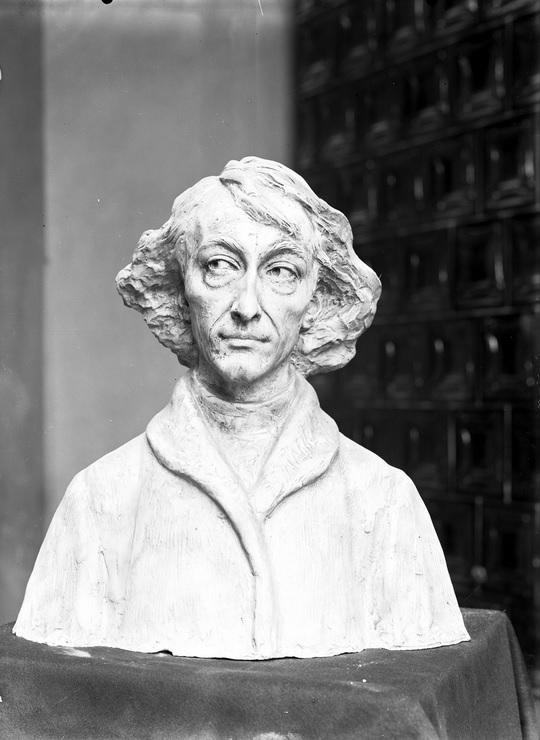
Nicolaus Copernicus. Sculpture by Konstanty Laszczka, 1926. (photo from the Polish National Digital Archives)
After the Second World War, problems arose in this regard, even trying to find sponsors for subsequent publications on Mickiewicz and Copernicus. A radical change in this attitude occurred only with the approaching 500th anniversary of the Polish astronomer's birth in 1973. The need for a fitting commemoration of Copernicus was advocated by the Congress President, Professor Stanisław Mrozowski, during the 2nd Congress of the Polish Institute of Science in April 1971, but it was not the Polish Institute of Science, but the Polish American Diaspora Congress, which played the most important role.
The overall activities of the Copernican Committee of the Polish American Congress, established to commemorate the 500th anniversary of the Polish astronomer's birth, were most thoroughly described by Professor Joanna Wojdon in her work Unity is Strength. The Polish American Congress in the Years 1968–1988. Therefore, for those interested in this topic, the excellent publication mentioned above is highly recommended.
In 1973, alongside KPA, Polish veterans in America, gathered in the Polish Combatants' Association (SPK), also commemorated Copernicus. Popularising the Polish astronomer among former soldiers of the Polish Armed Forces who did not return to the Soviet-ruled country after the Second World War was not unusual. Similar efforts were also made in Canada, where Copernicus, like Chopin, Moniuszko, Reymont, and Curie-Skłodowska, was a figure constantly remembered.
When Polish veterans in Portland, Oregon, informed the SPK Board in New York of their extensive involvement in the Copernicus celebrations in their city, which was allegedly due to the fact that, as they wrote, “American Germans” were appropriating Copernicus, the president of the SPK Board, engineer Janusz Krzyżanowski, did not share this enthusiasm, writing:
“This false flame of the Copernican Year is not making me happy at all. Every event like this is a golden opportunity for the regime to infiltrate the Polish diaspora and propagate new slogans meant to divert attention of the diaspora away from patriotic matters and towards focusing on their own bellies: »raising the prestige«, »gaining office positions«, »Polish Jokes« etc., etc. Our cause is to fight for the independence of Poland and to tell the world about the regime’s crimes and the crimes of its Moscow overlords, not to support policies which lead to the acceptance of the European status quo and the »agreement« between the Polish diaspora and the regime.”
This attitude among the SPK authorities did not prevent veterans from engaging in high-profile initiatives related to Copernicus. This was the case, for example, with members of Club 31 named after the 2nd Corps in Chicago, who enthusiastically supported the initiative of the Illinois State Branch of the Polish American Congress (KPA) to build a monument to Nicolaus Copernicus in Chicago. Polish veterans from Milwaukee also contributed money for this monument. Similar involvement was seen among SPK members in Miami, where, from February 15, 1973, Andrzej Gromadzki served as president, also serving as chairman of the local Copernicus Committee. The committee planned the construction of a Copernicus Planetarium in Miami, and the veterans supported this goal for 10 years – until 1984, as mentioned earlier. Wanda Gromadzka, the president's wife, designed and created beautiful postcards featuring Copernicus's bust, which were ceremoniously presented to local universities and the Historical Museum.
There were many initiatives by former Polish Second World War soldiers living in the U.S. who were connected to Copernicus. In 1973, Leopold Lambo of the SPK in Portland sculpted a beautiful bas-relief of Copernicus and donated it to the Copernicus Center in Chicago. The event received very positive press, resonating primarily with intellectuals. However, the centre was never built, and all funds collected from the Polish community were donated to the Chicago monument to the Polish astronomer. On February 18, 1973, SPK members in Chicopee, Massachusetts, participated in the celebration of Copernicus' birthday in Springfield, an event organised by the State Branch of the Polish . The SPK was responsible for the commemorative exhibition subcommittee, in which Jerzy Bajor was a prominent member. On the closing day of the exhibition, April 29, 1973, a concert was organised, featuring slides about Copernicus' achievements, performed by the aforementioned Dr. Franciszek Karkosz from Springfield. Nearly a thousand people attended the concert. On June 9, 1973, veterans from Los Angeles participated in the unveiling of the Nicolaus Copernicus plaque at the Griffith Park Observatory, for which they raised $300 from the local Polish community. SPK members from Boston helped form a men's scout troop composed of Polish youth named after, indeed, Nicolas Copernicus.
The SPK Club in Nassau in turn published an article in the May-June issue of the Line [“Linia”] bulletin in 1973 describing the ceremonies in the Hayden Planetary in New York, which took place on May 25. In it, they underlined the efforts of the former soldiers of the Polish Armed Forces in the West, Stanisław Szabunia, who prepared an exhibition of posters of Copernicus, and in June 1973 organised lectures on the Polish astronomer for the Polish diaspora.
Fighting for Copernicus’ Polish identity
The German-American lobby also took action (of anti-Polish nature). Some German groups traditionally sought to undermine Copernicus' Polish origins, protesting, for example, the 1973 U.S. Postal Service's issuance of a stamp featuring Copernicus, announcing that he was a Polish astronomer. It's worth devoting a few words to this issue.
The Polish Philatelic Association Polonus was founded in the United States in 1939. The name Polonus was chosen to honour the tradition of Nicolaus Copernicus, who, upon registering as a student at the Italian University of Padua, signed “Copernicus, Nationally Polonus.” Later, thanks to good contacts with the U.S. Postal Administration, Polonus secured the issuance of a stamp featuring Copernicus. This required a special resolution of the U.S. Congress. The Postal Department's announcement of the stamp's issuance referred to Copernicus as a “Polish astronomer.” German groups in the United States protested, demanding a correction.
Substantive counteraction by, among others, the Polonus Association prevented American Germans from falsifying history. A stamp bearing the inscription “Polish Astronomer” was issued in April 1973. In the same spirit of friendship for the Polish nation, the U.S. Postal Service accepted the invitation of the Polish Philatelic Association to participate in the World Exhibition commemorating the Year of Copernicus, held in Poznań at the turn of August and September 1973. For this occasion, the U.S. Postal Service presented a unique postal envelope, postmarked on the Moon by the first American astronauts. The U.S. Postal Service was represented in Poznań by Władysław Zachariasiewicz, who brought 60,000 attractive philatelic cards, specially issued by the Americans, featuring Copernicus and a photograph of the American postage stamp issued in his honour. In Poznań, the cards were distributed free of charge. They were gone within a few days. People waited in long lines to receive their “American card.”
A similar unpleasant incident, related to the upcoming celebrations of the 500th anniversary of Copernicus' birth and the actions of German-Americans, was noted by the Polish diaspora at the newly opened National Air and Space Museum at the Smithsonian Institute, where the inscription “German Astronomer” was placed next to a portrait of Copernicus already embedded in the wall. Meanwhile, the Americans themselves, who organised the Copernicus celebrations, naturally did not question the fact that Copernicus was Polish.
The person who resolved the issue of the false inscription on the plaque was the aforementioned Zachariasiewicz, who went to Michael Collins, the famous astronaut, participant in the first manned mission to the Moon on Apollo 11, who served as the first director of the newly built Museum from 1971. Zachariasiewicz provided Collins with additional materials confirming Copernicus' Polish identity. As a result, the plaque bearing Copernicus' likeness was covered up, a change the Museum authorities justified as necessary to maintain the high professional standards of their institution. A few weeks later, the plaque read that Copernicus was Polish
* * *
Finally, it’s worth adding that Americans themselves celebrated Copernicus’ 500th birth anniversary. On August 8, 1972, NASA sent an orbital station named after Copernicus to space. On February 19, 1973, President Richard Nixon declared February 19 “Copernicus Day.” That same year, the session of the American Science Academy took place between April 22-26.