
The NKVD usually based their accusations on the life stories of the arrested. We can see that i.e. in the case of Tomasz Jagiełło (case no. 38629).
Driver from Tyśmienica
Tomasz Jagiełło, son of Teodor, was born in 1893 in Tyśmienica, formerly part of the Siedlce Governate. In 1914, he was called to the Tsar’s Army, where he served in the rank of private in the 1st Cavalry Artillery Division.
The story of Tomasz Jagiełło clearly points to baseless, repressive actions on the orders of the NKVD. (…) For the Soviet way of treating people, he actually had a lot of luck.
After demobilisation, in 1918, he joined the engineering troops in Tbilisi. When the English troops came through Batumi in 1919, Jagiełło volunteered as a chauffeur. He was the driver for English engineer Doton and then the staff officers, including Military Governor General Cooke-Collis. In 1920, during the rules of the Mensheviks, he still worked in Batumi as a driver.
Between 1920-1925, he had a Polish citizenship. His two brothers and two sisters lived in Poland, and he kept in touch with them until his arrest in 1931. In the years 1922-1925, Jagiełło worked as a driver for the Copper Smelting Plants owned by Ferdinand Siemens.

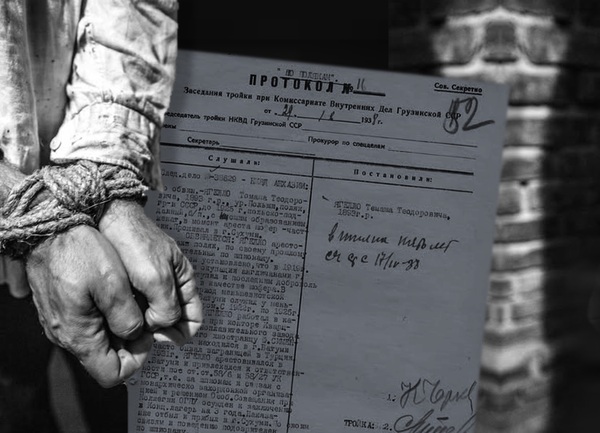
Reenactment. Hands tied. Bemowo Reconstruction and Film Group, photo by C. Pomykało. Photo presented in the 2018 Institute of National Remembrance Archive exhibition entitled “Order No. 00485. Anti-Polish NKVD Operation in Soviet Ukraine 1937–1938”
Two sentences
He often travelled to Turkey and stayed there for longer periods for work. It was there, where he (according to the NKVD) got involved in smuggling and made contact with the White movement. After the plants shut down in 1925, he took Soviet citizenship and tried his hands at various public institutions, although not for long. When the Italian consulate was opening in Batumi, he tried getting a job there. He tried to hide his visits to the consulate from the Soviet authorities. Between 1925-1929, he was the driver for the Batumi border control, and in the years 1930-1931 he was the chauffeur for the Central Executive Committee of the Adjarian SSR.
The first arrest under the accusation of espionage had actual signs leading to that conclusion: his work with foreigners and numerous trips to Turkey.
On February 21, 1931, he was arrested based on articles 58-6 (espionage) and 58-27 (violation of foreign exchange regulations) of the Penal Code of the Georgian Socialist Soviet Republic. The search of his apartment revealed gold chekankas (495 pieces) and gold Turkish liras (81 pieces), as well as foreign currencies in cash and other valuables. All of that was deemed illegal contraband.
They also secured correspondence and photographs with English soldiers. Special College of the GPU of the Adjara ASRS found him guilty and on June 9, 1931, sentenced him to five years in a gulag. Jagiełło systematically appealed his sentence. On September 23, 1931, the GPU Special College for administrative deportations commuted his sentence to three years. He spent it in the White Sea-Baltic Gulag of the OGPU.
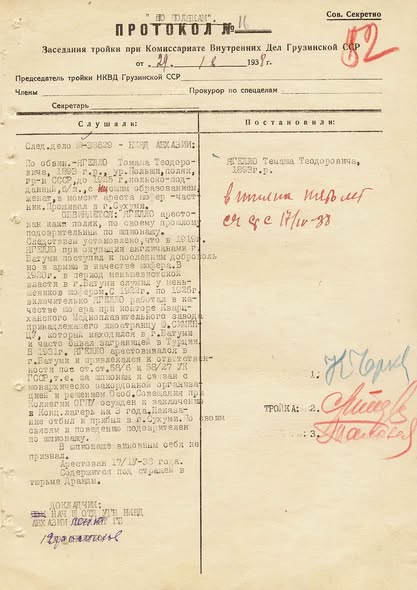
Protocol No. 16 of the meeting of the Troika at the NKVD GSSR containing the resolution that: “JAGIEŁŁO Tomasz, son of Teodor, born in 1893, be sent to the gulag for five years, serving the sentence from April 17, 1938.” Tbilisi, September 29, 1938. Document acquired for the Institute of National Remembrance from the Archives of the Ministry of Internal Affairs of Georgia
Based on the decision of the Central Executive Committee of the USSR from August 27, 1933, he was released early. After serving his time, he came back to Suchumi and started working as a private driver.
In both cases, Jagiełło’s guilt was never proven, he was found not guilty and released early.
Based on his earlier contacts and behaviour, on April 17, 1938, he was once again arrested and accused of espionage and anti-revolutionary activities on the basis of article 58-10 of the Georgian Penal Code. He plead not guilty on all counts.
On September 29, 1938, he was sentenced by the “special troika” in the Anti-Polish operation to five years in a gulag and sent to the city of Karyelino in the Sverdlovsk Oblast. By a decision of the NKVD of the GSSR of July 21, 1939, he was found innocent and released from the camp on August 13, 1939. His subsequent fate remains unknown.
- * * *
The story of Tomasz Jagiełło clearly points to baseless, repressive actions on the orders of the NKVD. The first arrest under the accusation of espionage had actual signs leading to that conclusion: his work with foreigners and numerous trips to Turkey. The second time, the only reason was his first, previous arrest and the order 00485. In both cases, Jagiełło’s guilt was never proven, he was found not guilty and released early. For the Soviet way of treating people, he actually had a lot of luck.