Eduard Lubusch was born on February 22, 1922, in Bielsko. His parents were Rudolf and Bernardyna née Vlcék. Bielsk was a town populated by both Poles and Germans, which made Eduard fluent in both of their languages. He graduated from primary school in 1934, and a year later began his studies at the evening vocational school.
In June 1939, he finished his education and got his locksmith certification. He then worked in this profession in the Bielsk workshops, until he was transferred to the Garmisch-Partenkirchen factories where he moved with his father. Between September and the end of November 1939, he worked in electrical plants. On December 1, 1939, he came back to his home town. Then, on December 8, 1939, he volunteered for the military check-up.
Service at KL Buchenwald and KL Auschwitz
The personal card of the Wehrmacht Information Office and the biography written by Eduard Lubusch indicate that from December 14, 1939 he served as a guard in the KL Buchenwald concentration camp. This information hasn’t been present in any of the known sources. It’s not precisely clear when he finished his service at KL Buchenwald. According to Lubush’s granddaughter, his mother bribed the authorities to transfer him closer to the family home, most likely to KL Auschwitz.
The exact time of these actions and the date of the start of his service at Auschwitz remain unknown. Popular science articles point to the date of February 1, 1941 as the beginning of his service at KL Auschwitz, but the documents of the National Auschwitz-Birkenau Museum (APMA-B) and the Bundesarchiv don’t confirm this. Wiesław Kielar, a former Auschwitz prisoner, recalled that in 1940 Lubusch served as the Blockführer. Another prisoner, on the other hand, Stanisław Trynka said that at the end of 1941 Lubusch served as the Kommandoführer. In the spring of 1941, Lubusch contributed to the opening of the camp’s foundry, which he most likely oversaw.
These memories point to the fact that Eduard Lubusch most likely served at KL Auschwitz already between 1940-1941, which suggests that his service at KL Buchenwald lasted about a year.
![Eduard Lubusch or Bronisław Żołnierowicz. Photo of the secret collaborator [TW] under the pseudonym “Karol” (photo from the IPN archives)](/dokumenty/zalaczniki/166/166-196122.jpg)
Eduard Lubusch or Bronisław Żołnierowicz. Photo of the secret collaborator [TW] under the pseudonym “Karol” (photo from the IPN archives)
Head of the camp’s ironworks
In 1942, Eduard Lubusch got promoted to the position of the head of the camp’s ironworks in the rank of an SS-Rottenführer. According to the prisoners’ accounts, in his work he concentrated on the precision and quality of the products. The workshop which he oversaw also carried out private orders of the camp’s commandant Rudolf Höß, which gave his activities special meaning.
Lubusch’s behaviour in the workshop was different from the typical brutality of other SS-men. There were reports of him treating the prisoners too leniently which was to be the reason behind the decision to transfer him to the Stutthof concentration camp. There, he was to be taught a more brutal approach towards the prisoners. However, in the available APMA-B and Bundesarchiv documents there is also nothing confirming these recollections.
In the accounts of Lubush’s granddaughter there is a mention of the scars on his belly, which according to his stories came from the war, including his time in the Berlin prison. One can also assume that it could be connected to his service at Auschwitz, but that also lacks any confirmation in the known sources.
According to the statements found in APMA-B, the prisoners who worked in the ironworks had no negative memories of E. Lubusch. Stanisław Trynka recalled that Lubusch took in one of the prisoners as a workshop assistant. Prisoners treated this kind of work as time to regenerate their bodies. Kazimierz Wandowski recalled that Lubusch organised medicine and food for the weakest prisoners. During commandant Rudolf Höß’s trial, witness Michał Kula, former prisoner of KL Auschwitz who worked in the ironworks, recalled that Lubusch underwent a change in his behaviour. In his statement, Kula said:
“The first management of the ironworks came in the autumn of 1942. This position was held by SS-Rottenführer Lubusch Edward from Bielsko. At first, he beat prisoners. Then, he changed.”
It is the only available account which portrayed E. Lubusch in a negative light. The overwhelming majority of prisoners’ recollections describes him positively. Nevertheless, we shouldn’t forget he was the member of the SS and participated in the German system of terror.
The SS-man’s private life
In February 1943, Eduard Lubusch applied to the SS Main Office for Race and Settlement for permission to enter into a Catholic marriage with Hildegard Kneblowski. It is surprising that an SS-man serving in Auschwitz would seek a Catholic wedding. According to his granddaughter, Hildegard was a deeply religious person, which may have influenced Lubusch's decision to seek permission for such marriage.
The engaged couple had to submit detailed documentation, including information on illnesses in the families, genealogies, biographies, medical records, and fill out a questionnaire assessing their ability to enter into marriage. On April 15, 1943, the application was rejected for three reasons: Lubusch had been diagnosed with a sexually transmitted disease, the unknown origin of his maternal grandfather, and too big of an age difference between the future spouses - Hildegard was three years older than Eduard. The marriage in the Catholic rite was an additional problem.
On April 16, 1943, the head of the SS Main Office for Race and Settlement changed his mind – he gave his consent, but to a civil marriage. In October 1943, Eduard and Hildegard welcomed their son Włodzimierz.
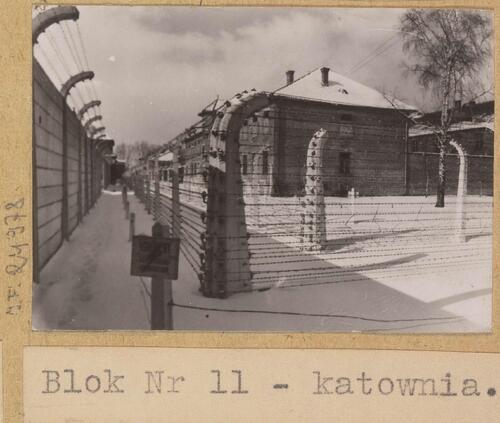
Auschwitz-Birkenau concentration camp. Block No. 11. Male Zimetbaum and Edward Galiński were interrogated in this block (photo: polona.pl/public domain/National Library)
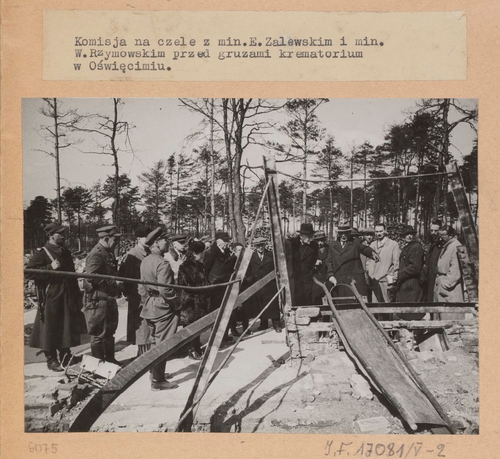
Members of the Commission for the Investigation of Nazi Crimes in Oświęcim (photo: polona.pl/public domain/National Library)

Auschwitz-Birkenau concentration camp. Portable gallows (photo: polona.pl/public domain/National Library)
Post-war escape and change of identity
In the family archives there is a report by a man who testifies that Eduard Lubusch, wanting to gain a positive reputation after the end of the war, began to help prisoners escape. In May 1944, he allegedly helped Franciszek Faix, an officer of the 2nd Legions Infantry Regiment, who was promoted to captain in 1920, to escape. Faix was awarded the Military Order of Virtuti Militari. Lubusch also helped a pair of prisoners in love, Edward Galiński and Mala Zimetbaum. He organised weapons and an SS uniform for them. This help enabled the couple to escape from the camp together on June 24,1944. Unfortunately, the lovers were later captured again and sentenced to death. Edward Galiński met Lubusch while working in the camp's ironworks.
Popular science articles claim that Eduard Lubusch left the SS in 1944. There is no mention of desertion in APMA-B or the Bundesarchiv. Such a fact would have certainly been noted. One theory suggests that Lubusch could have escaped after Galiński and Zimetbaum were captured and tortured in block 11. Fearing that they might tell on him, he decided to desert. Another theory assumes that, foreseeing the imminent defeat of Germany and fearing the consequences, he decided to hide. His wife's family was to help him with that, especially his father-in-law, Jan Kneblowski, who had contacts in the Home Army. It is known that thanks to the support of the Home Army, Eduard, his wife Hildegarda and their one-year-old son Włodzimierz obtained new identity documents. The family hid in the Greater Poland province, taking on new names and surnames:
– Eduard Lubusch became Bronisław Żołnierowicz,
– Hildegarda Kneblowski became Marta Żołnierowicz,
– their son became Włodzimierz Żołnierowicz (formally adopted).
It is certain that Eduard Lubusch was entered into the Central Register of War Criminals and Suspects under the number 265880.
Life in the Polish People’s Republic
After the war, the Żołnierowicz family settled in Luboszyca in Greater Poland. Marta completed a pharmacy course, and Bronisław worked as a locksmith. The family also maintained close relationships with friends, the Sienkiewicz family, living in Rudna Wielka, whom they visited even after moving from Luboszyca. In 1947, Bronisław's parents-in-law, the Kneblowski family, settled in Jelenia Góra. In the 1950s, Bronisław himself and his family moved to this city and settled on the Szpacza Street. Initially, the family worked in trade, and later Marta took up work at PSS Społem [grocery store co-operative]. At the turn of the 1960s and 1970s, Bronisław became a guide for PBP “Orbis"[travel agency]. Thanks to his fluent knowledge of German, he guided tourists arriving from the Federal Republic of Germany.
On October 23, 1976, B. Żołnierowicz voluntarily enlisted to the communist Security Service as a secret collaborator under the pseudonym "Karol". He observed negative behaviours and statements of visitors coming to the country and monitored the environment of PBP "Orbis" drivers. He informed on people suspected of establishing contacts with foreign tourists. Due to his advanced age and deteriorating health, in 1982 he was reclassified as an operational contact. Bronisław Żołnierowicz died on March 10, 1984 in Wrocław and was buried in the Jelenia Góra cemetery.