The fire took place on the night of October 31 and November 1, 1980. To the demise of the inmates and hospital workers, who had office apartments there, the fire was first spotted by one of the patients. In a grim twist of irony, the patient, called Ali by others, was being treated for pyromania.
Ali was supposed to be keeping a watch on the corridor, while the nurses, after administering evening medication and locking the rooms, went to the social room to prepare dinner for themselves. That very same patient had said the day before that “the wall is warm”, but he wasn’t taken seriously.
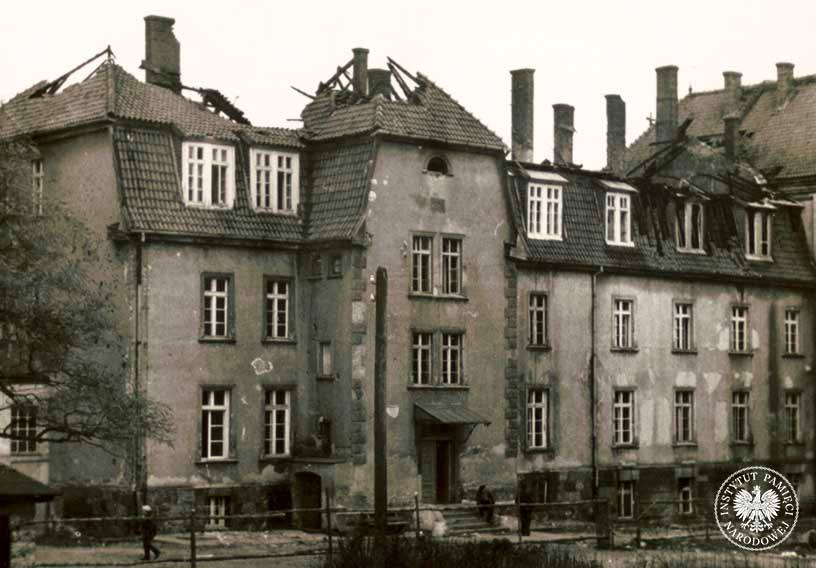
Buildings of the Hospital for the Mentally and Psychologically Ill in Górna Grupa. State of the building after the fire, November 1, 1980. The photo comes from Wiesław Biesek's master's thesis entitled “Organisation of protective and orderly activities of the Voivodeship Emergency Medical Services in Bydgoszcz during catastrophes and natural disasters on the example of the fire in the psychiatric hospital in Górna Grupa”
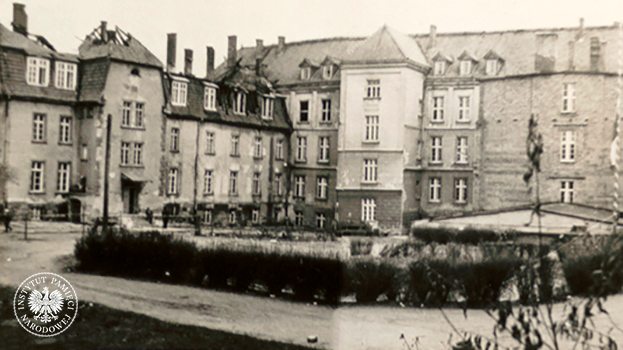
Buildings of the Hospital for the Mentally and Psychologically Ill in Górna Grupa. State of the building after the fire, November 1, 1980. The photo comes from Wiesław Biesek's master's thesis entitled “Organisation of protective and orderly activities of the Voivodeship Emergency Medical Services in Bydgoszcz during catastrophes and natural disasters on the example of the fire in the psychiatric hospital in Górna Grupa”
Death smouldering beneath the floor
It is very likely that the fire started because of a leaky chimney. The experts later found that the walls filled with flammable insulation (moss, tree needles, sawdust) had been smouldering for some time already. As a result of the fire, the electric wiring got damaged and the lights went down in the entire facility. This, however, was not unusual due to recurring power shortages. When the maintenance worker left his office apartment to turn on the emergency generator, he was alarmed by one of the nurses:
“We’re on fire!!!”
The documentary “Death smouldering beneath the floor”, aired on TVP Historia (as part of the series “Unknown disasters”), reconstructed the events and showed interviews with the hospital’s former employees. They were young nurses, often sent there immediately after graduating from medical high school. Years later, they recalled with tears in their eyes how they did everything they could to save their patients.
Unfortunately, despite the dedicated efforts of the employees in the evacuation, 52 people died on site, while three lost their lives in the hospital of their wounds.
Some of the mentally ill, strapped to their beds for safety, had no means of escape at all. Others, for whom the hospital rooms were their one and only world, refused to run away. They were afraid of the soldiers and firemen running to help them. The rescuers had to put on hospital lab coats so the patients would agree to be escorted out.
To make matters worse, the rescue operation was hindered by the lack of water to put out the fires, as the nearby pond was filled with leaves and the fire engines couldn’t pump water from it. Unfortunately, despite the dedicated efforts of the employees in the evacuation, 52 people died on site, while three lost their lives in the hospital of their wounds. The rescue operation was very chaotic.
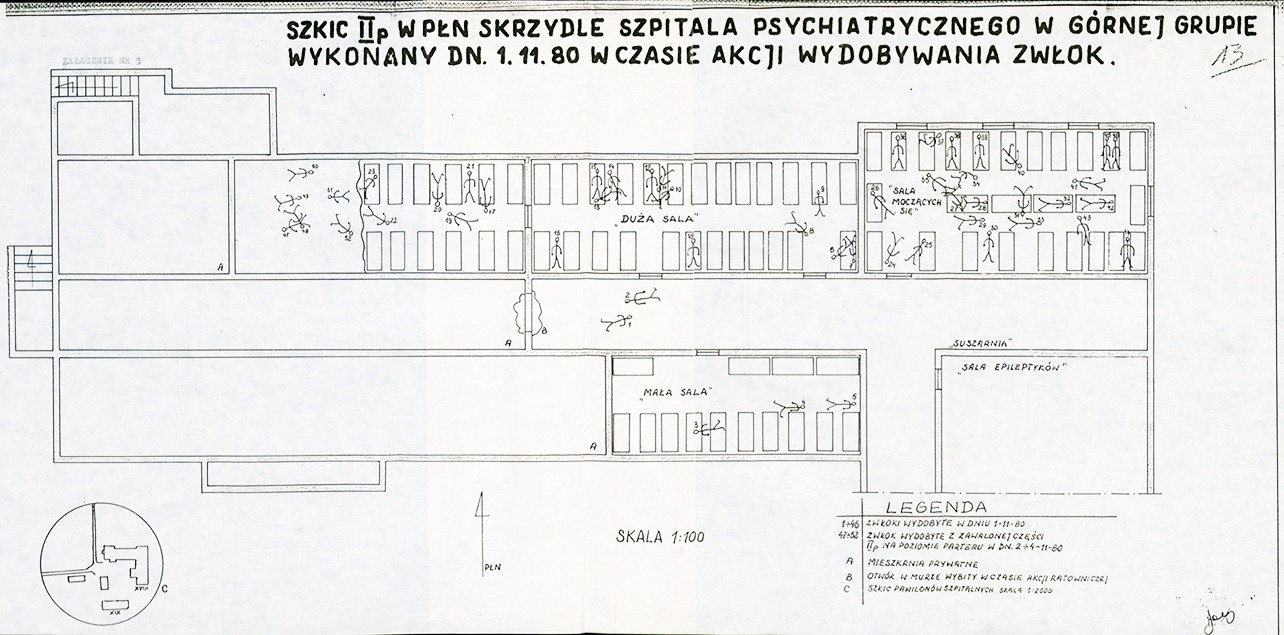
Sketch of the second floor in the northern wing of the Hospital for the Mentally and Psychologically Ill in Górna Grupa., drawn during the operation of extracting bodies after the fire, November 1, 1980. Drawing comes from Wiesław Biesek's master's thesis entitled “Organisation of protective and orderly activities of the Voivodeship Emergency Medical Services in Bydgoszcz during catastrophes and natural disasters on the example of the fire in the psychiatric hospital in Górna Grupa”
The result of systemic negligence
Psychiatric care in Poland in the 1980s left much to be desired. Lack of financing, medical personnel shortages and the deplorable state of hospital buildings used to keep patients pushed to the margins of society: that’s the picture of the mental institutions painted by doctors and nurses working in these facilities.
It was no different in the facility in Górna Grupa, near Grudziądz, the branch of the Hospital for Mentally and Psychologically Ill in Świecie. It was set up in the old monastic house of the Verbites, built in the 19th century, and then taken over by the communist state. The hospital, however, wasn’t renovated and adapted to the needs of the new facility. Only several years later, during an inspection, it was noted that the hospital is set up in a building with wooden ceilings.
(…) the multi-person hospital room was the only world they knew. They were practically casted out from society. Their relatives abandoned them, nobody visited them, no one sent any packages.
The patients were crammed together in common rooms. Smaller rooms counted 20 beds, the bigger ones between 40 to 50. They were laid out so close to each other that there was no way of moving next to them. The patients had to crawl over the beds of their neighbours. Nevertheless, there were no efforts to improve these conditions. There was also no other place where the mentally ill could be transferred.
For the most seriously ill, epileptics, schizophrenics, catatonics and other patients isolated due to severe mental disabilities, the multi-person hospital room was the only world they knew. They were practically casted out from society. Their relatives abandoned them, nobody visited them, no one sent any packages. Only after the tragic events, when it turned out that families were entitled to compensation did the relatives suddenly show up.
In the masters dissertation of Wiesław Biesek, a student of the Interior Affairs Academy of the Public Order and Combat Training Institute, a copy of which is in the archives of the Institute of National Remembrance (Biesek Wiesław, “Organisation of protective and orderly activities of the Voivodeship Emergency Medical Services in Bydgoszcz during catastrophes and natural disasters on the example of the fire in the psychiatric hospital in Górna Grupa”), we can read that the building had wooden ceilings, here and there reinforced with steel beams. The floors were wooden as well, covered with a PCV flooring, which was flammable. The padding of the plastered wall was also made out of highly flammable materials.
According to the facility’s witnesses and former employees, the corridors had built-up passages, which made it impossible to safely evacuate. A tragedy was difficult to avoid with conditions such as these.
![Statement by hospital employees, members of the Solidarity Trade Union, after the fire at the facility in 1980, indicating the terrible state of psychiatric treatment (from the archives of the Institute of National Remembrance). “Our hospital is the screaming example of the shortages and lack of basic safety requirements of public health care. […] Budget cuts on health care result in mortal victims!”](/dokumenty/zalaczniki/166/166-190527.jpg)
Statement by hospital employees, members of the Solidarity Trade Union, after the fire at the facility in 1980, indicating the terrible state of psychiatric treatment (from the archives of the Institute of National Remembrance). “Our hospital is the screaming example of the shortages and lack of basic safety requirements of public health care. […] Budget cuts on health care result in mortal victims!”
* * *
The fire of the Hospital for Mentally and Psychologically Ill in Górna Grupa was yet another tragedy in the 1980s which uncovered the negligence in health care facilities. The hospital’s employees who were members of the Solidarity Trade Union issued a statement in which they protested against the inaccurate informing of the public opinion on the actual causes of the scope and occurrence of the tragedy.