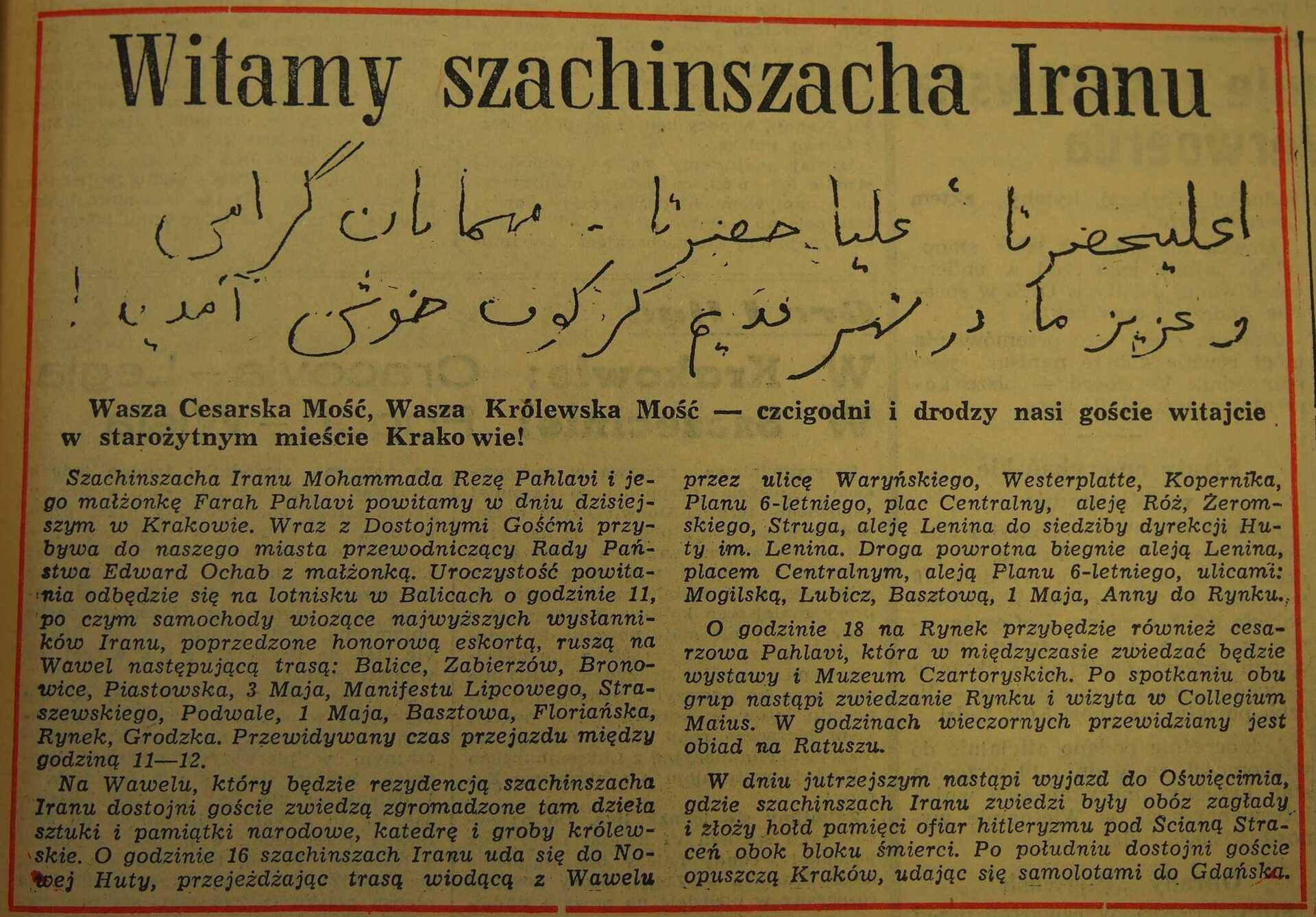

“Citizens of Warsaw and children from school delegations gathered on the Okęcie airport field, which was decorated with flags of both nations. The officials included Edward Ochab with his wife, Józef Cyrankiewicz, Czesław Wycech, Stanisław Kulczyński and other prominent members of the communist government, i.e. Adam Rapacki. The silver body of a Boeing 727 appears on the sky escorted by fighter jets from the country’s border. It’s noon. The plane lands on the air field. The President of the State Council, Edward Ochab welcomes the shah of shahs on the Polish land. The orchestra plays national anthems.”
This way, on September 13, 1966, began the first visit of Iranian shah Mohammad Reza Pahlavi and his wife Farah to Poland (the second one took place between 22-26 August, 1977).
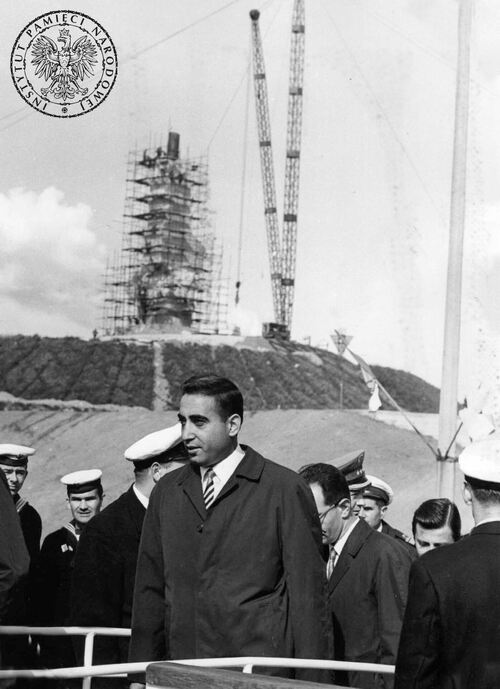
Member of the Iranian delegation during the visit to Gdańsk, September 1966 (photo from the collections of the Institute of National Remembrance)
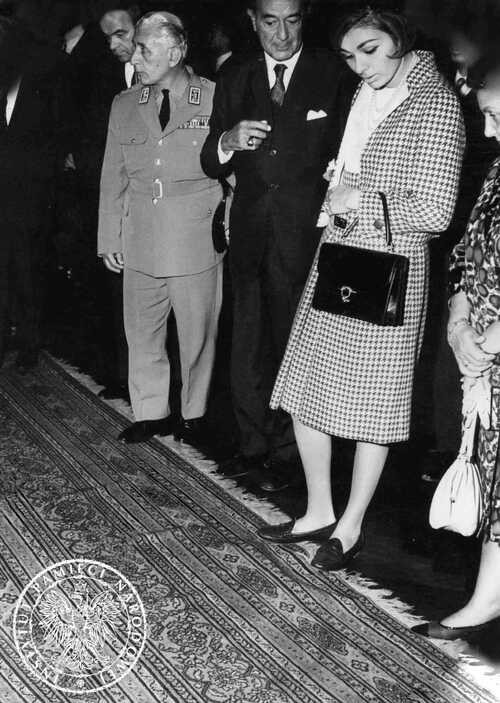
Wife of Iranian shah, Farah, during the visit to Poland, September 1966 (photo from the collections of the Institute of National Remembrance)
Economic flirt
The reason behind the shah’s visit to Poland was first and foremost economic. During that time, Reza Pahlavi was modernising his country and sought to acquire foreign technologies. It’s worth pointing out that since 1963 Iran was realising, with varied effect, the so-called white revolution, an ambitious plan of developing the country. In its first stage, the goals comprised six points (agricultural reform; nationalisation of forests and pastures; privatisation of state companies; giving their employees partial ownership; tackling illiteracy; giving voting rights to women), and then they grew to more than a dozen.
Because of that, Iran’s relations with countries of the eastern bloc became warmer and more dynamic. Poland, on the other hand, was very keen on increasing trade, especially of agricultural machinery, chemicals and home appliances, and even entire industrial facilities i.e. sugar factories.
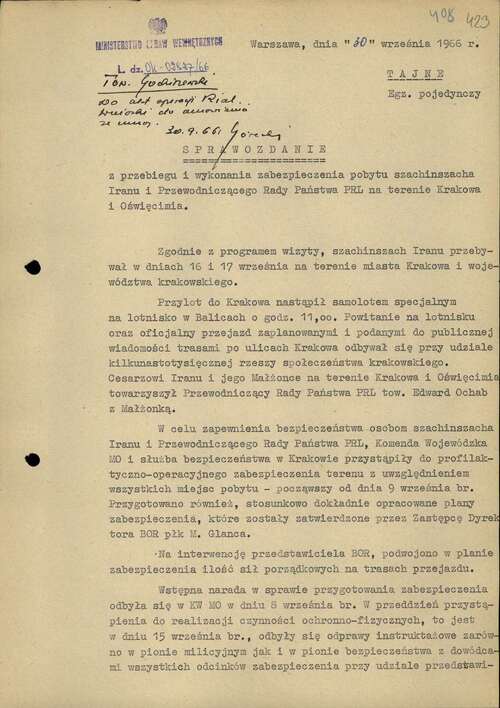
Report from the course and securing of stay of Iranian shah of shahs and President of the State Council of the Polish People’s Republic in Krakow and Oświęcim (first page). Warsaw, 30.09.1966 (photo from the collections of the Institute of National Remembrance). The report describes the shah’s arrival and security measures.
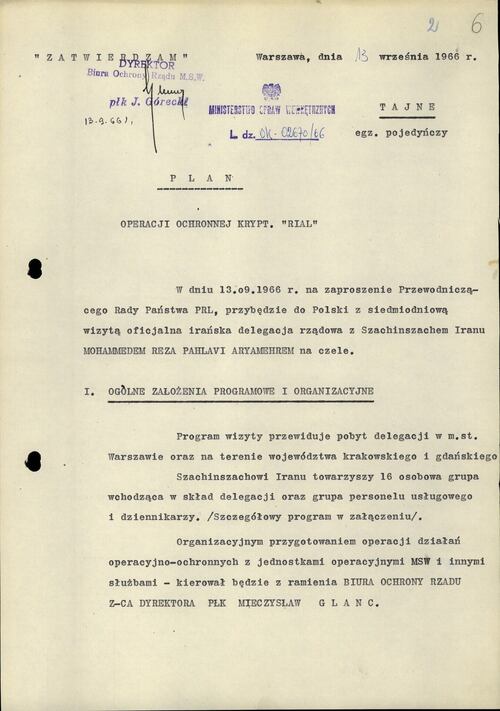
Page from the program of Iranian shah’s visit to Poland, September 1966 (photo from the collections of the Institute of National Remembrance)
From Chopin to Auschwitz
During the first visit to Poland, the royal couple went to Warsaw, Żelazowa Wola, Krakow, Oświęcim and Gdańsk. One of the main subjects of talks was the raising of bilateral cooperation and an agreement on cultural exchange between the two countries. The press of the Polish People’s Republic, both central and local, followed the stay of the royal couple in Poland with great interest and reported on every point of the stay. At the same time, the media tried to present Iran to their readers and paint the changes taking place in the country in a proper light. That’s why we can find articles in the old newspapers about Iran’s history, its social relations and political situation, its contacts with Poland and even impressions from the travels.
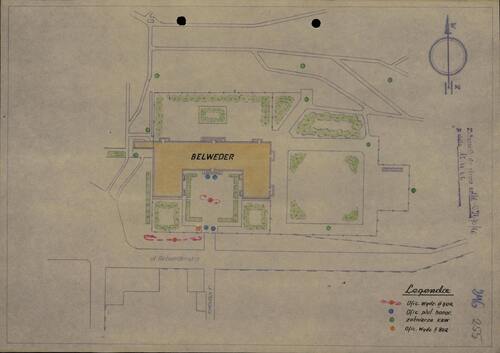
Plans for securing the Belvedere Palace during the Iranian shah’s visit, 1966 (photo from the collections of the Institute of National Remembrance)
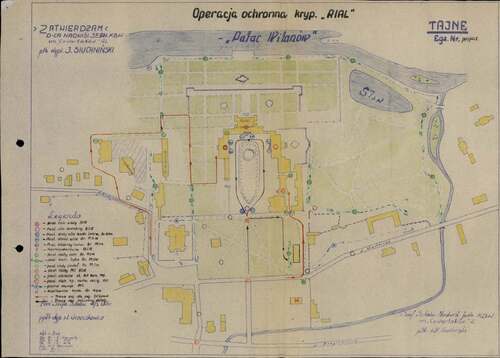
Plans for securing the Belvedere Palace during the Iranian shah’s visit, 1966 (photo from the collections of the Institute of National Remembrance)
The first visit of the royal couple to Poland ended on September 19. A joint statement was published at the end, where both sides:
“Expressed readiness to use all of their possibilities, especially in economic and cultural affairs, to further deepen their bilateral relations.”
Avicenna and “Polish carpets”
Years later, the shah’s wife recalled her stay in socialist countries in her memoirs:
“We kept relations with all countries of the communist bloc and we visited them all, excluding Albania, Cuba and East Germany […]. These visits were rather difficult for me, since they were full of hypocrisy. We were completely aware of the negative attitude of our hosts towards monarchy, while we, due to obvious reasons, were untrusting of the communists […]. The biggest joy for me was finding traces of the Persian influence during our travels. In Krakow, where they talked about Avicenna, we came across writings of that philosopher in Persian, Also in Poland, I saw Persian carpets weaved with gold and silver which the Polish kings ordered in Iran; back at our home they were called >>Polish carpets<<. But the visit to Poland is also connected in my mind to the feeling of horror, which came over me during the visit to the concentration camp in Oświęcim.”