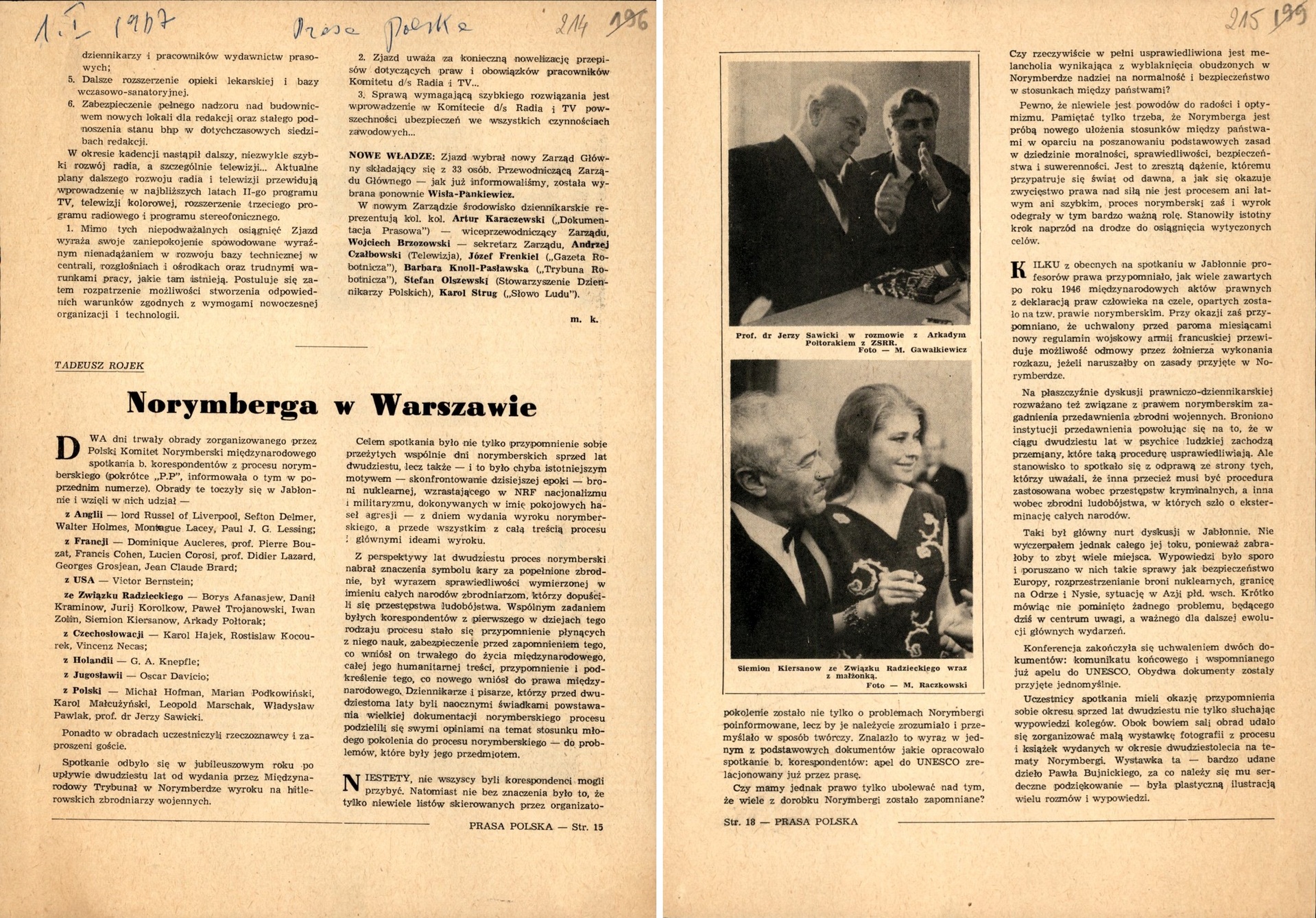
More than 10,000 correspondents from all over the world fought to get a place in the press box which only seated 250 people. The Polish Press Agency sent Leopold Marschak, Marian Podkowiński and Michał Hoffman to report on the trial to the Polish nation, while the Polish accusers’ delegation included Tadeusz Cyprian, Stefan Kurowski, Stanisław Piotrowski and Jerzy Sawicki, who prepared an inditement on Nazi crimes in Poland.
Nuremberg correspondents
The trial led by the International Military Tribunal lasted a year. 218 proceedings took place during that time. The trial was conducted in four languages: German, English, French and Russian with simultaneous translation. The trial’s protocols contained 16,000 pages. During that time, the Polish press delegation increased to 10 people, including special correspondents of the Polish Radio (Władysław Pawlak), reporters from individual newspapers (like Karol Małcużyński from Robotnik [The Worker]), and experts on German matters (Edmund Osmańczyk).
Due to the war devastation, normal communications were still down. The Polish delegation sent its reports home by telegraph, first from Nuremberg to Frankfurt, from where they traveled to New York and then to Warsaw via Moscow. This communication chain was riddled with errors, as each word, letter by letter, had to be telegraphed by people who didn't speak Polish.
The correspondents from other countries included the world-famous legends of journalism and writing like Ernest Hemingway, John Dos Passos and Konstanty Fiedin, as well as people who then played important roles in history like Marcus Wolff, later head of Stasi, or Norwegian correspondent and future chancellor of West Germany, Willy Brandt. All of them were part of the International Correspondents’ Committee accredited by the Tribunal. Its members swore a journalistic oath that wherever they would work, also in the future, they would always stand against aggression, war criminals and war itself, and that they would always stay faithful to the “rules of Nuremberg.”
The correspondents’ lives were spent between the courtroom, the hotels, from where they sent their reports, and the bar, where they exchanged opinions with the other journalists. They spent their evenings in friendly atmosphere, but also heated discussions on war and politics. Despite their differences, however, they managed to find a common language by categorically condemning the Nazi German crimes. They formed bonds and friendships back there which lasted entire lifetimes. The trial’s rulings were announced on October 1, 1946.
A reunion, years later
In 1960, former Polish correspondents from Nuremberg had the idea to organise a meeting to commemorate the 15th anniversary of the trial’s beginning. Finally, the Reunion of Former Nuremberg Correspondents took place on the 20th anniversary of the end of the International Military Tribunal, between November 11-12, 1966, in Jabłonna near Warsaw. But before the reunion took place, they formed the Initiative Committee for the Reunion of Former Nuremberg Correspondents was established under the Association of Polish Journalists. The committee included Michał Hofman (chairman), Karol Małcużyński (vice-chairman), Marian Podkowiński (vice-chairman), Leopold Marschak (secretary), Władysław Pawlak, Jerzy Sawicki, and Czesław Pilichowski (GKBZH). The committee determined that, in addition to the correspondents, some prosecutors from the Nuremberg Trials would be invited, as well as lawyers and journalists specialising in the Nuremberg cases. Approximately 40 people were expected to attend.
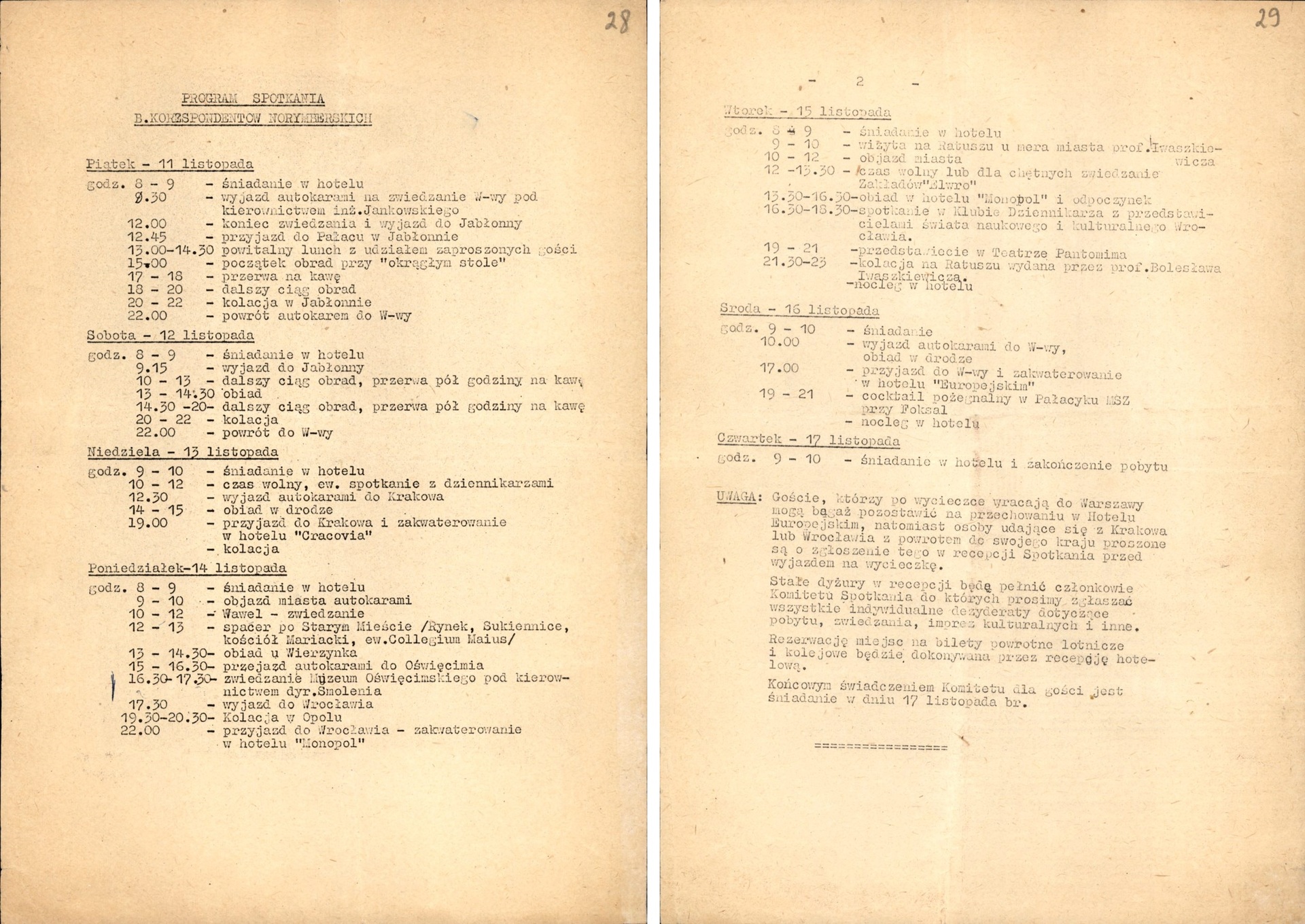
Program of the Reunion of Former Nuremberg Correspondents
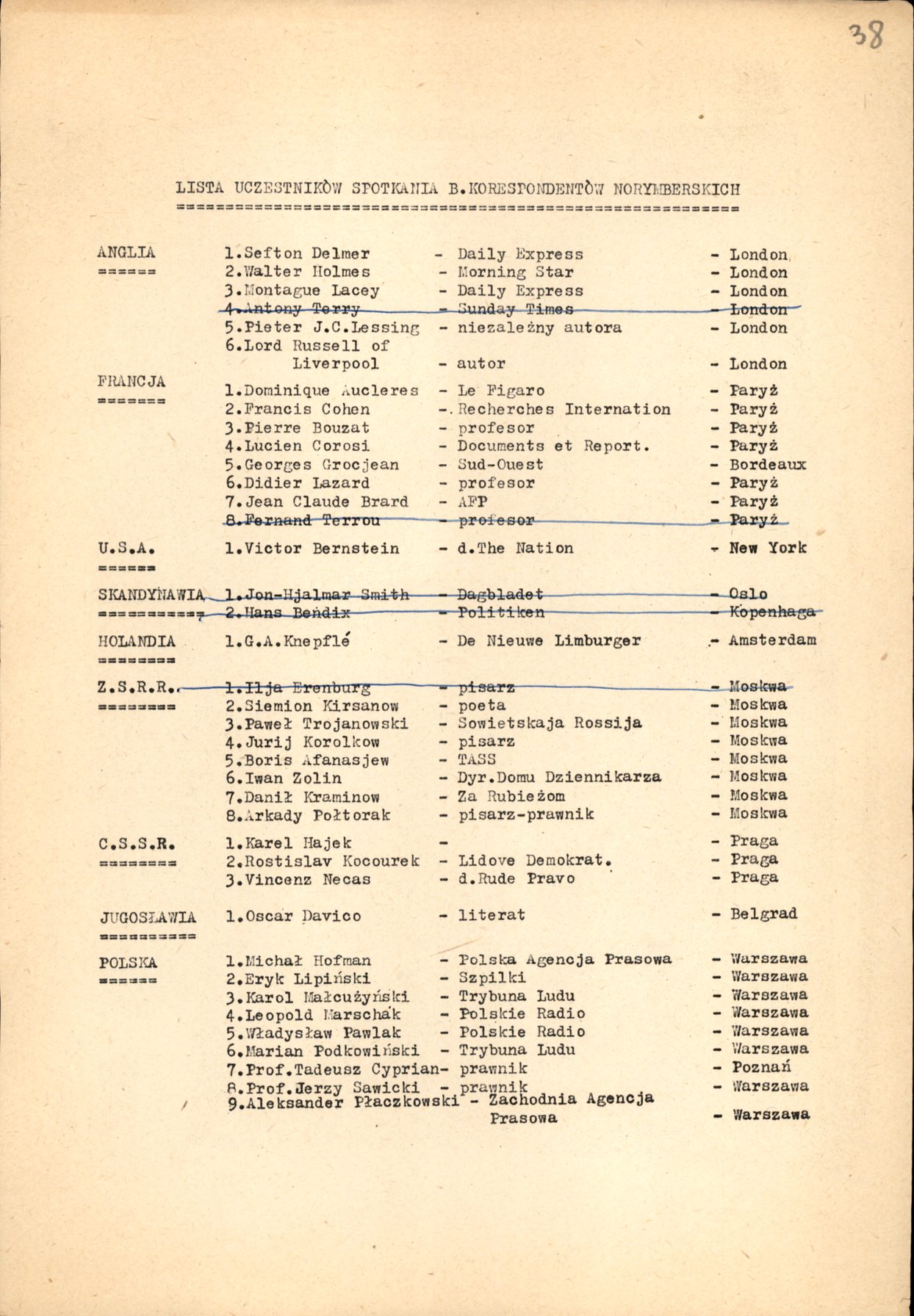
List of participants of the Reunion of Former Nuremberg Correspondents
The Committee obtained an incomplete list of journalists accredited to the International Military Tribunal and attempted to contact as many as possible to invite them to the meeting. Invitations were extended only to journalists from countries of the former anti-Hitler coalition, excluding East Germany, West Germany, Italy, Romania, Bulgaria, and Hungary. In total, they contacted 150 individuals from the United States, United Kingdom, Canada, France, the Netherlands, Switzerland, Yugoslavia, Denmark, Czechoslovakia, Brazil, and the USSR. Early on, it became clear that some of them had abandoned the journalistic profession, many addresses could not be located, and many former correspondents were already deceased. Overall, however, the response to the initiative and the invitation was surprisingly positive, with approximately 50 people ultimately arriving in Warsaw.
Although the meeting of former correspondents was social in nature, it was also driven by serious issues. As Karol Małcużyński said at the opening session, its goal was “not only to share memories from 20 years ago,” but also “the need to recall, in the age of nuclear weapons, the achievements of the Nuremberg Trials, (…) to recall the lessons learned from the trial, to protect from oblivion its lasting contribution to international life.” This was important, he noted, because neo-fascist movements were resurfacing in Germany, the status quo in Europe was getting undermined, attempts were being made to forgive and erase the Nuremberg Trials, to question historical documentation, and to cut off the younger generations from historical truth.
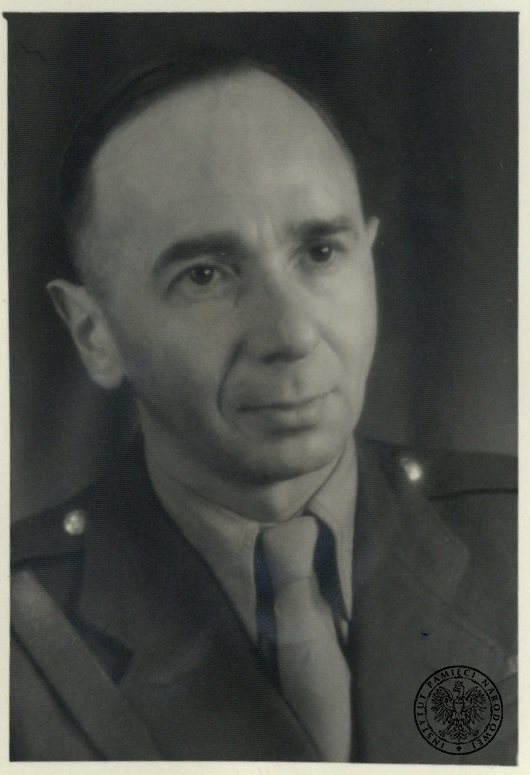
Leopold Marschak, former Nuremberg correspondent, secretary of the Reunion of Former Nuremberg Correspondents. Photo from the Archives of the Institute of National Remembrance
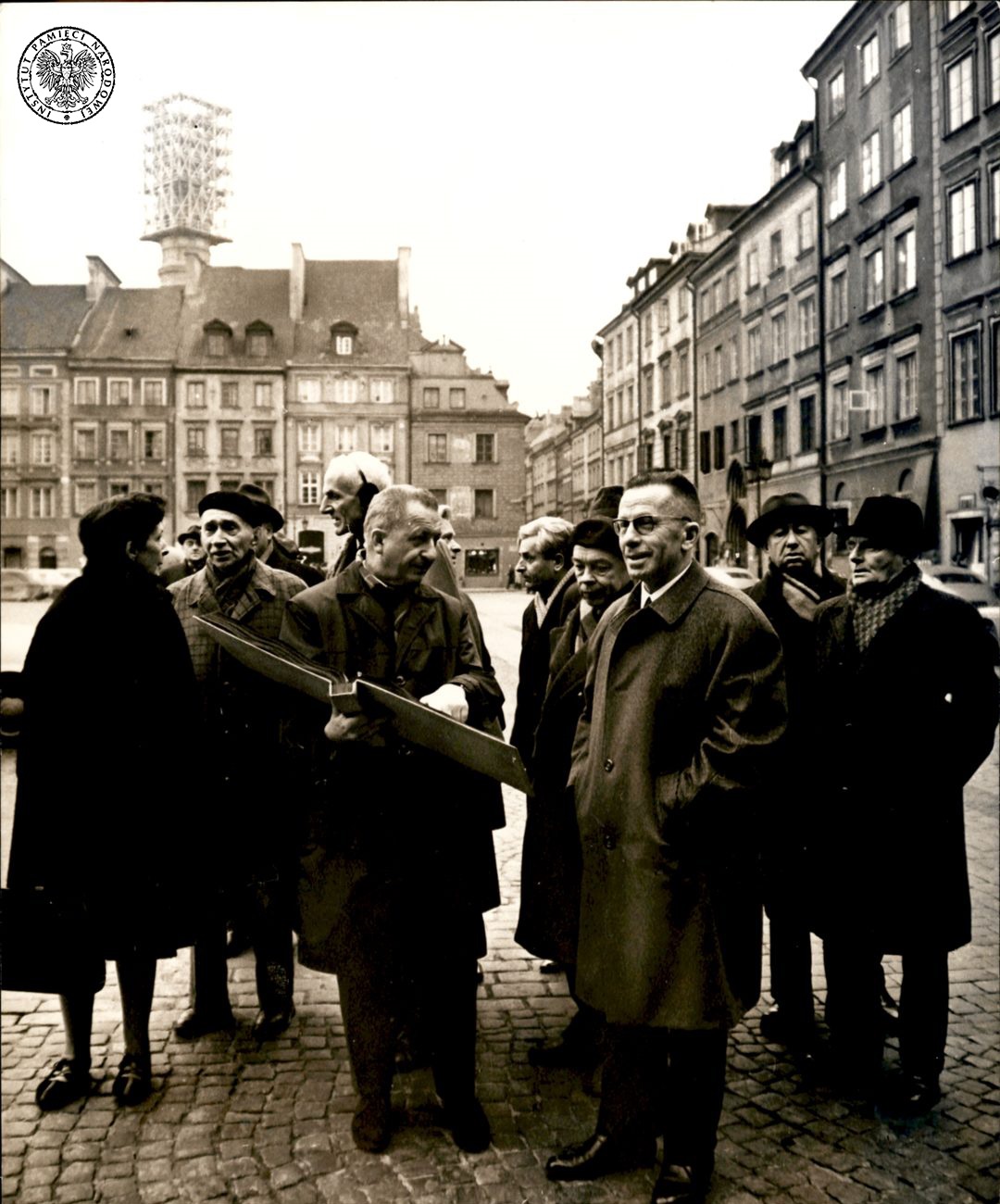
Participants of the Reunion of Former Nuremberg Correspondents in Warsaws Old Town. Photo from the Archives of the Institute of National Remembrance
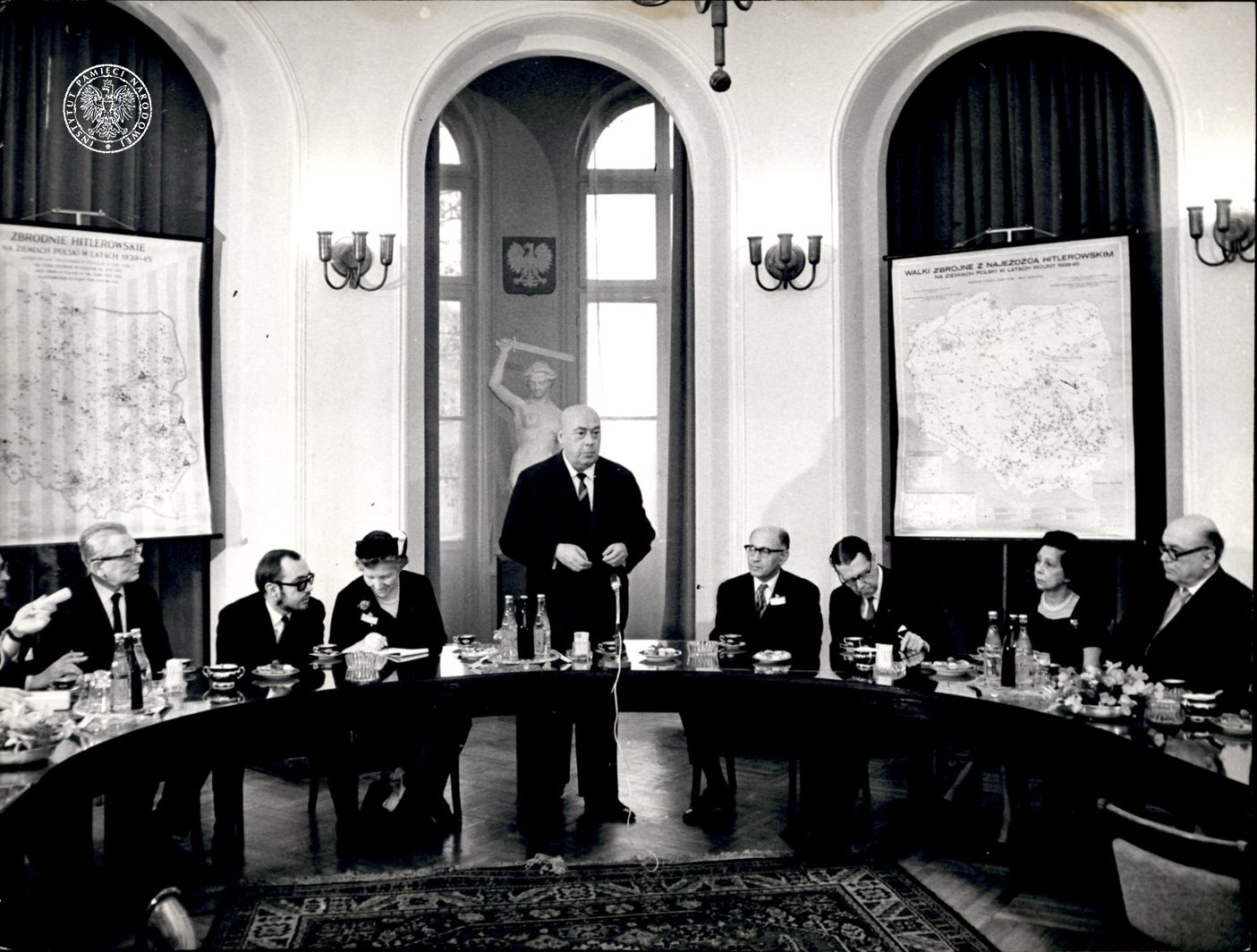
Józef Cyrankiewicz, chairman of ZBOWiD, at the Reunion of Former Nuremberg Correspondents. From the Archives of the Institute of National Remembrance
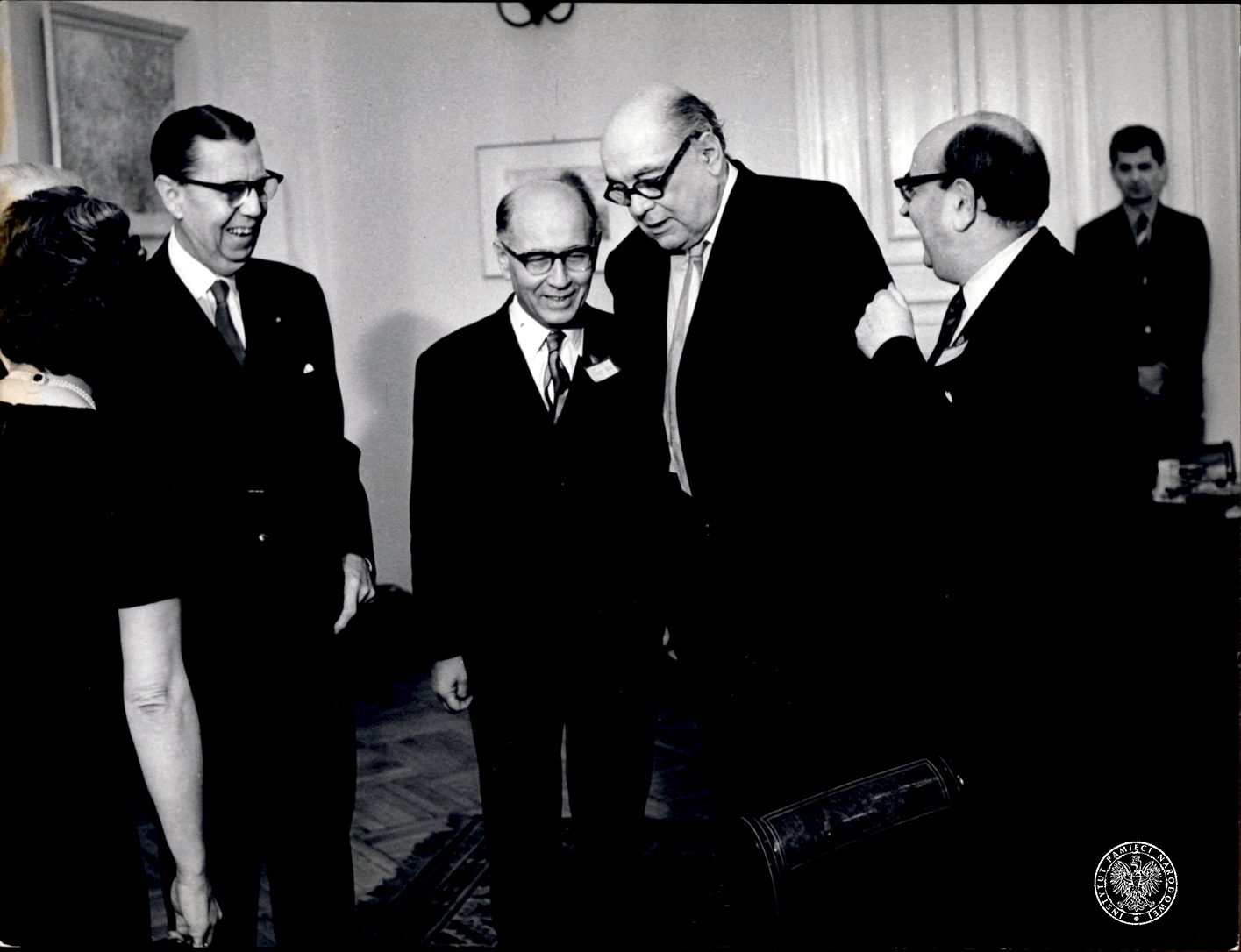
Participants of the Reunion of Former Nuremberg Correspondents ring a break in the proceedings. Photo from the Archives of the Institute of National Remembrance
The discussion in Jabłonna took place under the round table format and were accompanied by other events, including the sightseeing of Warsaw, Wrocław and Kraków and the concentration camp in Oświęcim, as well as seeing a theatre play and meeting with scientists and artists. The discussions were attended by Józef Cyrankiewicz who represented the leadership of the Society of Fighters for Freedom and Democracy. The meeting ended with an official statement emphasising the weight of the Nuremberg trial as well as the fact that it failed to meet all expectations. It also noted attempts at twisting historical truth, a threat to the security of Europe and the world and fuel for chauvinisms and nationalisms. It also stressed the need to cultivate international relations and exchange of views and experiences, so the horrors of the Second World War would never be repeated.
The reunion’s attendees proposed the initiative of establishing the International Centre for Nuremberg Information which would assist the Chief Commission for the Prosecution of Crimes against the Polish Nation on, among others, informing the international community on Nazi criminal wanted by Poland, educating the youth and publishing articles. Ultimately, the centre never came to be. There were also no further meetings of the former Nuremberg correspondents.
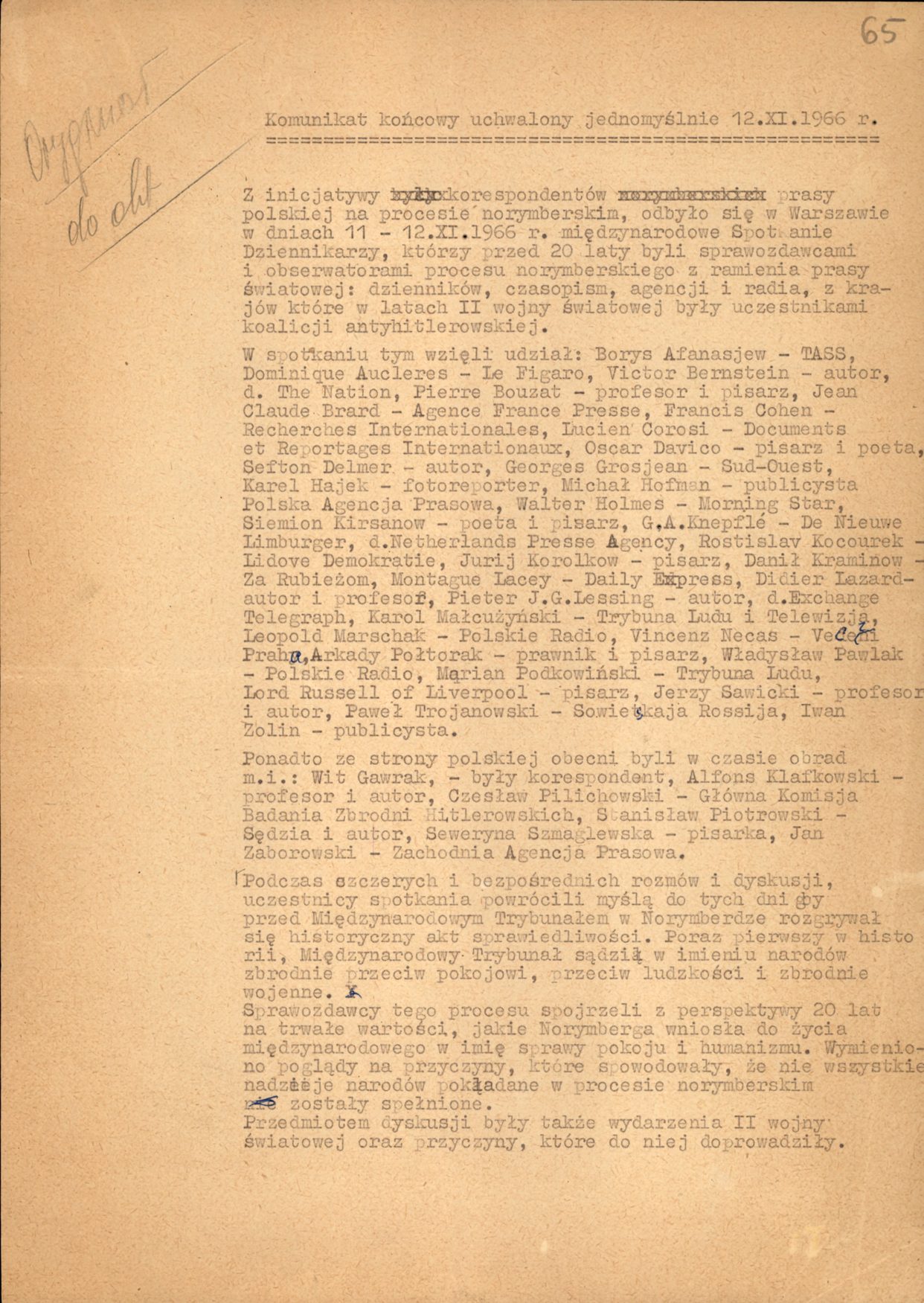
Final Communiqué of the Reunion of Former Nuremberg Correspondents, November 12, 1966. From the Archives of the Institute of National Remembrance
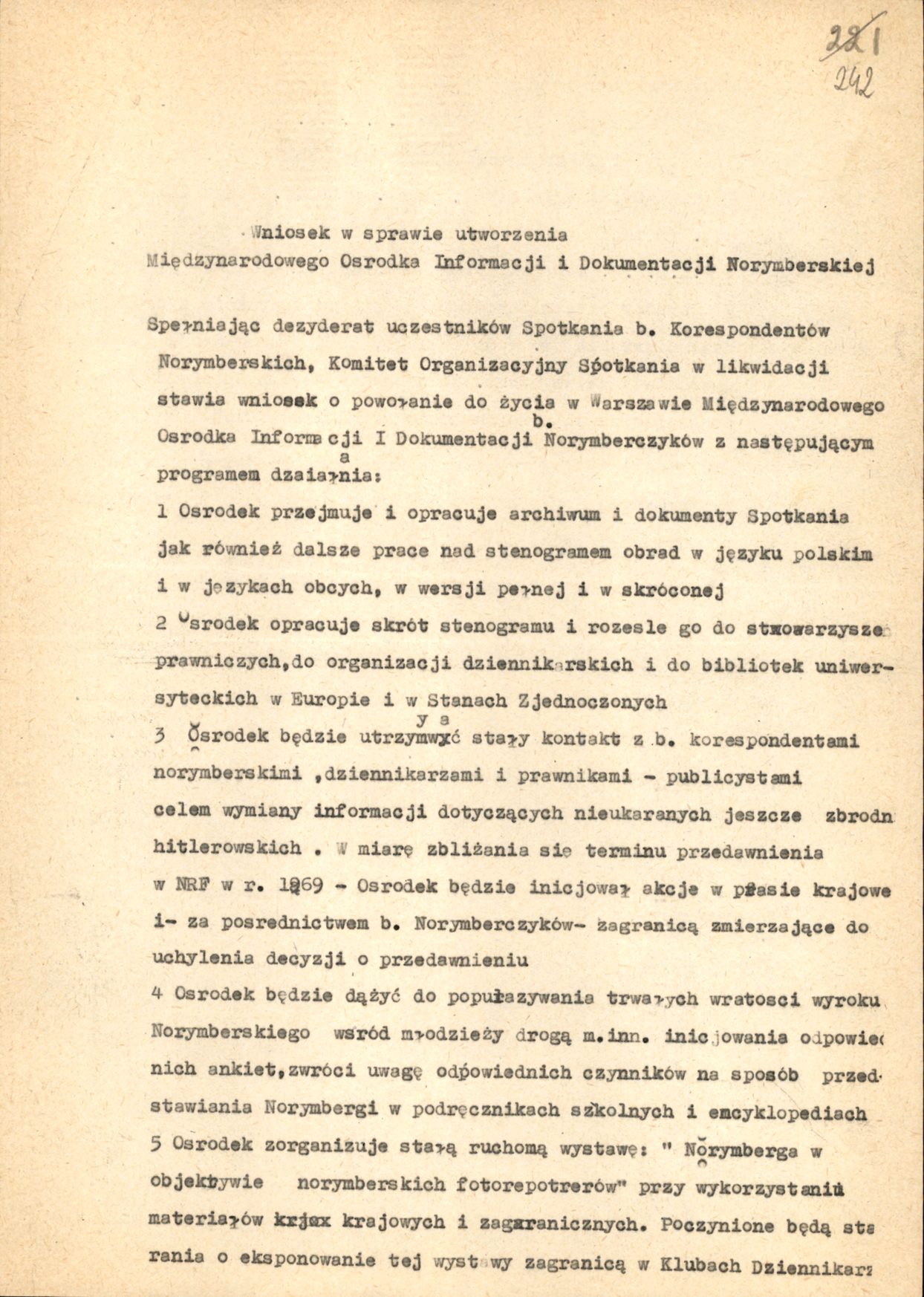
Motion to establish the International Nuremberg Information and Documentation Centre. From the Archives of the Institute of National Remembrance
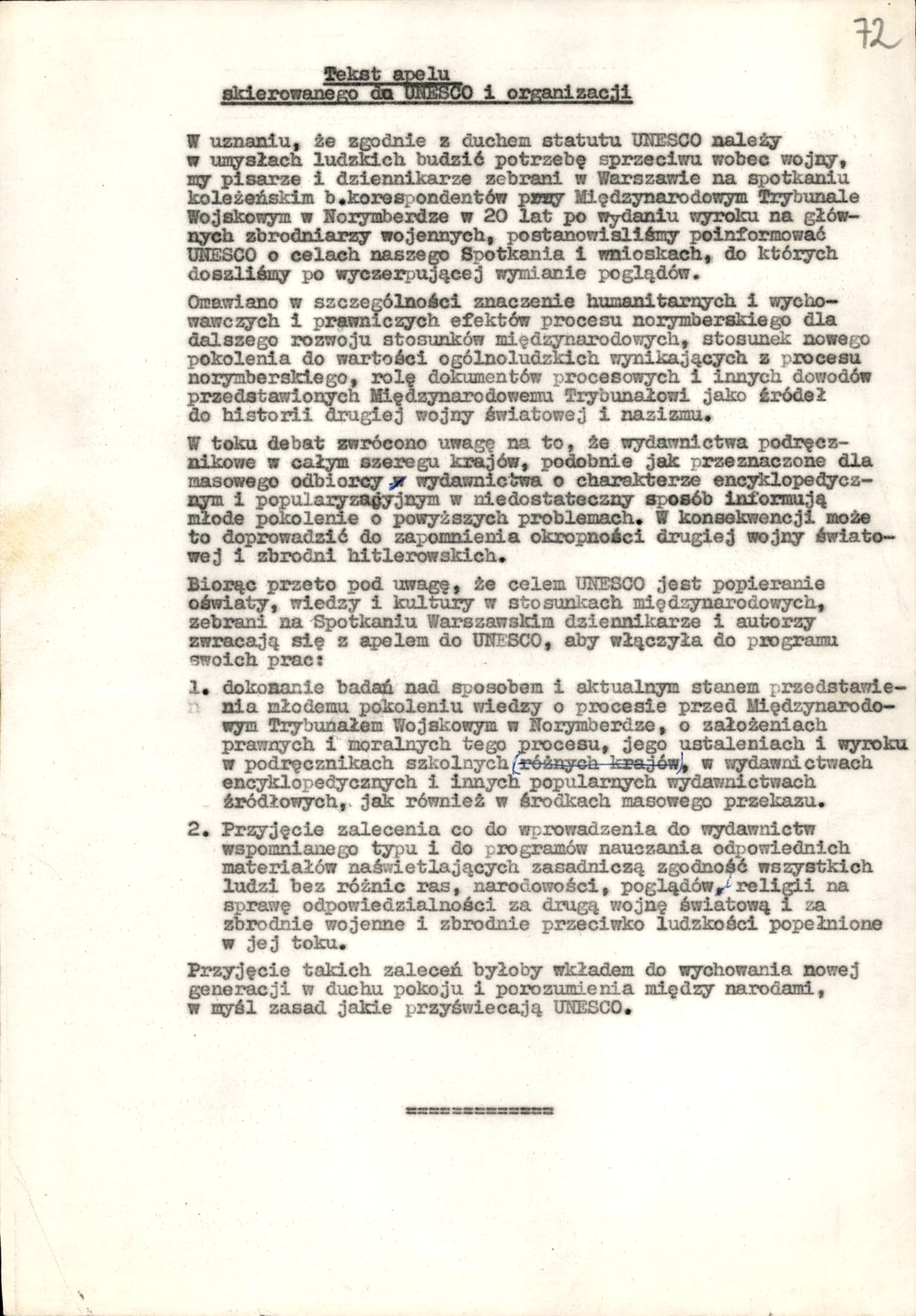
Appeal of the participants of the Reunion of Former Nuremberg Correspondents to UNESCO. From the Archives of the Institute of National Remembrance