
The communist propaganda in Poland very gladly exploited the subject of the German occupiers’ brutality during the Second World War. It was meant to cover up the crimes of the Soviet regime, but also solidify the image of the Red Army in Europe as the liberators of Central Eastern Europe. Therefore, the communists eagerly supported aid initiatives for the victims of Nazi repression, including former concentration camp prisoners.
However, some aspects of Sue Ryder’s charity work for Poles and in Poland, as she was tightly connected with the country, caused so much concern for the communist security services that they kept her under extensive surveillance for more than a dozen years (1959-1974).
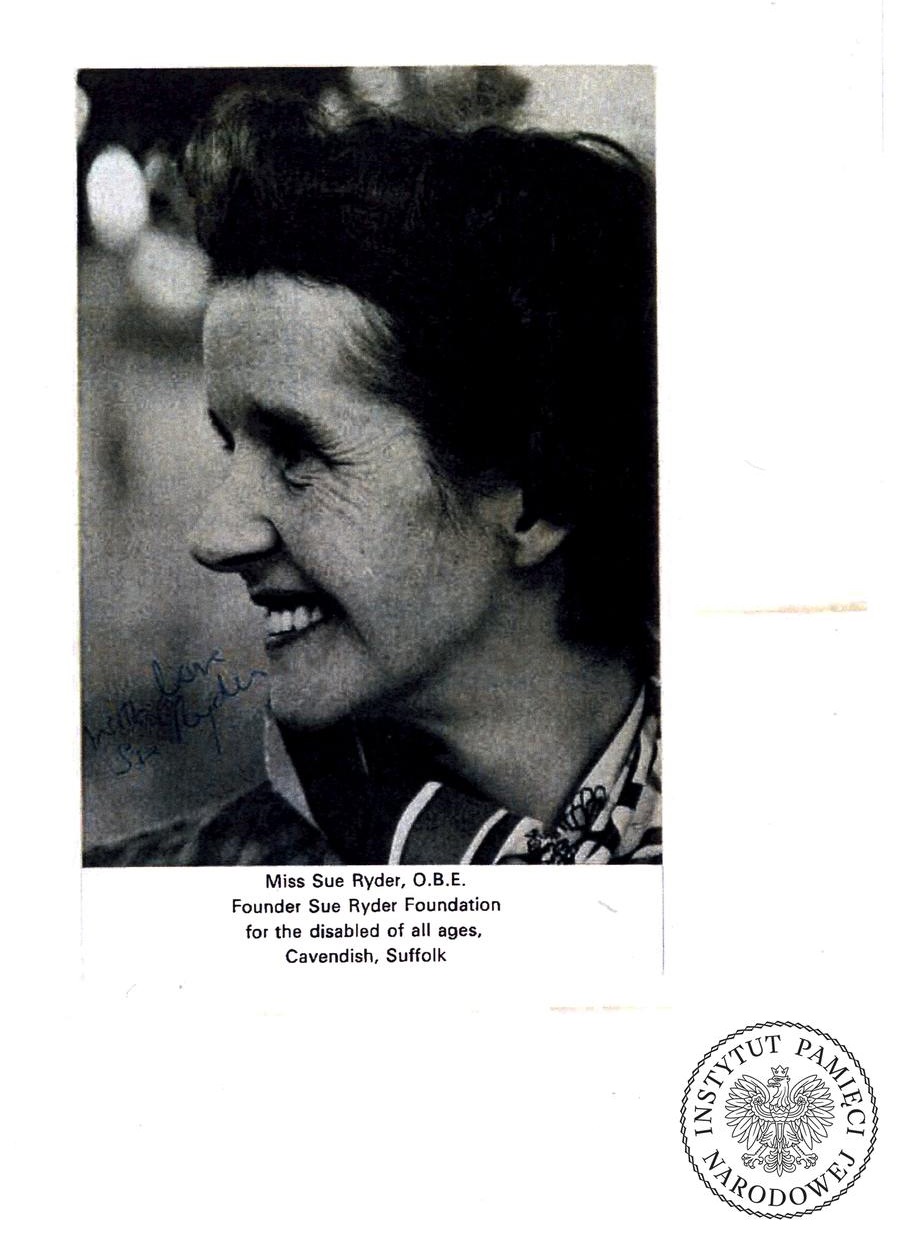
Sue Ryder, photo from a publication concerning the stay of 26 former concentration camp prisoners in England in July 1979, (photo from the Archives of the Institute of National Remembrance)
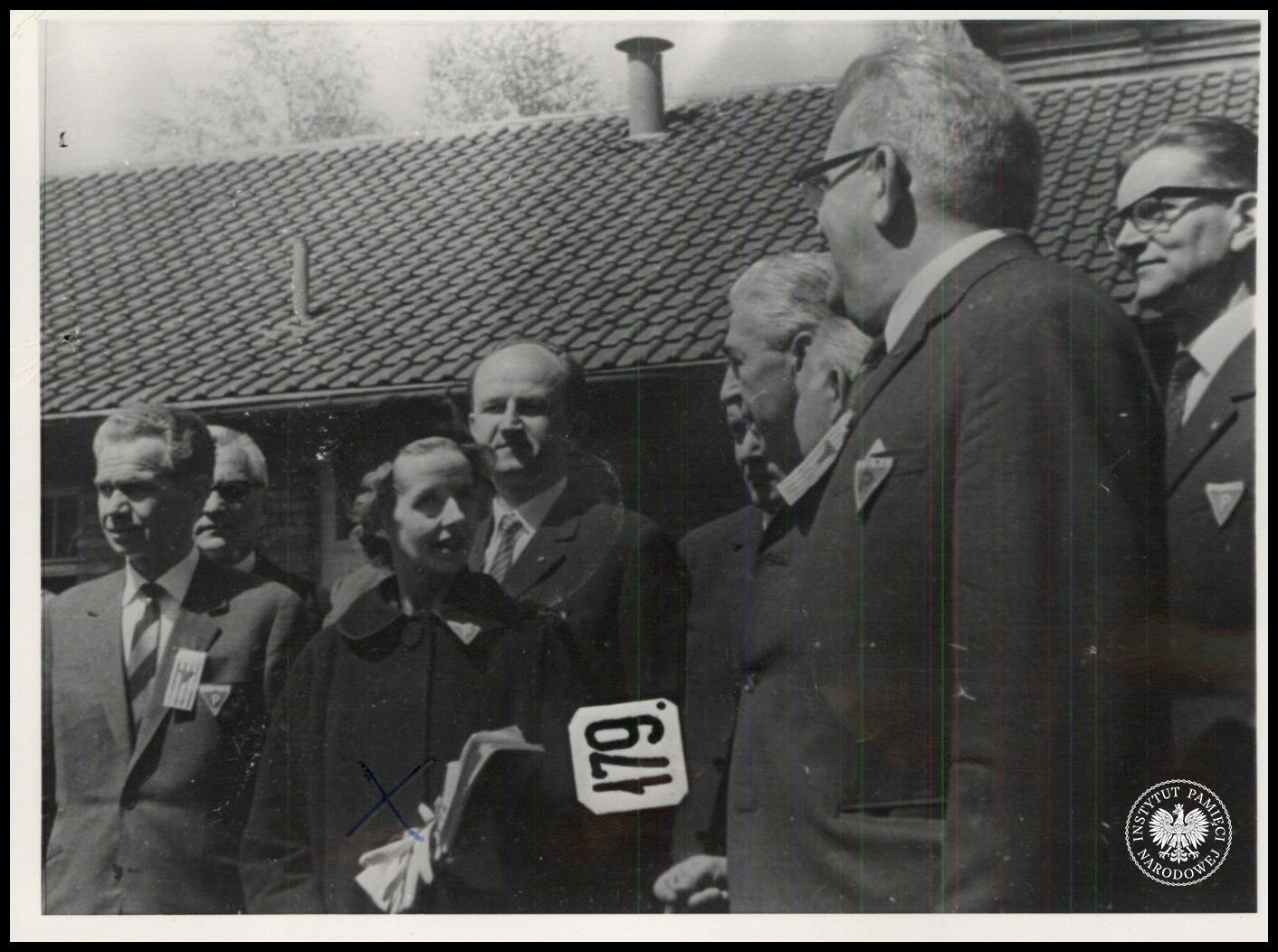
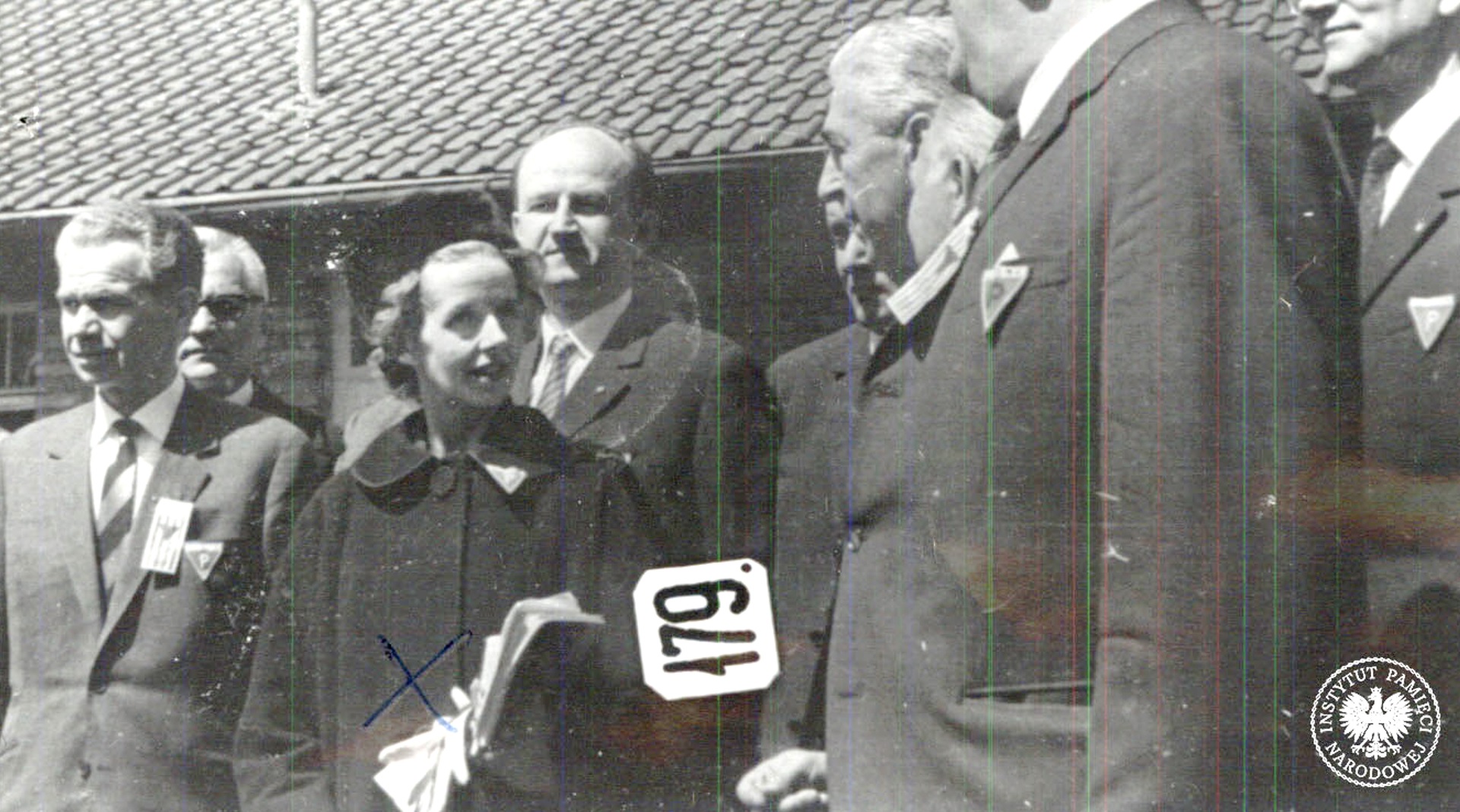
Operational photo most likely taken during Sue Ryder’s stay in Poland. She is marked with a cross. (photo from the Archives of the Institute of National Remembrance)
One-woman institution
In 1959, when Sue Ryder was already internationally recognised, the communist Security Service in Poland received information “from the Soviet and German comrades” (meaning from the sister services in the Eastern Bloc) of the alleged recruitment of Sue Ryder by the British intelligence, operating against the USRR. As a result, in 1959, they opened up the first and shortly after second operational files against her, and put her under intense surveillance.
![Report: application for permission to initiate an investigation into Sue Ryder (first of 49 [!] pages of the document). Warsaw, May 9, 1959, (photo from the Archives of the Institute of National Remembrance)](/dokumenty/zalaczniki/166/166-202600.jpg)
Report: application for permission to initiate an investigation into Sue Ryder (first of 49 [!] pages of the document). Warsaw, May 9, 1959, (photo from the Archives of the Institute of National Remembrance)
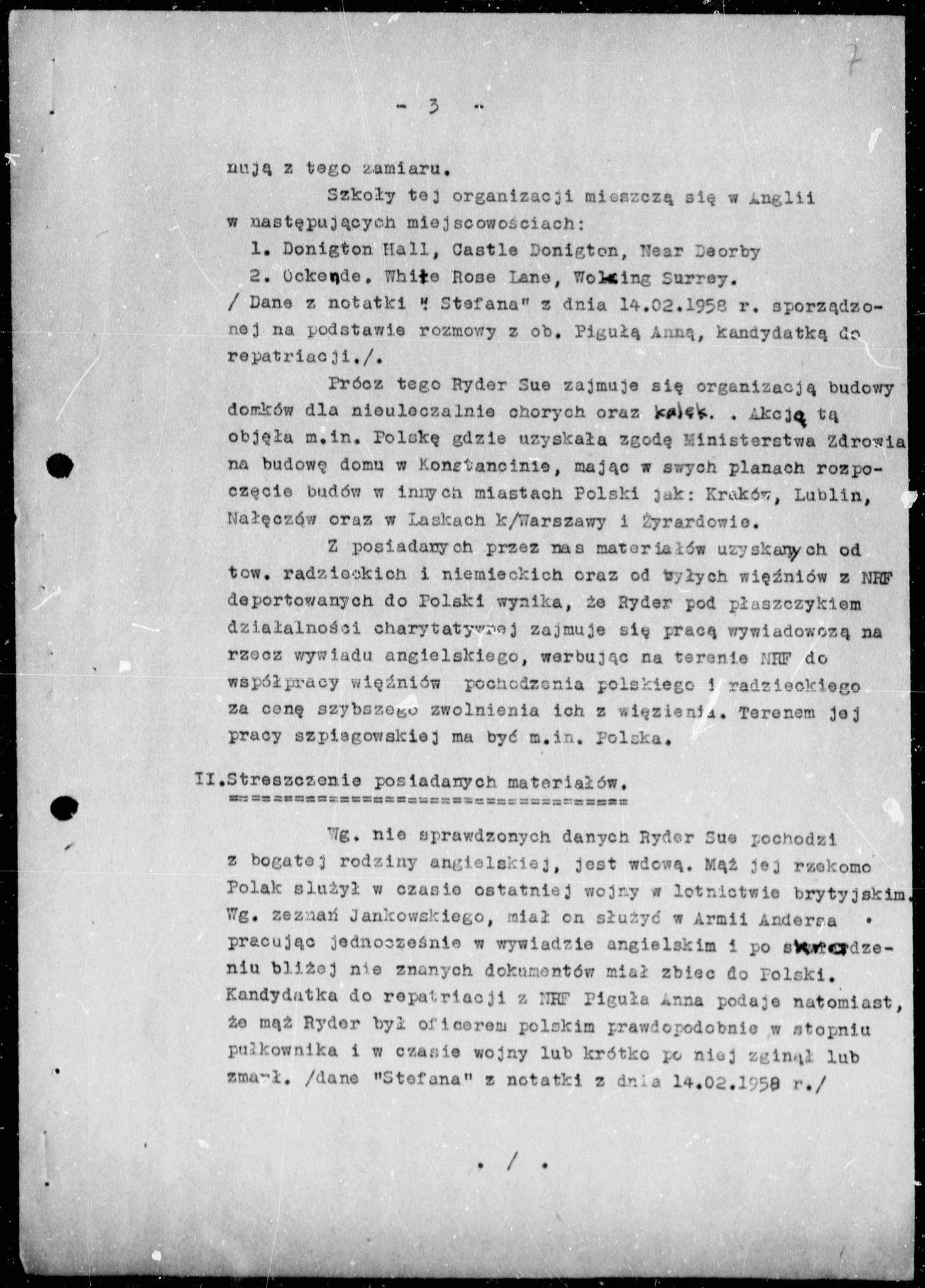
Report: application for permission to initiate an investigation into Sue Ryder (third page). The document includes, among other things, a reference to “materials obtained from Soviet and German comrades,” according to which “Ryder, under the guise of charity, engages in intelligence work.” Warsaw, May 9, 1959, (photo from the Archives of the Institute of National Remembrance)
In the 1960s, the secret services’ operations began expanding to bigger and bigger circles: the case files on Sue Ryder and her secretary Danuta Urbaniec under the codename “Filantropki” [“Philanthropists”], opened up in 1963, included seven thick volumes of documents.
“Filantropki” were surrounded by a wide network of agents. The communists eagerly dug for information on their families, the former prisoners leaving to England for the Sue Ryder Foundation rehabilitation tours, the employees and subcontractors hired by her for various activities as well as on the Foundation’s initiatives. Sue Ryder’s every trip to Poland was under close surveillance: from the initial signs pointing to a planned expedition, through the moment of crossing the border and finally to every stage of the visit, including meetings, conversations, night stays etc.
The numerous operational reports on Sue Ryder, even from those who wished her ill, paint her as a one-woman institution, a person of inexhaustible energy, outstanding memory, intelligence and ability to manage countless matters, as well as someone with a great ease of making new contacts and efficiently using them, and a person completely devoted to her charity work. The thing that bothered some about her was her faith and setting very high standards for her coworkers. Sue Ryder, living a modest life herself (the documents mention her relentless work for many hours without a break, minimal needs in terms of food, comfort of travel or sleep), expected the same from others.
![Report: motion to establish an operational surveillance case codenamed “Filantropki” concerning Sue Ryder and her secretary Danuta Urbaniec (front page). Warsaw, February 2[?], 1963 (photo from the Archives of the Institute of National Remembrance)](/dokumenty/zalaczniki/166/166-202606.jpg)
Report: motion to establish an operational surveillance case codenamed “Filantropki” concerning Sue Ryder and her secretary Danuta Urbaniec (front page). Warsaw, February 2[?], 1963 (photo from the Archives of the Institute of National Remembrance)
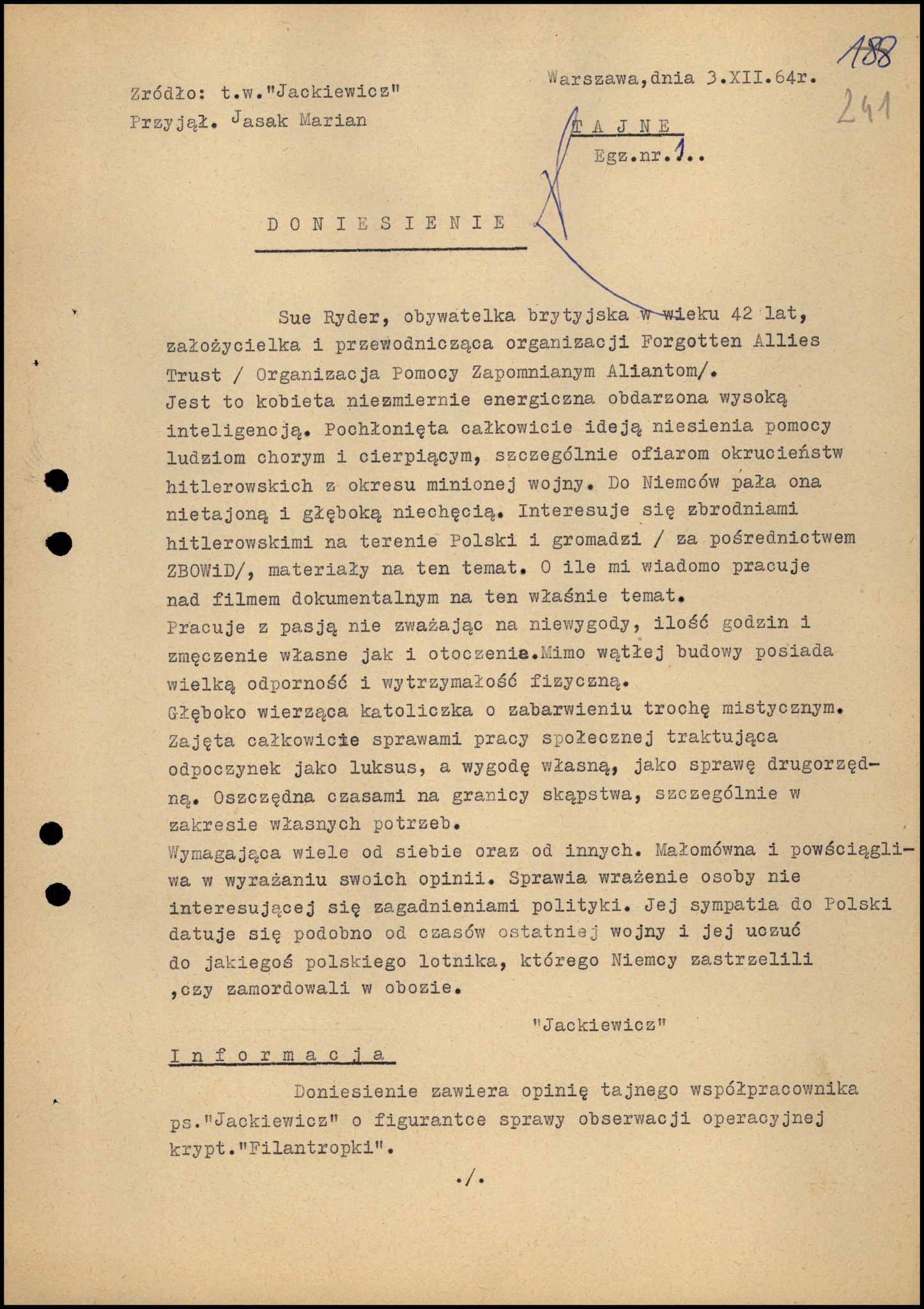
An agent's report by a secret collaborator codename “Jackiewicz,” containing a description of Sue Ryder. Warsaw, December 3, 1964. The first part says: “it’s a woman of great energy and high intelligence. She is completely focused on her mission of bringing aid to the ill and suffering, especially the victims of the Nazi terror.” (photo from the Archives of the Institute of National Remembrance)
Window to the world. A threat for the communists
In 1966, the communists set up a separate operation under the codename “Kontakty” [“Contacts”] on people leaving to England at the private invitation of Sue Ryder, without the involvement of the Society of Fighters for Freedom and Democracy (ZBoWiD), which allowed the authorities to have more oversight over the case.
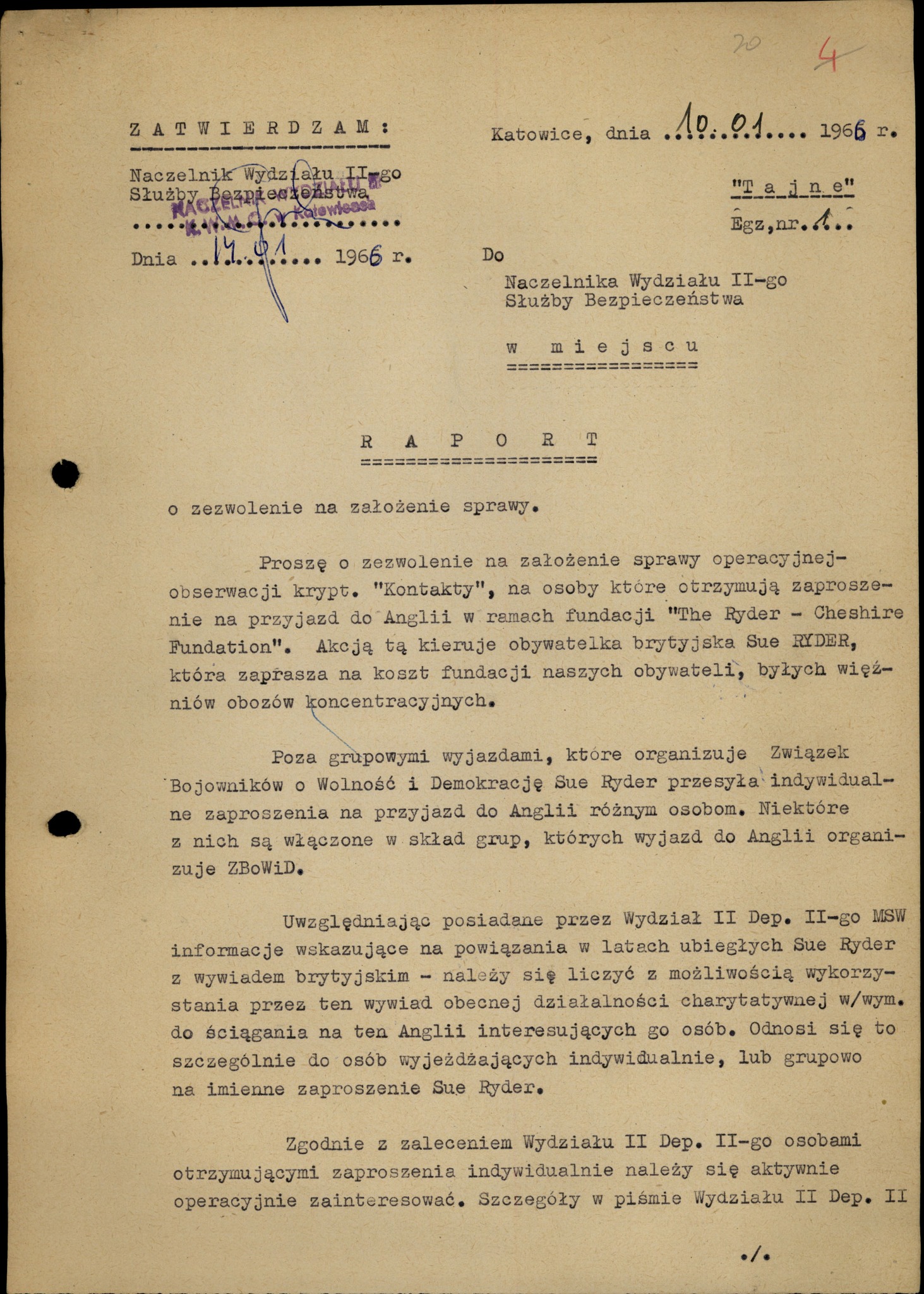
Report: motion to establish an operational surveillance case, codenamed “Contacts,” concerning former concentration camp prisoners who came to England at the invitation of Sue Ryder (front page). Katowice, January 10, 1966 (photo from the Archives of the Institute of National Remembrance)
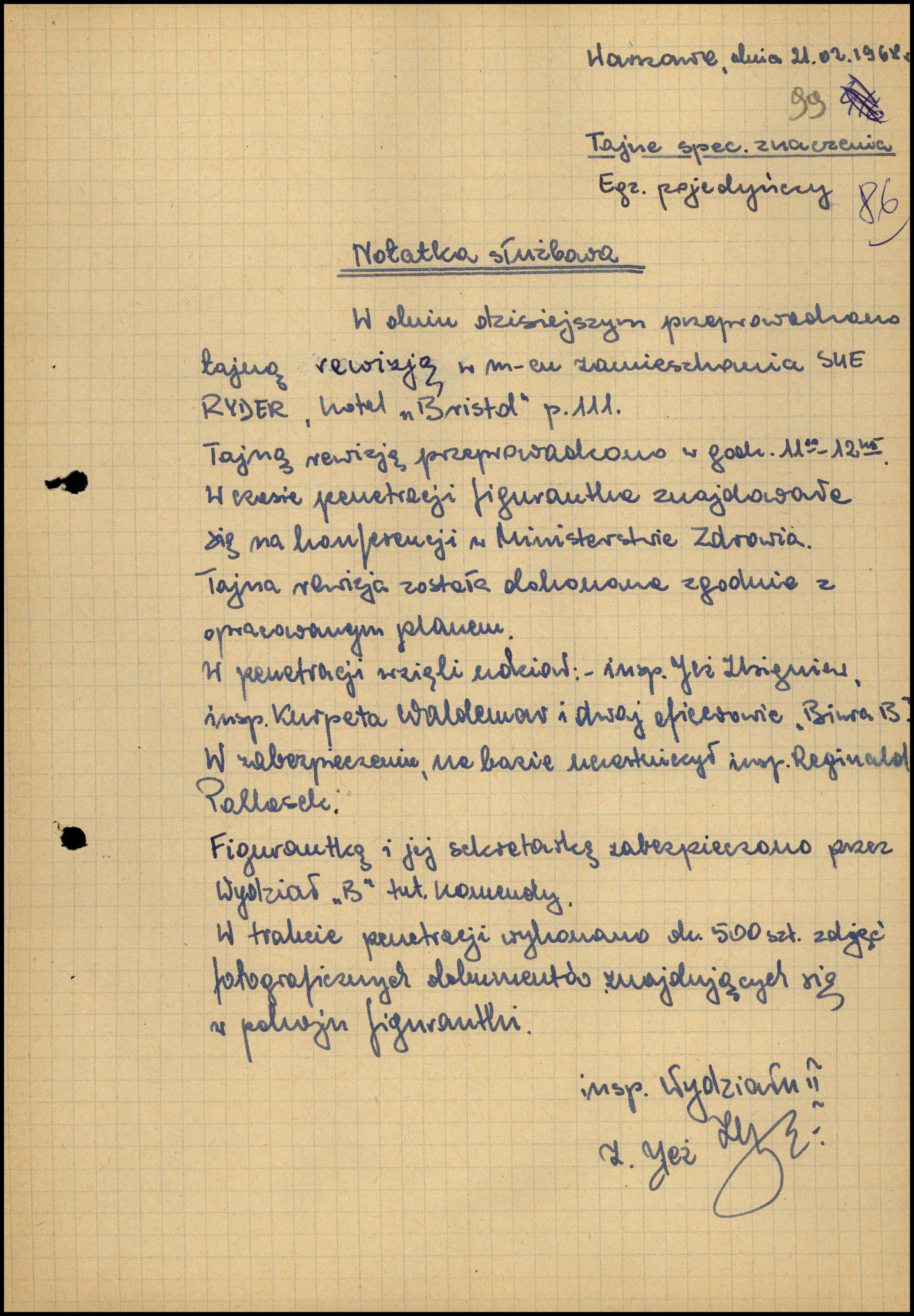
A memo regarding a secret search conducted in Sue Ryder's room at the Bristol Hotel in Warsaw. The document states, among other things, that approximately 500(!) photographs were taken of documents found in the room. Warsaw, February 21, 1968 (photo from the Archives of the Institute of National Remembrance)
An extensive document from March 1972 shows exactly why the communist security services so stubbornly looked for any threats in Sue Ryder’s charity work, especially when it came to the trips to Great Britain she organised for the former prisoners. One secret collaborator, writing about the employees of the Warsaw office of the Sue Ryder Foundation, pointed out that: “many of these people are deeply dissatisfied, or even hateful, towards the current reality”, since a large number of them “used to be part of the resistance during the war (Home Army, National Armed Forces), and apart from concentration camps spent some time in prison after the war (1949-1955).” Because of the repressions they suffered during Stalinist times, “they could carry with them the memory of wrongdoings and a desire for vengeance,” which meant a hostile attitude towards the USSR and a reason for supporting anti-communist intelligence.
That same secret collaborator also wrote about the guests invited by the Sue Ryder Foundation, “for whom it was often the first trip abroad for rest,” and thus “after experiencing the excellent conditions of the Foundation house […] could involuntarily become informers […] and then used as tools for anti-Polish activities” (meaning anti-communist).
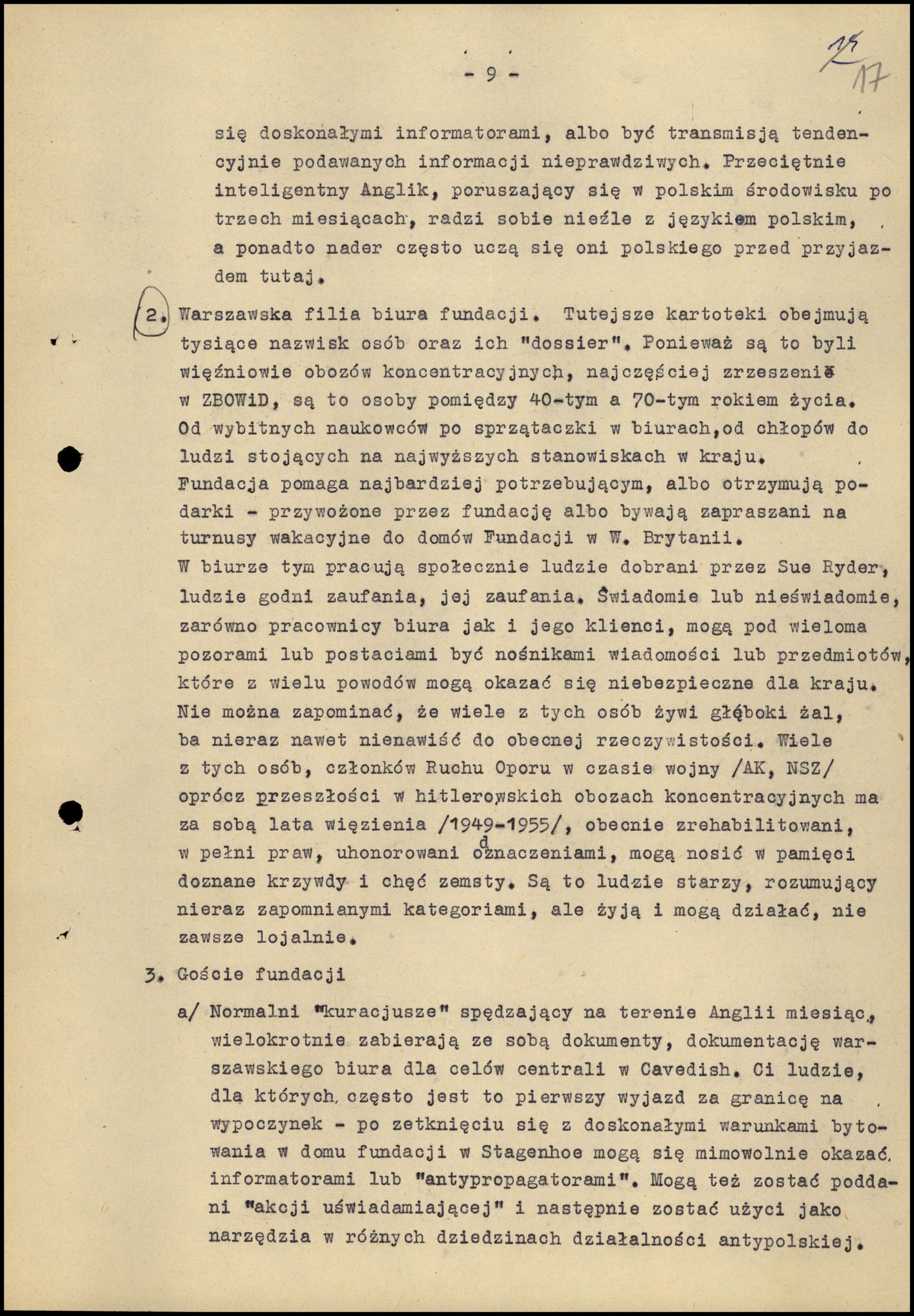
Note from a secret collaborator regarding the Sue Ryder Foundation (page nine). This page of the document characterises the Foundation's Polish employees and guests as potentially dangerous groups from the perspective of the interests of the Polish People's Republic. Warsaw, March 22, 1972 (photo from the Archives of the Institute of National Remembrance)
* * *
Despite the extensive efforts to connect Sue Ryder’s activities with the British intelligence, the communists couldn’t prove anything for a few dozen years. Until her passing in the year 2000, she relentlessly continued her charity work in many countries of the world, including Poland.