
Following years of discussions, public disputes and clashes with the Tsarist officials, the project prepared by Wacław Szymanowski (the statue) and Franciszek Mączyński (the architectural design) was underway. However, the works had to be suspended after the outbreak of the First World War.
After Poland regained independence, the concept of raising the monument resurfaced. The Fryderyk Chopin Monument was unveiled in Warsaw’s Łazienki Park on November 14, 1926.
Under the sword of Damocles
The monument survived the September Campaign unscathed. But since General Governor Hans Frank chose the Belvedere Palace as his residence, the neighbouring Łazienki Park was closed by the German authorities and the residents of Warsaw lost access to the statue.
The sixteen-ton, bronze monument was blown up and then cut into smaller pieces and transported to the smelting plants in the Third Reich.
In April 1940, Hans Frank issued a public order calling for the collection of metals on the territory of the General Government to satisfy the needs of the German army. Chopin Monument became one of the first victims of this order.
Before the city authorities had a chance to react, Hans Frank ordered to have the monument destroyed, calling it ugly and saying it ruined Łazienki’s scenery.
Eradicating culture
On May 31, 1940, the sixteen-ton, bronze monument was blown up and then cut into smaller pieces and transported to the smelting plants in the Third Reich. In Łowicz, where the train stopped, a random bystander took photographs of the rail platform where, among others, lied the monument’s head.
After the war, it was obvious that the monument had to be rebuilt in its original form. The biggest problem was the lack of the original model.
The fact that the monument’s destruction occurred not only due to aesthetic reasons is best exemplified by the Germans also destroying its copies and all documentation related to it in Polish museums.
It’s worth adding that the April order by Hans Frank was the signal for a coordinated campaign of destruction of monuments across the General Government and for the beginning of the next stage of eradicating Polish culture. In the end of 1940, the occupation authorities sent a letter to the Warsaw City Hall with the order of removing other Warsaw monuments, including those of Adam Mickiewicz and prince Józef Poniatowski, and scrapping them. Thanks to the enormous effort and often complicated manoeuvring by the Warsaw City Hall, almost all of them survived until the outbreak of the Warsaw Uprising.
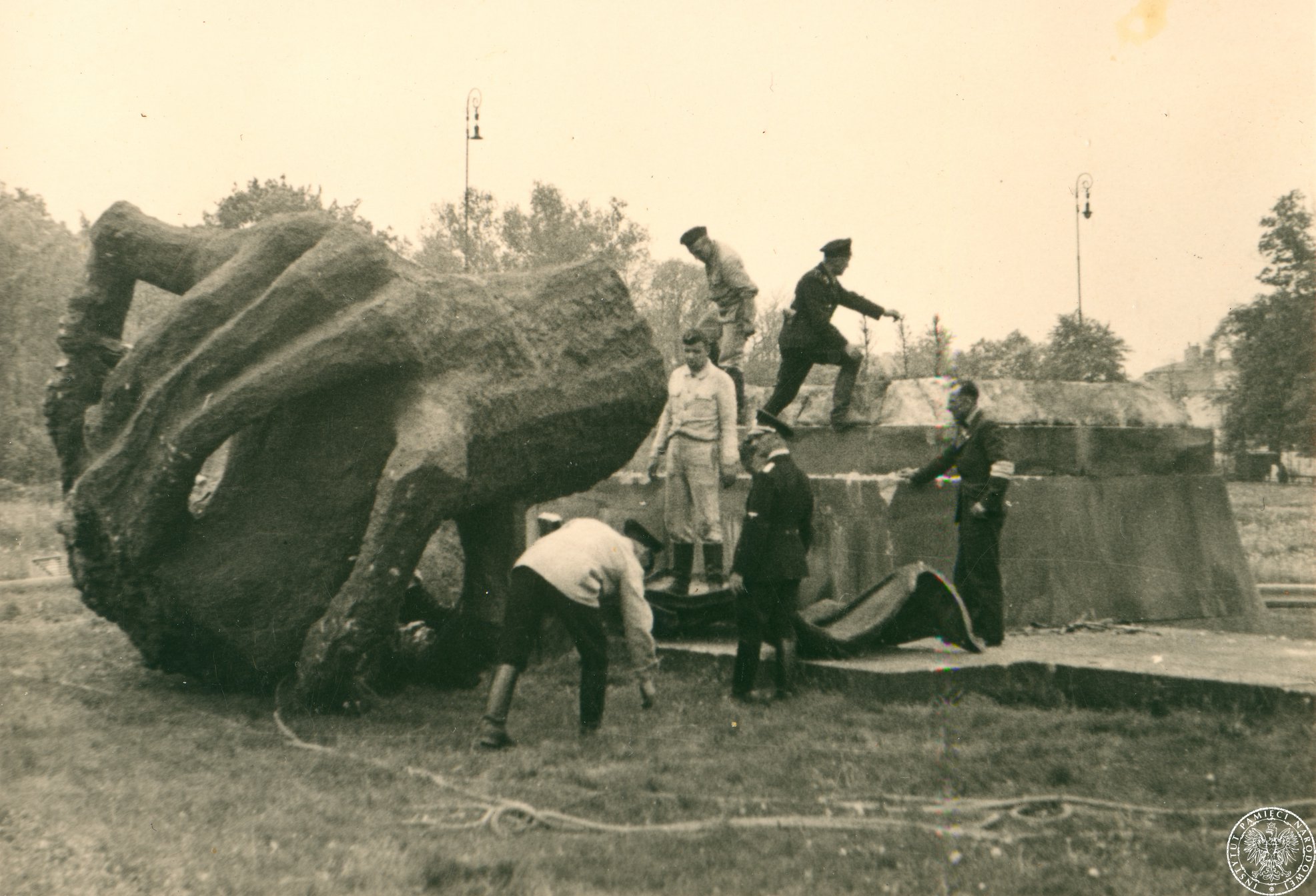
Fragment of the Chopin monument after it was blown up, May 31, 1940. Family archive Janusz Kaźmierczak (photo from the Archives of the Institute of National Remembrance)
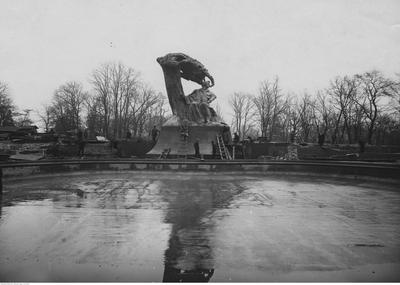
Fryderyk Chopin Monument in Łazienki Park. Finishing works, November 1926 (photo: National Digital Archives)
The challenge of reconstruction
After the war, it was obvious that the monument had to be rebuilt in its original form. The biggest problem was the lack of the original model. For several years, many great artists and architects conducted tedious reconstruction works. For example, architect Leon Suzin, based on the recovered miniatures, drawings and pre-war pictures, created the photogrammetry of the statue. This analysis later helped create a 1:1 model of the cast.
Finally, on May 11, 1958, the Fryderyk Chopin Monument was once again raised in Warsaw’s Łazienki Park.