
In Poland, the plaque of the new Office of State Protection hanged on the building of the former communist Security Service on Rakowiecka street as late as in May 1990. The officers of the new state service were recruited mostly from the ranks of the former Security Service, which was still under liquidation by the end of July that same year. It was in this crucial moment for Poland that the country started its intelligence sharing with western secret services.
Hungary and Czechoslovakia first in line
Hungary was the first former communist state to try and establish connection with the western secret services. It was the consequence of the talks in Budapest between U.S. President George Bush and Hungarian Prime Minister Miklós Németh in July 1989. Next, on the invitation of the Hungarian foreign ministry, the delegation of the Intelligence Comittee of the U.S. Senate led by Senator James Diestrik visited Hungary. The talks, which took place in November 1989, also included local CIA representative Donald Kursch, the Minister Plenipotentiary of the U.S. embassy in Budapest. It should be noted that the meetings were held at a high level with the participation of Foreign Minister Gyula Horn, head of military intelligence General Jeno Porasca, and head of the Main Directorate for Counterintelligence and Economic Protection Colonel Frenc Benko.
The official dinner at the U.S. Embassy in Budapest, held to celebrate the establishment of intelligence relations, was also attended by Prime Minister Miklós Németh, Interior Minister István Horváth, and numerous representatives of the Hungarian opposition. The talks included various topics such as the invigilation of U.S. diplomats in Hungary, the Soviet-Hungarian intelligence co-activities in the United States or the conditions for opening the Hungarian consulate in Los Angeles. Generally speaking, the Americans and Hungarians both demanded ceasing intelligence operations against each other, while any further talks were postponed due to the lack of specific directions and expectations of the Hungarian side.
In the following months, western countries revealed their officers responsible for the security of diplomatic missions, making them informal liaisons with the Hungarian secret services. The Americans and British were the first to do this, and then followed the French, Italians, West Germans, Israelis and even Japanese and South Koreans. But the cooperation took off for good only after establishing the National Security Bureau (Nemzetbiztonsági Hivatal) on March 1, 1990.
In February 1990, representatives of the U.S. State Department semi-officially signalled the possibility of decreasing the counterintelligence regime against the employees of the Polish missions in the United States but also the conditional creation of the Polish consulate in California and even lifting the international embargo on exports of strategic devices and technologies to Poland which would normally fall under international control concerning their potential transfer to the Soviets.
Things followed a similar course in Czechoslovakia. Here, the impulse were the visits of President Václav Havel to western countries, during which he suggested setting up relations with various western intelligence services. They were reflected in the official invitation to Washington for Czechoslovak Interior Minister Richard Sacher, who became the first representative of the Warsaw Pact countries to make an official visit to the CIA headquarters in Langley. Officially, the talks concerned international terrorism, drug trafficking and illegal trade and production of explosives. Unofficially, it was about ceasing hostile intelligence operations, recalling agents and assets or, if it wasn’t possible, at least ending their employment.
Apart from the CIA management, the talks were also attended by the FBI. The Czechoslovakian side received an offer of extensive support in both equipment and officer training, and an operational group of American servicemen was sent to Prague. It was especially crucial in the context of the changes taking place in Czechoslovakia under the process of democratic transformation. On January 12, 1990, the decision was made to stop the activities of the local political police StB (Státní Bezpiečnost), which was liquidated already on January 31. The officers had only two weeks to hand in their guns, badges and service documents (although many files were destroyed similarly to Poland in a rampant process of eradicating evidence). In public, Czechoslovakia is described as the model example of the “zero” option, where there was no place for the former StB officers in the ranks of the new secret services. Reality, however, was vastly different from the political declarations. The British, Israeli and the French also quickly joined the support of the Czechs and Slovaks.
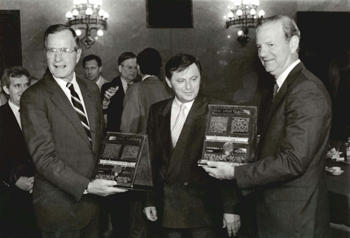
U.S. President George H. W. Bush, Prime Minister of the Hungarian People's Republic Miklós Németh, and U.S. Secretary of State James Baker (photo: Wikipedia/public domain/official White House Photograph — U.S. Diplomacy Center)
Poles were the last?
From the Americans’ perspective, the nation with the most puzzling approach were Poles. While the south-eastern part of Europe seemed to be rooted the most in cooperation with the USSR, with Bulgaria and Romania as prime examples, and Yugoslavia was entwined in an internal ethnic conflict, Poland showed no signals of political eagerness to start cooperating in terms of secret services. Only at the end of 1989, Brigade General Roman Misztal, who was then in charge of the Board of the Second General Staff of the People’s Polish Army, meaning the military intelligence of the Polish People’s Republic, went on an official visit to the Pentagon. He met with his American counterpart Lieutenant General Henry E. Soyster, the head of the Defense Intelligence Agency (DIA) and the heads of other U.S. military intelligence structures. It was, however, only the smaller cousin of the communist Security Service which was the main attraction for the Americans.
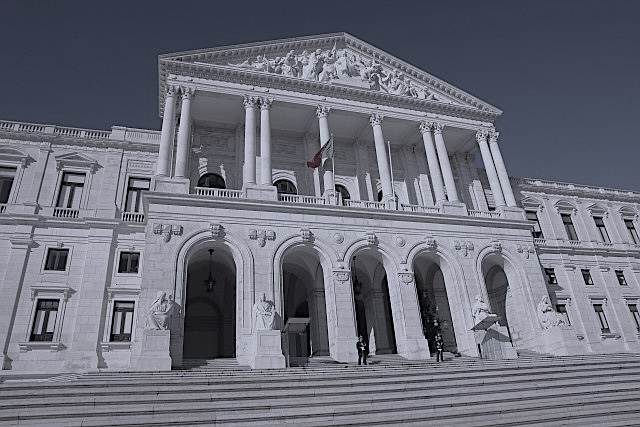
A true breakthrough came on March 1, 1990, when an American with Polish roots, John Edward Palevich, came to the reception of the Polish embassy in Lisbon and asked to see the embassy councilman Ryszard Tomaszewski.
From the files of the Security Service, it’s clear the Americans had the initiative. In February 1990, representatives of the U.S. State Department semi-officially signalled the possibility of decreasing the counterintelligence regime against the employees of the Polish missions in the United States but also the conditional creation of the Polish consulate in California and even lifting the international embargo on exports of strategic devices and technologies to Poland which would normally fall under international control concerning their potential transfer to the Soviets. The price for these concessions was to be the limiting of intelligence cooperation between Poland and the USSR, but also the cessation of Polish clandestine activities in the U.S.
Several U.S. administration officials formulated this stance in the presence of employees of the First Department of the Interior Ministry who were posing as diplomats in Washington. This was not by accident. Through the head of the Intelligence and Counterintelligence Service of the Ministry of Interior, General Zdzisław Sarewicz, the information was passed to the most important politicians of the transformation period: Wojciech Jaruzelski, Czesław Kiszczak, Florian Siwicki, Tadeusz Mazowiecki, Leszek Balcerowicz, Bronisław Geremek and Krzysztof Skubiszewski.
American offer of meeting
A true breakthrough came on March 1, 1990, when an American with Polish roots, John Edward Palevich, came to the reception of the Polish embassy in Lisbon and asked to see the embassy councilman Ryszard Tomaszewski. For clarity, it’s worth noting that he demanded to see the head of the mission in the rank of Security Service colonel, working on a secret contract of the First Department of the Interior Ministry under diplomatic cover and using the nickname Altan. Palevich showed his diplomatic passport and asked to speak in private.
The information from Portugal caused quite a stir in Poland. Just three hours later, Tomaszewski reported on his conversation and the Americans’ demands with an encrypted telegram, at the same time suggesting it was a CIA provocation.
In the room next to the reception, he revealed he was an officer of the CIA. The atmosphere immediately shifted and both men got extremely tense. It looked like Palevich was trying to recruit Tomaszewski.
The CIA agent broke the uncomfortable silence and openly said he wanted to give a message to Warsaw. He said the Agency was waiting to establish a working contact with the First Department to:
“Cooperate and keep the balance in Europe in the context of transformation taking place in the Warsaw Pact countries as well as the impending unification of Germany.”
This message was addressed directly to the Interior Minister Czesław Kiszczak, head of the Intelligence and Counterintelligence Service, Zdzisław Sarewicz, and director of the First Department of the Ministry of Interior, Henryk Jasik. Palevich also said that the intelligence officer in Lisbon had deliberately chosen a confidential channel after analysing other options. Similar initiatives were considered at diplomatic missions in Washington, London, Paris, and Cologne, among others. Ultimately, Tomaszewski and Lisbon were chosen, where the local counterintelligence regime was weakest and “you could do whatever you wanted.” The Polish authorities themselves would also be less likely suspecting a provocation. As Tomaszewski tried to weasel himself out of it and insisted he had nothing to do with the intelligence service, the CIA agent gave him the exact details of his service as a spy. To bolster his credibility, he provided a photocopy of his passport.
The information from Portugal caused quite a stir in Poland. Just three hours later, Tomaszewski reported on his conversation and the Americans’ demands with an encrypted telegram, at the same time suggesting it was a CIA provocation. He believed the approach in the Polish embassy in Lisbon to be part of a wider reconnaissance operation aimed at establishing the structures and staff of the First Department. A report on this matter, prepared by Henryk Jasik, director of the First Department, quickly reached the desk of Czesław Kiszczak, the Interior Minister. After a conversation with Zdzisław Sarewicz, head of the Intelligence and Counterintelligence Service, he commissioned the preparation of:
“A report on why the contact was initiated.”
Two options were put on the table. The first involved a meeting in Lisbon and relocating the talks to Switzerland or Austria. There, the Security Service felt more comfortable, had greater opportunities for field operations and operational security for the talks. The second option involved continuing the Lisbon talks in Washington. Ultimately, Kiszczak approved the first solution, but made a significant change in his memo. In the bracket with the telephone approval from Warsaw, he handwritten his name. This was a clear signal to his subordinate officers that they were to inform the Americans that their boss was personally behind the decision.
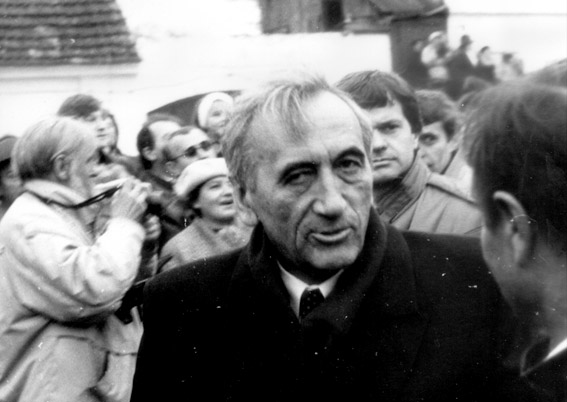
Tadeusz Mazowiecki (photo: Wikipedia/CC BY-SA 2.0/Artur Klose)
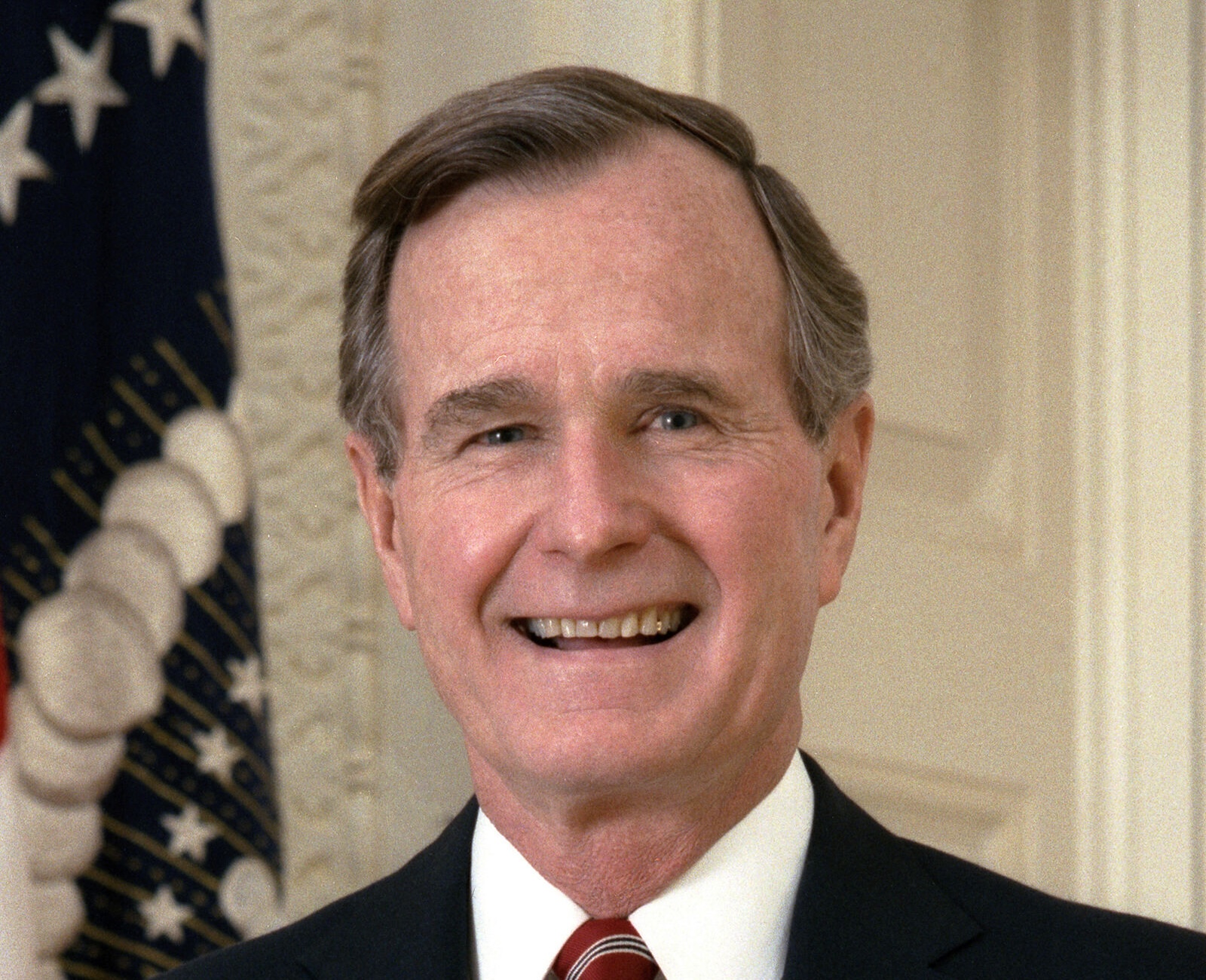
George H.W. Bush (photo: Wikipedia/public domain/David Valdez)
Things unfolded rapidly from there. As early as March 5, 1990, Ryszard Tomaszewski was ordered to contact the CIA by phone to organise a working meeting in Lisbon. Naturally, this took place through Palevich, who was given the codename Łącznik (Eng. Connection). At the same time, he was instructed to keep the matter secret. Following several phone conversations between Portugal and the United States, intelligence officers set a meeting for May 2, 1990, at the exclusive five-star Hotel Tivoli Lisboa. A few days later, on March 17, 1990, Tomaszewski was informed of Prime Minister Tadeusz Mazowiecki's approval of the operation, and the Security Service itself began documenting its progress within the Case File, codenamed Dialogue. At the same time, Altan was ordered in his talks with Connection to suggest to the Americans that the intelligence issues should not be discussed during Mazowiecki's official meeting with the head of the CIA, William H. Webster, in Washington (scheduled for March 26, 1990), and that it should be left to the discretion of the Security Service officers conducting talks at a working level.
Two experienced Security Service officers traveled from Poland to the Lisbon meeting: Colonel Bronisław Zych, deputy director of the First Department of the Interior Ministry, and Major Krzysztof Smoleński, deputy head of the Second Branch (American) of the First Deparment.
There was a deliberate attempt to push the Prime Minister's conversation toward the general principles of relations between the Polish and U.S. intelligence agencies, and the Interior Minister attempted to control the increasingly dynamic situation until the very end. At the same time, this was a response to earlier questions from the American side about the status of the Lisbon talks and, perhaps, to probe whether Kiszczak, who identified himself as the party for the contacts with the CIA, had informed the rest of the Polish government about them.
Two experienced Security Service officers traveled from Poland to the Lisbon meeting: Colonel Bronisław Zych, deputy director of the First Department of the Interior Ministry, and Major Krzysztof Smoleński, deputy head of the Second Branch (American) of the First Deparment. Tomaszewski, as the local intelligence resident, joined the Polish delegation. The Americans were represented by Paul Redmond, deputy director of the Operations Office for the USSR and Eastern Europe, Friderick Turco, director of the Counterterrorism Center, and, of course, John Palevich, head of the CIA's Polish Division.
Representatives of the intelligence services met in the lobby of a large apartment rented by the Americans, who naturally became the hosts. They also proposed a course of action focused on three topics: the threat of international terrorism, the establishment of a Foreign Broadcast Information Service (FBIS) office in Warsaw, and agreeing on the date, location, and format of future contacts. The Americans then provided valuable studies on terrorist threats from extremist groups and the countries supporting them, particularly Iran, Iraq, Libya, Syria, and Lebanon. All of this took place amid real fears of attacks following the Polish government's declaration in late March 1990 of support for the air transit of Jews emigrating to Israel from the Soviet Union, later implemented as Operation Bridge. The Jewish emigration sparked protests from the Arab population. There was even an automatic rifle attack on the Polish trade attaché at the Polish Embassy in Lebanon, which seriously injured two people. In Poland, the American materials on terrorism were considered highly valuable.
The Americans then provided valuable studies on terrorist threats from extremist groups and the countries supporting them, particularly Iran, Iraq, Libya, Syria, and Lebanon.
When it came to the establishment of an FBIS office in Warsaw, the general provisions were discussed. It would be an official and public CIA structure collecting and processing information needed by American decision-makers, businesses, and individuals regarding current politics, the economy, as well as crime and security issues. All of this was based on open sources from television, radio, and the press. The Americans made an informal offer to open such an office in Warsaw. The plan was to employ 35 staff members, including as many as 30 Poles. The official offer was to be made only if confidential talks were successful. The Security Service officers found it very attractive, especially considering that it was to be one of 30 such offices worldwide, with Warsaw specifically dedicated to Central Eastern Europe.
A report from the Lisbon meeting, annotated by Czesław Kiszczak, was submitted on May 14th to Deputy Minister Krzysztof Kozłowski, head of the newly established Office of State Protection. It was him who was put in charge of organising the next meeting between representatives of Polish and American intelligence services. This time it was to take place in Warsaw, which was approved by Prime Minister Tadeusz Mazowiecki and President George Bush. The path to intelligence cooperation between the two countries was opened.