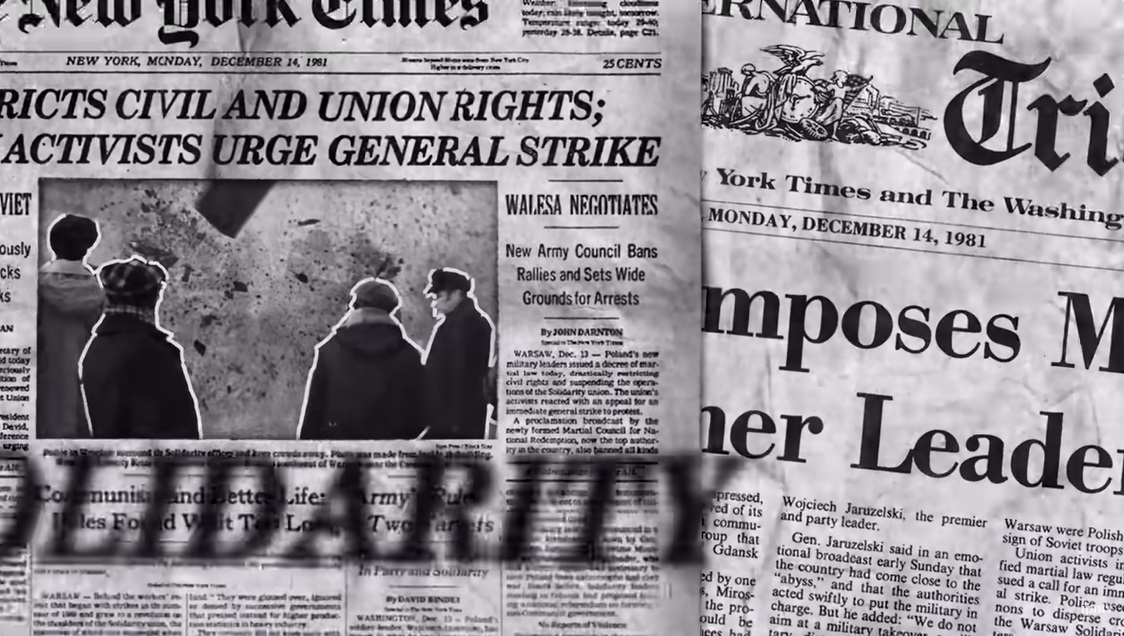

The United States imposed economic sanctions on the Polish People’s Republic and then the USSR. As a response to the introduction of martial law in communist Poland, Reagan’s administration declared January 30, 1982 the International Solidarity Day. Many places across the world saw demonstrations of support for the Polish trade union banned by the communists.
Always there in the distance…
On the next day, January 31, 1982 an extraordinary documentary Let Poland Be Poland! had its premiere on American television. The title was a reference to the Polish hymn by Jan Pietrzak to the melody of Włodzimierz Korcz’s song with the same title.
It is estimated that 185 million people viewed the film in 50 countries across the world. Public U.S. radio broadcaster Voice of America also prepared the audio version, which was aired in almost 40 languages.
Martin Pasetta, an experienced TV director and producer, was put in charge of the program’s production. He was responsible for organising the Academy Awards, Grammys and more. He was also the producer behind Elvis Presley’s Aloha from Hawaii concert, the most expensive and challenging entertainment enterprise of its time. It was viewed live in 40 countries all over the world. This time around, Pasetta had only ten days to record the program for the International Solidarity Day and it was one of the most complicated productions of his entire career.
One of the most touching moments of the show was when Frank Sinatra performed a song to the melody of the 19th century composer, Kazimierz Lubomirski, with the lyrics of Wiktoryn Zieliński’s poem O star that shined from 1842. This once popular and today almost completely forgotten poem, in its updated form, was titled simply Ever Homeward. It was originally used in the 1948 film The Miracle of the Bells by Irving Pichel, which had probably never been broadcast in Poland. In the film, Sinatra played the role of a priest. Then, as the unquestionable star, he agreed to perform the song once again for the Let Poland Be Poland! program. He sang two verses in Polish:
“Free heart, light soul
My home is nearby
The year flew by like a day
Because my hearth is close
Even if I don’t know what will be
My heart goes out to you
This is the home I dreamt of
Always there in the distance.”
Politicians and stars
The screen showed statements from more than a dozen world leaders and politicians, including U.S. President Ronald Reagan, British Prime Minister Margaret Thatcher, French President François Mitterrand, Japanese Prime Minister Zenkō Suzuki, and Canadian Prime Minister Pierre Trudeau.
The film often features the phrase Let Poland be Poland! spoken by well-known and respected figures from the world of culture: Charlton Heston (who narrated the entire program), Kirk Douglas, Bob Hope, Glenda Jackson, Max von Sydow, Orson Welles, Paul McCartney and others. Marty Pasetta assured The Washington Post in January 1982 that none of these celebrities received ready-made texts or statements to make. The film crew only helped them edit these speeches in such a way that they were shorter than those of world leaders.
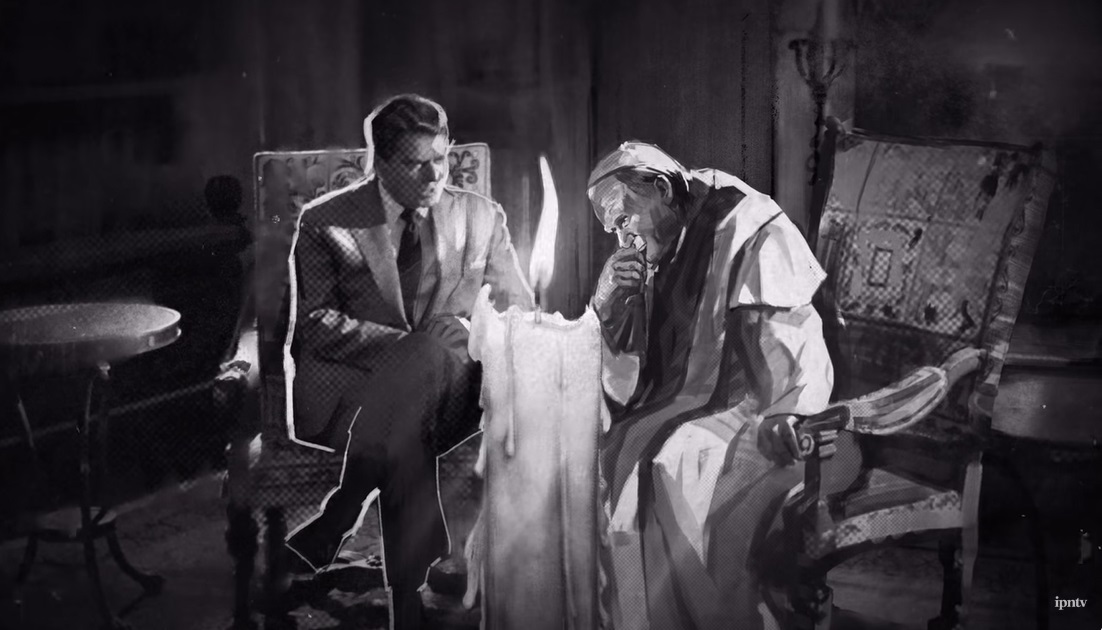
U.S. President Ronald Reagan and Pope John Paul II. Frame from the animation of the Institute of National Remembrance The Light of Freedom (2021)
At Chicago's International Amphitheater, now defunct, Secretary of State Alexander M. Haig Jr. delivered a speech condemning the introduction of martial law in Poland. However, the building was only half full. Protesters showed up at the event with slogans like "Russians Keep Your Bloody Hands Off Poland!”
Similar protests took place in other American cities, New York, Boston and Dallas, although the turnout there was relatively small or even very small (2,500, 300 and 100 people, respectively). Sometimes they were accompanied by declarations. At a rally in the Ohio Statehouse in Columbus, Governor James A. Rhodes assured that the state alcohol monopoly would no longer sell Russian vodka.
Propaganda or an honest gesture of solidarity?
It is estimated that 185 million people viewed the film in 50 countries across the world. Public U.S. radio broadcaster Voice of America also prepared the audio version, which was aired in almost 40 languages. The radio play was also broadcast on other stations, including Radio Free Europe. However, not all countries immediately decided to use the entire broadcast. For example, in West Germany, only fragments were used in news broadcasts, but there were no plans to show the whole program at first. In turn, a spokesman for a local television station in West Berlin, whose signal could also be received in the east, told The Washington Post that there were no plans to broadcast even fragments of the show. Only later ARD and ZDF broadcast three half-hour fragments during prime time, thanks to which the message reached additional millions of viewers.
The decision-makers of the British stations were also sceptical about the idea. The European press was mostly critical, condemning the "agitational" form and clumsy melodrama, as well as "boredom straight from Eastern European propaganda films". Among the leading press outlets, only the conservative French Le Figaro praised the show.
And indeed, the form left much to be desired. Experts using the tools of the time could have done more to make the message more attractive and credible. However, the form was not the point and it was not the factor that determined the popularity of the programme. The lukewarm opinions of the press in January and February did not overshadow the main idea, which was the most important thing here. The growing interest in the situation in Poland resulted in retransmissions being broadcast on other television stations. In Poland, the entire recording was not shown until September 2011.