
After five days and five nights of fierce fighting with grenades, combat knives, fists and teeth, the Tunisian regiment ceased to exist. More than 1,500 attackers died, and only three NCOs and 15 regular soldiers remained from the main advance. None of them was able to stand on their own. The only achievement from this strike was the realisation of the allied command of the German defences’ strength.
A blood bath
The Allies prepared for the next strike for three weeks. On Feb. 11, the American 34th Infantry Division struck from the other side of the monastery hill — straight through the Cassino town and the land depression known as the Gorge — to the Massa Albaneta’s grange, after which the Rapido valley opened up and then the road to Rome. There was only one problem with that — Cassino, Massa Albaneta and the hills towering over the Gorge were all manned by soldiers from the “Hermann Göring” division. The night strike turned out to be another defeat for the Americans. The minefields and the heavy machine guns from the various concrete fortifications on the Cassino foreground brought huge losses to the attackers. Tanks, which were supposed to provide cover, got stuck in the mud. After 24 hours of fighting, the division only advanced several hundred metres, in exchange for 90% casualty rate among the infantry storm groups. It was only saved from total defeat by the 36th Texan Infantry Division, the one decimated in the previous attack. Due to their heavy losses, the Allies had to retreat five divisions to the deep rear: the 34th and 36th American divisions, the 5th and 56th British divisions and the 3rd Algerian division.
The Americans’ blood bath caused the Allies to send a New Zealand corps. Its commander, Gen. Bernard Freyberg, said he wasn’t interested in any dreams of saving any historical monuments and wouldn’t send his soldiers to fight until the “invincible” monastery towered over the battlefield. Moreover, one of the New Zealand scouts reportedly saw a reflection from the binoculars of a German observer in the monastery. A decision was made to use heavy strategic bombers on the Benedictines’ abbey. On Feb. 14, the Allies dropped leaflets on the monastery, calling on the Italians to abandon the area and announcing the bomb strikes. A day later, 256 waves of B-17 Flying Fortresses dropped 576 tonnes of explosives on the monastery, turning it into piles of rubble.
Ironically, this actually made the Germans’ job a little easier, because the bombings failed to destroy the thick walls of the ground floor and various basements. After the bombing run, German paratroopers manned the ruins, turning them into strong defence points.
The levelling of the monastery by the Allies did not aid them at all.
Thus, the levelling of the monastery by the Allies did not aid them at all. On the same day, the 2nd New Zealand Division attacked the Cassino train station. The soldiers were backed by artillery and many tanks. The latter, due to the two weeks worth of rain in the days prior, could only advance along the railway embankments, which were heavily damaged, mined and systematically targeted by the German artillery. The tip of the attack was led by the 28th Maori Battalion. They managed to push the Germans out of the train station, but had to retreat only three days later after suffering more than 70% losses. They only managed to hold the train bridge and a small foothold leading to Rapido, which became the foundation for the future advance on the town.
Meanwhile, the 4th Hindi Division launched an attack straight on the monastery. The Gurkhas managed to go all the way to Hill 593, but had to retreat on Feb. 18, as they were getting shot at from all sides, also from the terrain they thought was under their control, losing more than 240 soldiers. General Freyberg was forced to admit that his advance broke down.
A month later, on March 15, another attack began. For more than 3.5 hours, 575 heavy and medium bombers, as well as 200 bombing fighters, dropped close to 1,100 tonnes of bombs on Cassino and the surrounding areas, while the artillery fired more than 10,000 rounds. The town was razed to the ground. Three divisions launched their assaults: the 4th Hindi Division, the 2nd New Zealand Division and the 78th British Division which included an armoured brigade. The New Zealanders got a part of the town and the hills above it.
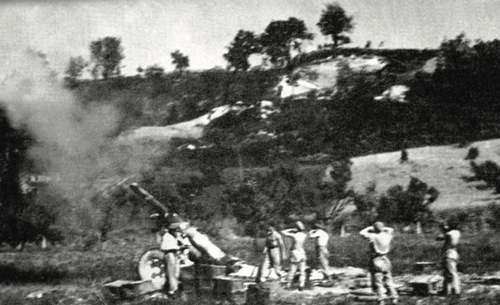
Heavy artillery support fire (photo: Mieczysław Herod)
After five days and five nights of fierce fighting with grenades, combat knives, fists and teeth, the Tunisian regiment ceased to exist. More than 1,500 attackers died, and only three NCOs and 15 regular soldiers remained from the main advance. None of them was able to stand on their own. The only achievement from this strike was the realisation of the allied command of the German defences’ strength.
A blood bath
The Allies prepared for the next strike for three weeks. On Feb. 11, the American 34th Infantry Division struck from the other side of the monastery hill — straight through the Cassino town and the land depression known as the Gorge — to the Massa Albaneta’s grange, after which the Rapido valley opened up and then the road to Rome. There was only one problem with that — Cassino, Massa Albaneta and the hills towering over the Gorge were all manned by soldiers from the “Hermann Göring” division. The night strike turned out to be another defeat for the Americans. The minefields and the heavy machine guns from the various concrete fortifications on the Cassino foreground brought huge losses to the attackers. Tanks, which were supposed to provide cover, got stuck in the mud. After 24 hours of fighting, the division only advanced several hundred metres, in exchange for 90% casualty rate among the infantry storm groups. It was only saved from total defeat by the 36th Texan Infantry Division, the one decimated in the previous attack. Due to their heavy losses, the Allies had to retreat five divisions to the deep rear: the 34th and 36th American divisions, the 5th and 56th British divisions and the 3rd Algerian division.
The Americans’ blood bath caused the Allies to send a New Zealand corps. Its commander, Gen. Bernard Freyberg, said he wasn’t interested in any dreams of saving any historical monuments and wouldn’t send his soldiers to fight until the “invincible” monastery towered over the battlefield. Moreover, one of the New Zealand scouts reportedly saw a reflection from the binoculars of a German observer in the monastery. A decision was made to use heavy strategic bombers on the Benedictines’ abbey. On Feb. 14, the Allies dropped leaflets on the monastery, calling on the Italians to abandon the area and announcing the bomb strikes. A day later, 256 waves of B-17 Flying Fortresses dropped 576 tonnes of explosives on the monastery, turning it into piles of rubble.
Ironically, this actually made the Germans’ job a little easier, because the bombings failed to destroy the thick walls of the ground floor and various basements. After the bombing run, German paratroopers manned the ruins, turning them into strong defence points.
The levelling of the monastery by the Allies did not aid them at all.
Thus, the levelling of the monastery by the Allies did not aid them at all. On the same day, the 2nd New Zealand Division attacked the Cassino train station. The soldiers were backed by artillery and many tanks. The latter, due to the two weeks worth of rain in the days prior, could only advance along the railway embankments, which were heavily damaged, mined and systematically targeted by the German artillery. The tip of the attack was led by the 28th Maori Battalion. They managed to push the Germans out of the train station, but had to retreat only three days later after suffering more than 70% losses. They only managed to hold the train bridge and a small foothold leading to Rapido, which became the foundation for the future advance on the town.
Meanwhile, the 4th Hindi Division launched an attack straight on the monastery. The Gurkhas managed to go all the way to Hill 593, but had to retreat on Feb. 18, as they were getting shot at from all sides, also from the terrain they thought was under their control, losing more than 240 soldiers. General Freyberg was forced to admit that his advance broke down.
A month later, on March 15, another attack began. For more than 3.5 hours, 575 heavy and medium bombers, as well as 200 bombing fighters, dropped close to 1,100 tonnes of bombs on Cassino and the surrounding areas, while the artillery fired more than 10,000 rounds. The town was razed to the ground. Three divisions launched their assaults: the 4th Hindi Division, the 2nd New Zealand Division and the 78th British Division which included an armoured brigade. The New Zealanders got a part of the town and the hills above it.
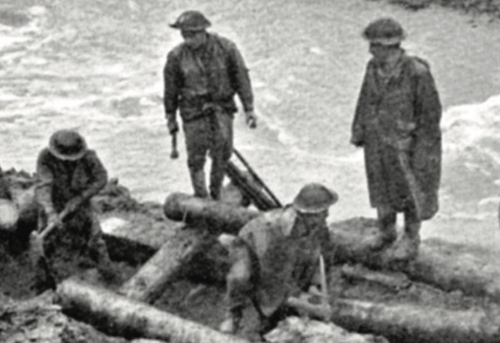
Polish engineers building a road (photo: Mieczysław Herod)
They came as far as 300 metres from the monastery. But the constant rain made it hard to keep moving forward. Tanks got stuck among the rubble and in bomb craters. Additionally, the Germans survived the bombings in the ruins and fought back. On March 26, the remnants of the attackers came back to their starting positions. Three thousand New Zealanders lost their lives, 700 were MIA. The only success was the capture of a small village of Caira (modern-day district of Cassino).
The advance in the left mountain wing went much better. The French Expeditionary Corps broke through the defences in the Aurunci Mountains. Units of the 2nd American Corps, suffering substantial losses, opened up the way to the Liri river valley. However, it was impossible to cross it with the German paratroopers still occupying the Monte Cassino monastery in behind. The battle remained unsettled.
General Anders has a choice
The next advance was under preparation. This time, the main attacking force was to be the 2nd Polish Corps led by Gen. Władysław Anders. While Soviet propaganda claimed his soldiers avoided fighting with the Germans and only wanted to get through to the end of the war, the British commander of the 8th Army, Gen. Oliver Leese, had a different view on that matter. At the March 24 debrief, he ordered Gen. Andrers to capture Monte Cassino. He honestly warned him that if he refused his corps would be sent to cross the Liri river. Anders believed that the successful storming of the monastery would be good for the Polish cause and put an end to the Soviet propaganda, while the crossing of the Liri river would most likely bring nothing but huge losses, and that no one would even hear about the Polish soldiers (who among you, dear readers, has ever heard about the Liri river?). On April 8, the unit commanders of the Polish Corps received the information about their task.
The Polish troops and artillery managed to get into the starting positions without alerting the Germans. On May 11, an hour before midnight, covering artillery fire fell on the German paratroopers. More than a thousand cannons from both infantry divisions, the corps artillery and the army artillery fired at the Germans. On the night of May 12, at 1 a.m., the storm groups began their advance. The soldiers launched a night attack through the mined, open area and under constant fire from the bunkers and artillery and mortar positions which weren’t destroyed in the initial shelling.
The Polish troops and artillery managed to get into the starting positions without alerting the Germans.
Moreover, they didn’t know the terrain at all, as the Corps was forbidden from doing any reconnaissance so they could hide from the Germans that they were fighting against Poles. The 2nd Carpathian Riflemen Battalion was attacking Hill 593. Meanwhile, the 1st Battalion entered the tank-strengthened Gorge with the task of capturing the Massa Albaneta palace. The infantrymen carried light grenade launchers and anti-armour PIATs (Projector Infantry Anti-Tank) to destroy bunkers. The engineers who cleared their way were equipped with the Bangalore pipes (special, long pipes with explosives at the end to neutralise minefields and barbed wires) and flamethrowers. Despite the strong German resistance, the 2nd Battalion captured Hill 593 and advanced to Hill 569. Soon, they were joined by the 1st Battalion which lost two tanks in the Gorge and almost all engineers who tried to de-mine the way for them.
The “Hermann Göring” paratroopers launched four counter-attacks at the Polish storm groups on Hill 593. All these strikes were repelled, but with huge losses. Both company commanders leading the storm groups died. Major Ludwik Rawicz-Rojek, who brought over his staff company as support for the defenders, lost his life. Battalion commander, Major Tytus Brzósko, got heavily wounded. In the morning of May 13, the storm groups ran out of ammo after repelling a fifth counterattack. They had to retreat to starting positions. The 3rd Carpathian Riflemen Division lost 700 men that day and failed to complete its task.
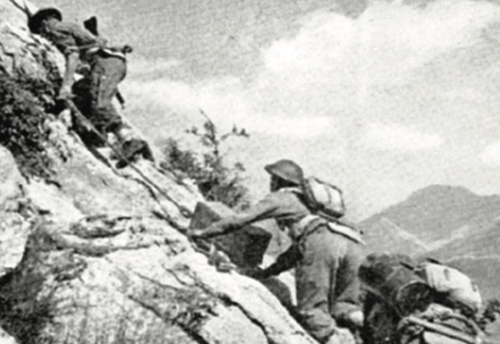
A transport of ammunition (photo: Mieczysław Herod)
Storm groups from the 13th and 15th Vilnius Riflemen Battalions moved to advance on the Spectre Hill. Sappers went with them. Artillery fire took a bloody toll among the attackers in the mountainous terrain. When they finally burst into Spectre with 20% losses, they moved to attack Hill 575. The advance halted as it came under fire from the side, from the unbothered San Angelo Hill. After Hill 575 was taken, the companies then moved towards San Angelo. On the way, they stumbled upon a wide crevasse, heavily mined and defended with machine gun nests. They were forced to retreat to Hill 706, and from there they were ordered to retreat to starting positions.
General Anders, after getting the units in order, wanted to send them for another attack on the same day in the afternoon. But the British commander decided that the strikes of his 13th Corps in the Liri Valley and Poles on Monte Cassino should be coordinated. Poles’ only task was to constantly conduct patrol missions, pestering the paratroopers and drawing them out to deadly artillery fire. The Corps’ artillery was constantly firing, while on May 15 it simulated covering fire for an advance, provoking the German artillery to open fire and reveal their positions. The German positions were bombed by the air force on a daily basis. The 2nd Corps’ advance, although without any territorial gains, confused the Germans on where the main attack of the British 8th Army would be. They also spotted most positions of the paratroopers, as well as located a mortar and artillery battery. The prisoners confirmed huge losses on the German side. The 1st Battalion of the 1st Paratrooper Riflemen Regiment got drawn out to a counterattack and wound up under the Polish artillery fire, effectively ceasing to exist. Many companies were left with no more than a dozen men. The supply lines for the first line of defence weren’t working properly. The morale of the German elite units was quickly falling. General Leese believed that Poles engaged two-thirds of the German forces. Thanks to that, the British 13th Corps crossed the Garigliano river and got significant terrain gains, allowing it to flank the Germans from behind.
The final advance
The break in fighting was used for a precise analysis of mistakes made from the night of May 11 to May 12, which brought huge losses. They decided to free the engineers from carrying redundant equipment. The heavy and cumbersome flamethrowers were of little use in the mountainous terrain. The Bangalore pipes would explode on the sappers’ backs after being hit with stray bullets and shrapnel. The drum containers with rolls of white tape which were used to mark the cleared minefields made it difficult to move. The tapes themselves, perfectly visible under the light of rockets, made it easy for the German machine gunners to find their targets. Paradoxically, the storm group which lost the marked path during the advance suffered the least losses, as they crossed a field of thorny bushes and suddenly found themselves between the German positions on Hill 573. The sappers were only to carry mine detectors, spikes to find mines in the ground and bricks of TNT to destroy bunkers.
The infantrymen from the storm groups also received additional magazines with ammunition and grenades, with permission to stuff their pockets with them, as well as “non-regulated” bags and backpacks. Additional radio stations were put in place of the broken ones and soldiers from artillery regiments were assigned to the storm groups in order to coordinate artillery strikes. Most radio operators died in the first advance — the light reflecting off of their antennas drew the fire of snipers and mortars. This time, they masked the antennas with nets and mud. The command explained to the soldiers that while the previous advance did not lead to the monastery’s capture, it did fulfil its task by drawing the German fire away from the British flanks.
Many companies were left with no more than a dozen men. The supply lines for the first line of defence weren’t working properly. The morale of the German elite units was quickly falling. General Leese believed that Poles engaged two-thirds of the German forces. Thanks to that, the British 13th Corps crossed the Garigliano river and got significant terrain gains, allowing it to flank the Germans from behind.
When the time came for the final advance, on May 16, at 10:20 p.m., the 16th Lviv Riflemen Battalion suddenly broke through to Spectre without artillery support. They got bunker after bunker. The German counter attacks broke down one after another. After one of them, Poles went to advance on Hill 593 on one side, and towards San Angelo on the other. The situation quickly became critical for the Germans. The capture of these two hills would open up the Poles’ way to the mortar and artillery positions. The paratroopers, supported by heavy mortars, launched a counter attack before dawn of May 17. The Poles were running out of ammo again and the battalion’s lines started to crumble. That’s when Sergeant Marian Czapliński began to sing the national anthem. The Lviv soldiers picked up the song and moved to a direct fight. That’s when Major Jan Żychoń lost his life. At the last second, one of the platoons of the second advance reached the site of the battle and brought extra ammunition, turning the tide on the Poles’ side. They managed to hold Spectre and capture San Angelo, Hill 593 and the Massa Albaneta palace. The 1st Paratroop Panzer Division Hermann Göring got the orders to retreat to the monastery. Poles intercepted this order and their artillery systematically shelled the likely paths of the enemy’s retreat.
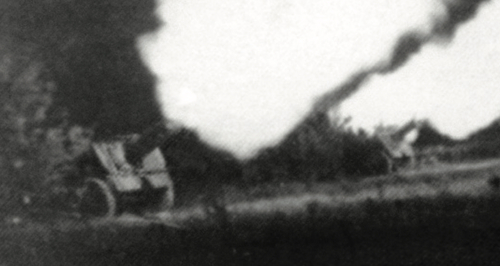
Artillery preparation (photo: Mieczysław Herod)
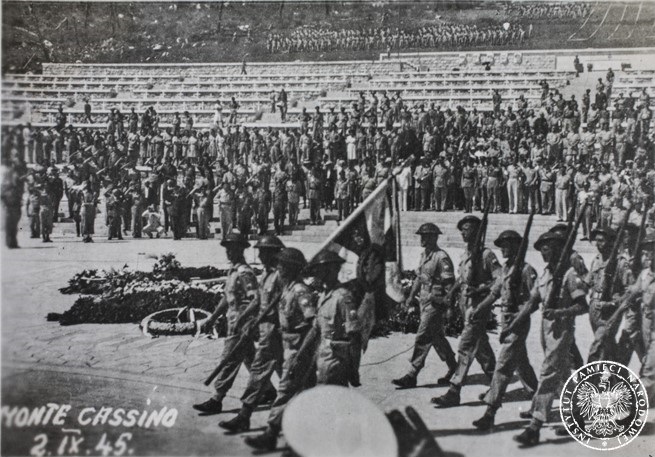
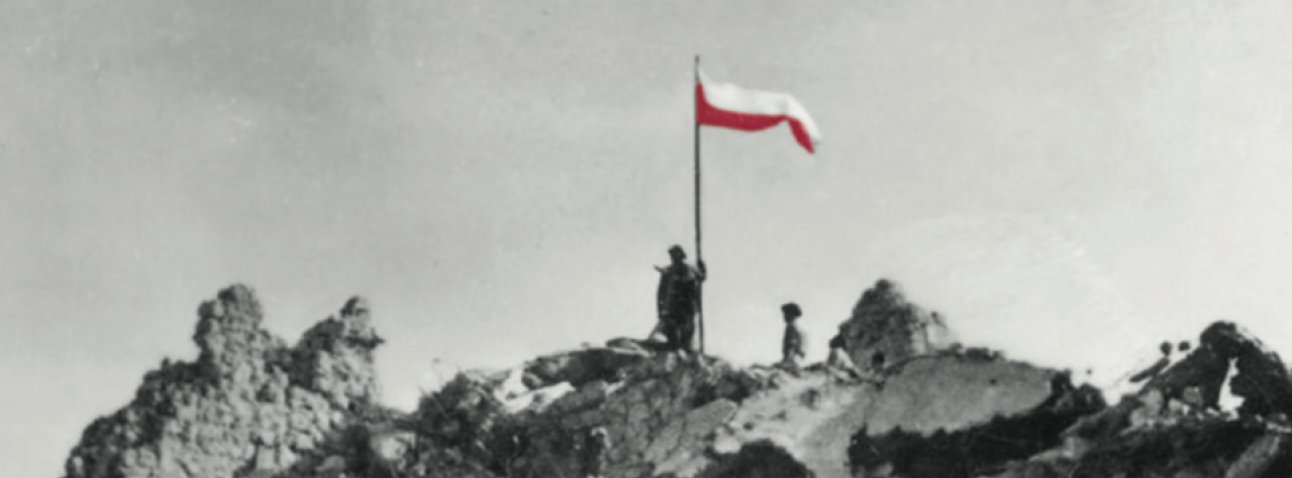
More than a hundred paratroopers from the rear guard went down from the monastery to the south. They preferred to surrender to the British rather than the Poles. Several dozen Poles moved under fire towards Monte Cairo and the new line of defence. In the morning of May 18, a white flag was spotted on the monastery ruins. The 12 Podolian Uhlan Regiment, led by Second Lieutenant Kazimierz Gurbiel, entered the ruins. They took sixteen wounded Germans prisoner, as they were left behind by the retreating paratroopers under the care of three medics. The Poles first placed the regiment’s standard on the monastery walls, and then a Polish flag. Several hours later, on a special order by Gen. Anders, a British flag was raised a little higher. At noon, Corporal Emil Czech stood on top of the ruins and played the traditional St. Mary’s Trumpet Call.
At its own section, the 13th British Corps crossed the Rapido river and reached Liri. The Moroccans flanked the German positions through the mountains and threatened to complete the circle around the paratroopers. The Germans quickly abandoned the broken Gustav Line and retreated more than a dozen kilometres to the reserve Hitler Line. Due to that, the units of the 8th British Army gained the freedom to operate in the Liri river valley. The usage of all troops along the line allowed the Allies to launch an advance from the outpost at Anzio, on May 23. On June 4, the Americans took Rome.
The balance
923 soldiers died in the attack on Monte Cassino and 345 were declared missing in action (in reality these were the ones that they couldn’t properly bury). 2,931 got wounded (some of them later died).
The Allies achieved a tactical victory for the price of thousands of dead, missing in action and wounded, lost mostly by Gen. Mark Clark who led the 5th American Army: instead of cutting off the German divisions and pushing them into the sea according to the initial plans, he marched for the questionable glory of a liberator, towards the undefended Rome.
Between 1944 and 1945, Polish War Cemetery was built on an almost flat piece of terrain between Monte Cassino and Hill 593, on the way of the 3rd Carpathian Riflemen Division’s advance. It was designed by architects Wacław Hryniewicz and Jerzy Skolimowski. They built it under the supervision of engineer Roman Wajda, a soldier who took part in the battle. 1,072 soldiers of all ethnicities of the Republic of Poland were buried there: Poles, Belarusians, Ukrainians and Jews. They were joined many years later by Gen. Władysław Anders, who asked in his will to be buried at Monte Cassino. His grave is located at the central part of the cemetery. Two more cemeteries were raised nearby, the British one (5,000 graves) and one for the Germans (7,000 graves), mostly unnamed.
What was the general view of the battle? Finally, after almost half a year of bloody fighting, on May 18, 1944, the Polish 2nd Corps pushed the paratroopers off of the Gustav Line at Monte Cassino; the Moroccan mountaineers from the French Expeditionary Corps moved through the section located higher in the Apennines, while the British 78th Infantry Division crossed the Liri river. The Allies achieved a tactical victory for the price of thousands of dead, missing in action and wounded, lost mostly by Gen. Mark Clark who led the 5th American Army: instead of cutting off the German divisions and pushing them into the sea according to the initial plans, he marched for the questionable glory of a liberator, towards the undefended Rome. This gave Kesselring the time to retreat most of his forces behind the next line of defence in the north of Italy. The strategic goal of the landing in Italy, which according to British prime minister Winston Churchill was to march to Vienna and reach Europe before the Soviets, was completely unachievable at this stage. Moreover, for decades to come everyone denied the existence of such a plan, because if it existed someone would have to bear the responsibility for its failure.
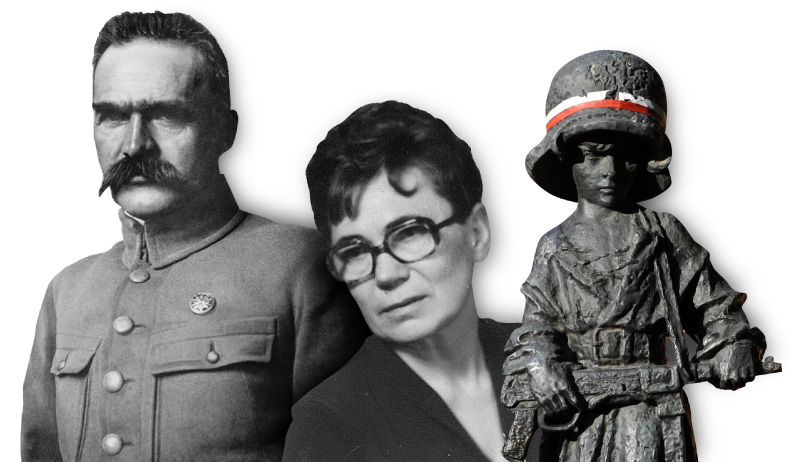
In Poland, meanwhile, the battle became legendary. Feliks Konarski “Ref-Ren” wrote the song The Red Poppies on Monte Cassino on the eve of the final advance. For many years, it became the informal independence anthem. Melchior Wańkowicz (who went to the site of the battle long after it was over) wrote a three-volume book about it, with a true journalistic passion, glorifying the sacrifice of the soldiers who fought there.
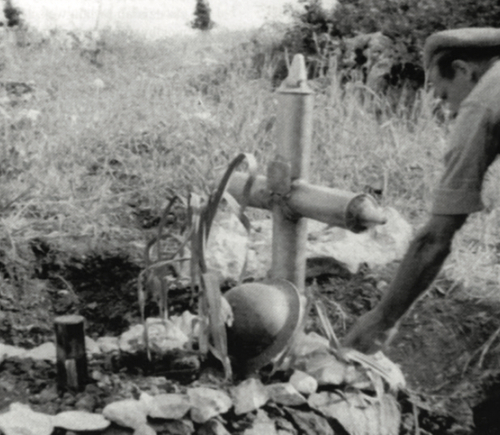
A grave of a Polish artilleryman (photo: Mieczysław Herod)
In the West, the battle lives only in the memory of the fallen’s families, the Polish veterans, a handful of military historians and… the graduates of elite American military universities, where the battle is taught as an example of fighting over strategic mountainous positions. In Germany, it is slowly fading from memory. Even in the traditions of the Bundeswehr paratrooper units, the successful Crete landing is mentioned more often than the six-months-long defence in the Apennines. The Italians rebuilt the abbey and returned to normal life. Only their eyes have to look at the three large cemeteries, which remind them of the bloody battle every day.
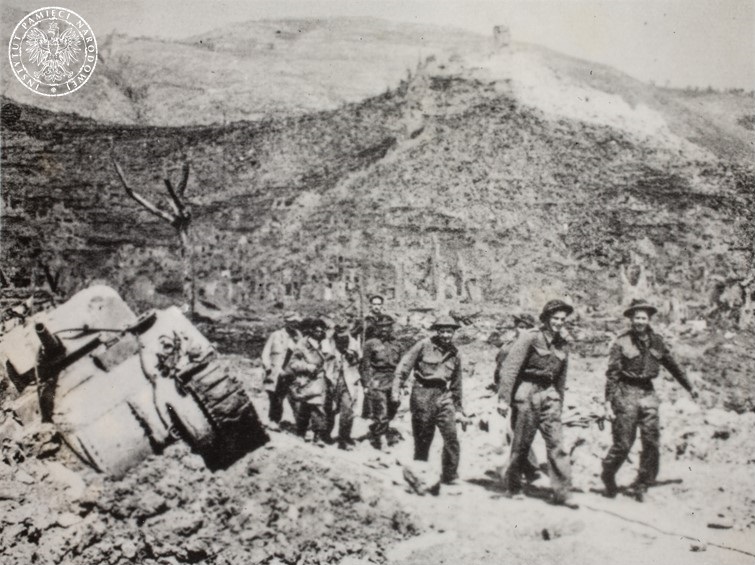
Polish soldiers carry and lead the wounded. Monte Cassino abbey is visible in the background. A damaged M4 Sherman hangs on the side of the road on the left
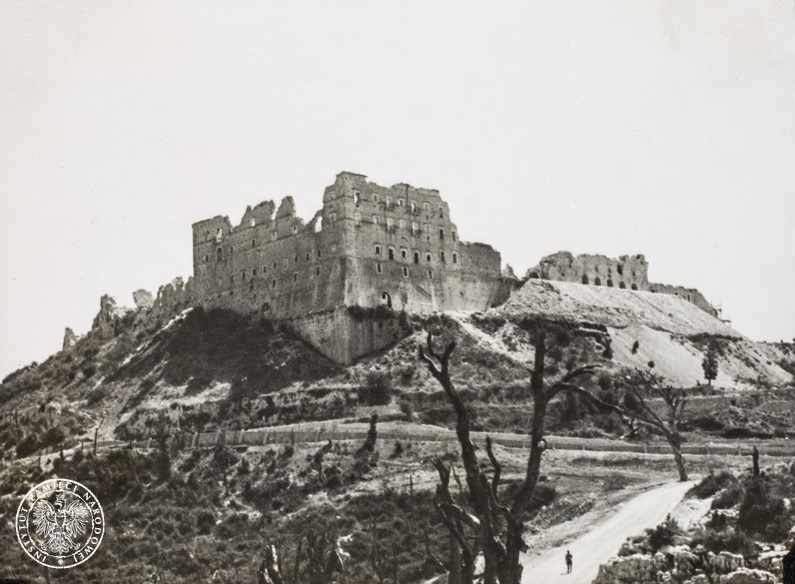
Monte Cassino monastery. May, 1945