During their conversation, Ms. Joanna informed Deputy President Szpytma that several days prior she had accidentally discovered a hideout on her property in Otwock used by her family to shelter a Polish Jew during the war.
There was very little time to conduct a local visit and film documentation, as the very next day the property was to be taken over by the Strabag company, which was constructing the S-17 highway on the Otwock section. Before the takeover, the team from the Department of Notation and Multimedia Development of the National Education Office of the Institute of National Remembrance made it to the site. They were accompanied by the employees of the Museum of Polish History. Dr. Anna Stupnicka-Bando, President of the Polish Society of the Righteous, suggested checking whether there was any mention of this hiding place in existing reports. Ms. Joanna notified the POLIN Museum of the History of Polish Jews about the case, and later the Jewish Historical Institute. If the hideout was indeed a WWII shelter, then it would be a unique and fortunate discovery.
How was the discovery made?
The whole idea behind hideouts is that no one would ever discover them. How was this discovery made then? Before handing over the land to the investor, the owners of the property were required to empty the residential building, the utility building and the wooden barn of all movable contents. The barn contained old tools of Ms. Joanna's grandfather and coal, and all of it was covered by a huge pile of old firewood. While removing this material, on December 11, 2018, a wooden box was discovered, as it seemed at first, standing on the floor of the barn. When the workers tried to remove it, it turned out to be permanently attached to the ground. After tearing off the lid at the bottom of the box, they exposed a metal flap with a steel handle for closing. After lifting the flap, they noticed a rotten wooden ladder which led to a small brick room under the floor of the barn.
Ms. Joanna was completely surprised: "I have entered this barn hundreds of times over the decades." Only after some time she recalled events from the German occupation that she knew from her family accounts and connected them to the discovery.
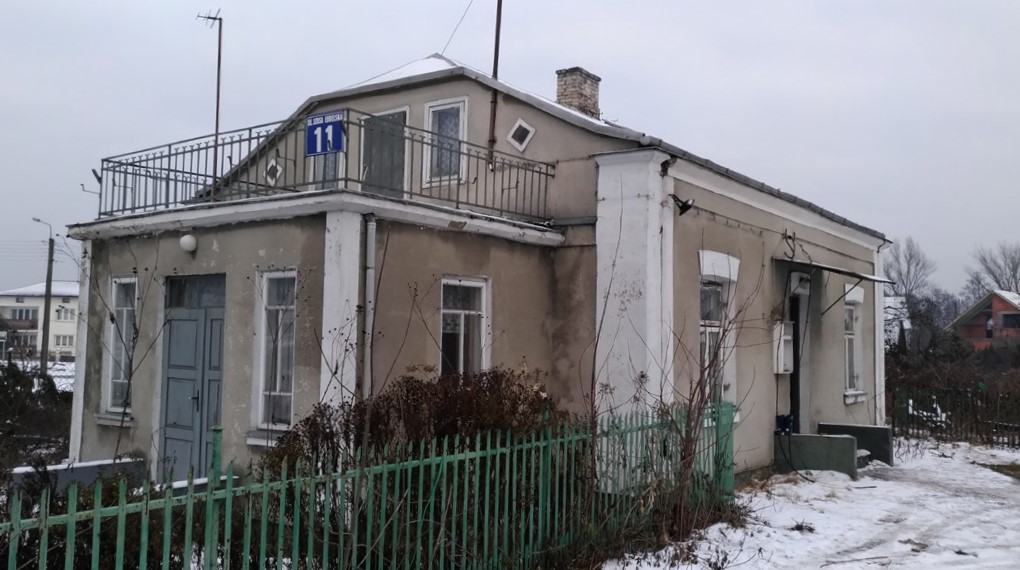
There was a very small space between the ceiling and the roof truss, where one could only stay lying down. Photo from the author’s collection
A story from years ago
The family of Ms. Joanna had lived in the brick house standing to this day in Otwock by the Szosa Lubelska 11 Street. The family included: grandparents Sabina and Aleksander Smolak, their daughter Krystyna, also born in 1936, Ms. Joanna's mother, grandmother's brothers Ryszard and Jan, as well as maternal great-grandparents Rozalia and Józef Goleniowski. The great-grandparents had previously occupied a service apartment at the military hospital in Otwock, and after getting married, the grandparents settled in the Rudka settlement near Otwock. The Jewish Bajtel family were their neighbours. Until 1939, Jews made up the majority of the population of Otwock. In November 1940, the Germans established a ghetto in which they confined the Otwock Jews, and two years later they deported them to the Treblinka extermination camp and murdered them. The seven-member Bajtel family was also sent to Treblinka. Moshe Bajtel and a fellow prisoner, working near the camp's electrified fence, took advantage of a power outage and escaped. According to Ms. Joanna's grandparents, Moshe Bajtel was caught again and found himself on a train to Treblinka for the second time. He escaped from the transport and after three days he reached the Smolak family home on foot.
I envied the dogs…
The house has a second floor. In the attic with a gable roof, in the gable parts, there were two rooms with windows where the grandmother's brothers lived. The ceiling was just above the windows’ line, which made for a very small space between it and the roof truss, where one could only stay lying down. That’s where Mr. Moshe stayed during the day, and in the evening, when it was safer, he would come downstairs and pretend to be a family member. Years later, he recalled the following during his conversations with his son:
“When I looked outside through a small window in the roof, I envied the dogs running around free in the yard.”
In the moments of greatest danger, Bajtel hid outside of the house. As Ms. Joanna managed to establish, 75 years later, the hideout built in the barn was used for this purpose. The hideout was most likely also used for short-term hiding of other Jews rescued after the liquidation of the Otwock ghetto, and for the needs of local Home Army insurgents and other endangered people (who, for example, smuggled food to Warsaw). Ms. Joanna recalled the tragic story of the Sierpiński family. Four brothers and their cousin, for being in the ranks of the Home Army, got arrested in 1941 and taken to Auschwitz. Only one of them survived, Henryk Sierpiński, who later became Ms. Joanna’s godfather.
Bajtel hid on the property until the Red Army entered these territories in the summer of 1944. Every day for two years, seven people risked their lives to save a single stranger. “Whoever saves one life…” Ms. Joanna’s grandmother always said:
“The most important thing is that we managed to save Mr. Moshe.”
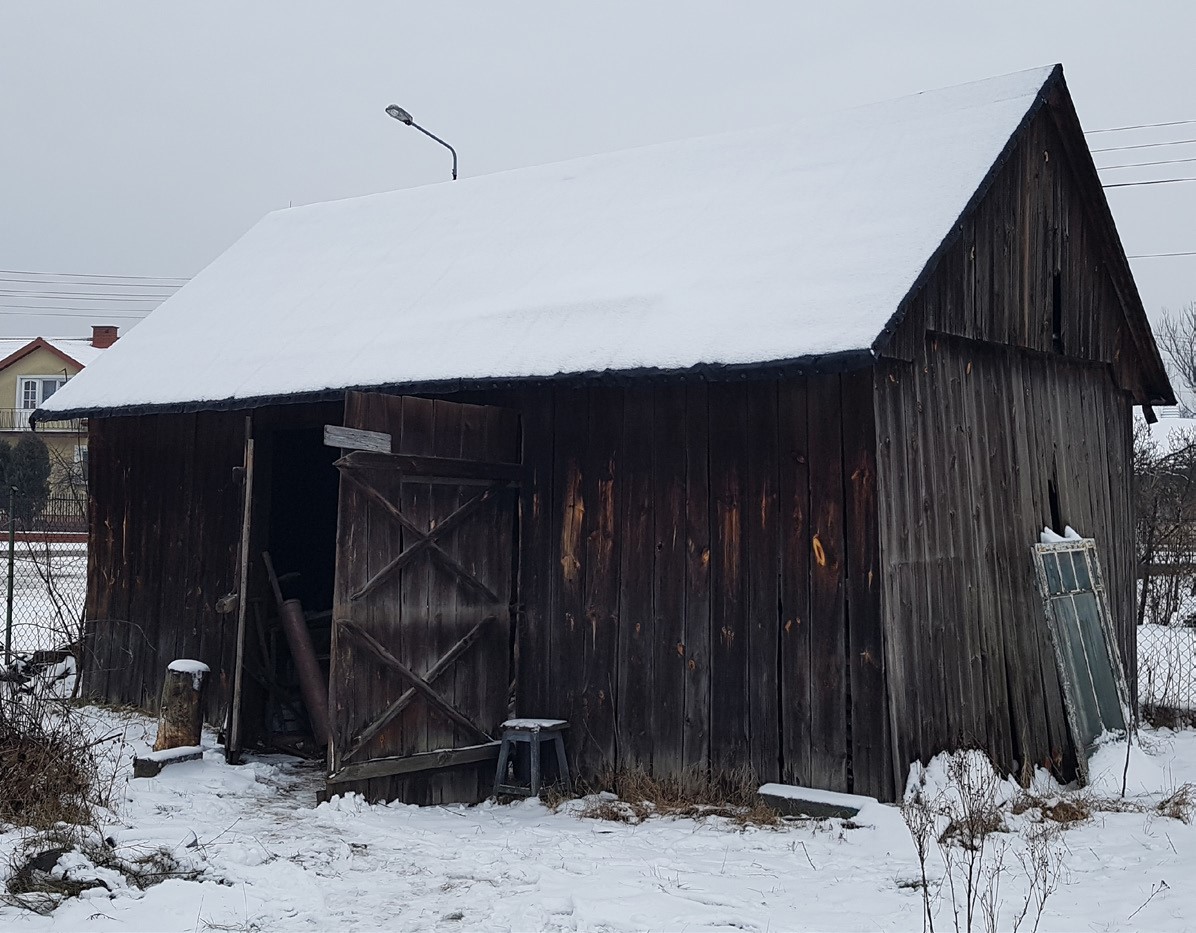
A chest was discovered in the barn, seemingly resting on the floor. Photo from the author’s collection
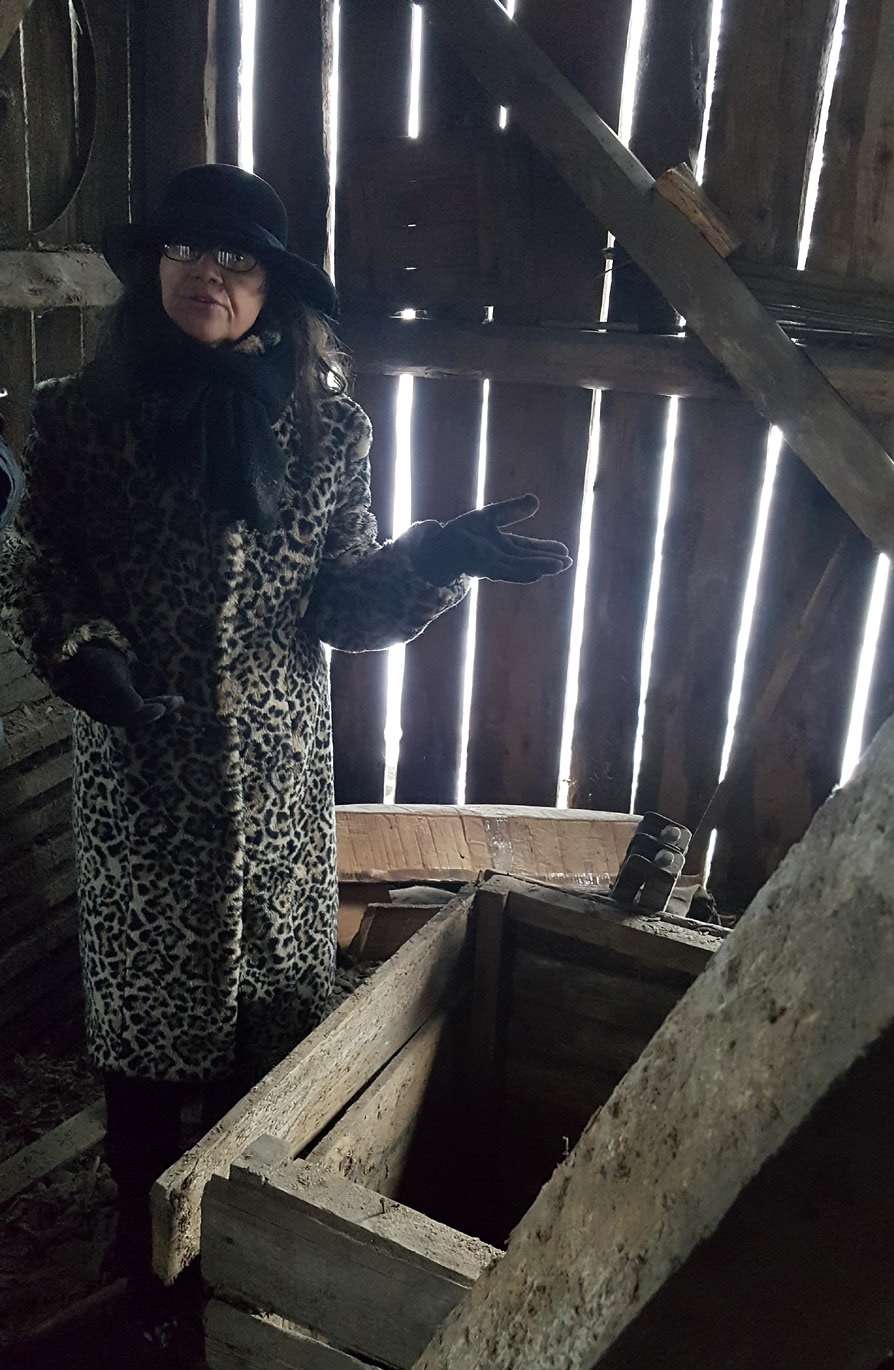
Joanna Bąk at the uncovered entrance to a small room built under the floor of the barn. Photo from the author’s collection
Broken contact, family memories
Bajtel left for Łódź and settled there. Otwock was a place of trauma for him. He lost his family there, and for two years he lived there in constant fear. He maintained contact with his saviours, but it broke off after he left for Israel in 1957. However, this was not a sign of ingratitude, but a result of the political situation at the time. As it turned out later, the letters he had sent never reached the Smolak family. Once, without notice, he came to Poland with his son, but found no one in the Otwock house. Their neighbours informed about his visit.
In the late 1980s, Ms. Joanna went to the United States to study for a doctorate funded by an American university. Her closest friend at the university was a Jewish woman, Iris Sroka, whose parents, aunt and uncle, survived the German Auschwitz extermination camp. The contacts she made and the moving stories she heard made her more interested in her own family's occupation history, as told by her grandmother and mother, after returning to Poland. She managed to persuade her mother to talk about these events.
“Often, even in severe frost, my parents would tell me to go out and play in the yard by the gate and immediately run home and inform them if the Germans were coming. I couldn’t understand why my parents wouldn’t let me invite my friends home… All this was great trauma for me as a little girl.”
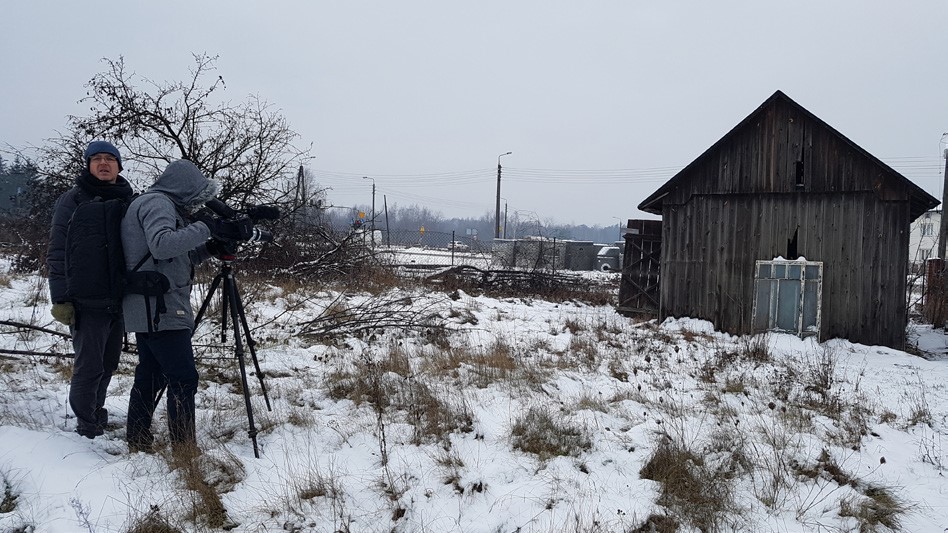
The Institute of National Remembrance staff documents the discovery. Photo from the authors collection
Posthumous bond
In 2000, Ms. Joanna's mother began to seek contact with Moshe Bajtel, initially turning to the Jewish Historical Institute for help. Ms. Krystyna Tokarska from the Jewish Historical Institute advised placing an ad in two Polish-language newspapers published in Israel. Ms. Joanna did not hide her emotion when she said that a friend of the Bajtel family quickly came across the ad, and immediately after that she received a call from Laibo Bajtel, who introduced himself as Moshe Bajtel's son. As it turned out from the conversation, he knew the story of his father's hiding with the Smolak family very well. Before his father died in 1997, he gave him the details of those events. One sentence that was particularly moving was:
"Dad said that your mother was such a clever girl.”
The Bajtel family tried for two years to posthumously honour Joanna's grandparents, Sabina (who died in 1995) and Aleksander (who died in 1967) Smolak, with the Righteous Among the Nations medal. This happened in 2004. Laibo Bajtel came from Israel with his wife and a friend, whose mother had found the advertisement in the newspaper, to present the medal to their descendants. They visited the Otwock cemetery to light candles and leave flowers on the grave of Sabina and Aleksander Smolak. They also visited the monument dedicated to the Otwock Jews and the ramp from which trains to Treblinka departed. The survivor’s son came to Poland on two more occasions: for the grand opening of the POLIN Museum of the History of Polish Jews in April 2013 and for the opening of the permanent exhibition in the same museum in October 2014.
Commemorations
Immediately after discovering the hideout, Ms. Joanna sent pictures of it to Laibo Bajtel, and then called him. He immediately confirmed that it matched the descriptions given to him by his father.
“Thanks to your family and this hideout, I exist in this world today.”
It’s worth remembering that this was indirect confirmation. Nevertheless, Laibo Baitel declared that in case of any doubts he could submit a statement to Yad Vashem, in which he would describe the appearance of the hideout as he knew it from his father's account.
The wooden hatch to the hideout and the remains of the ladder were donated to the Polish History Museum. The son of the rescued man expressed the wish for a plaque to be placed by the exhibit with the information that Moshe Baitel was hiding under this hatch. A decision was made to dismantle the barn and secure it in the Museum of the Otwock Region in Otwock for potential future exhibition purposes. The Polish Society of the Righteous Among the Nations sent a letter to the Mazovian Voivode in this matter, supporting the project of the Otwock Cultural Center, the aim of which is to preserve for future generations objects associated with the help of Poles for fellow citizens of Jewish origin during the Second World War.
The one saved life resulted in many more. Moshe Bajtel's granddaughter gave birth to triplets.